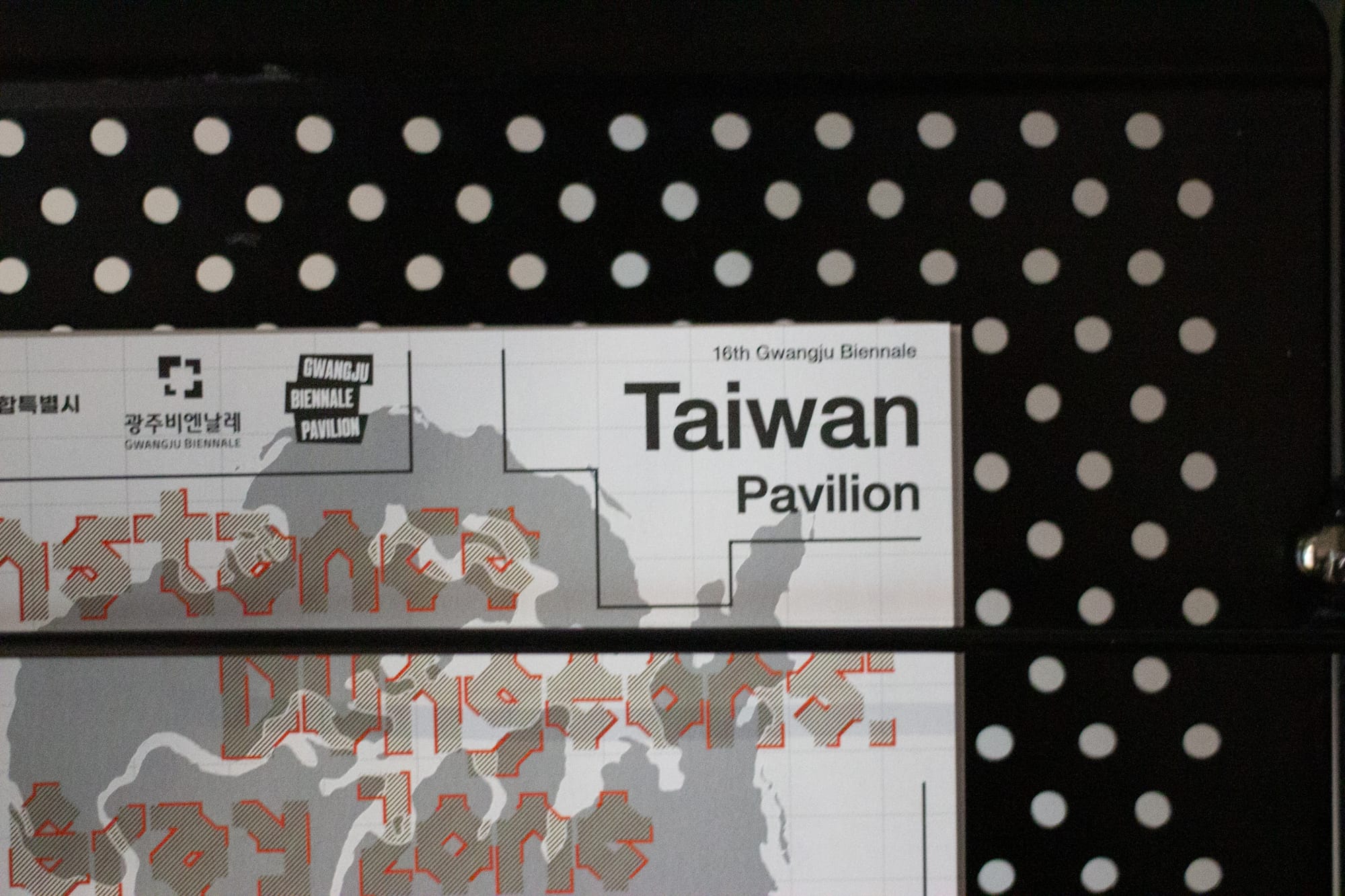
Taiwan Pavilion exhibit: “Instance Dungeons: Gray Zone”
National Asian Culture Center (ACC)
16th Gwangju Biennale: You Must Change Your Life
Sept. 5 — Nov. 15, 2026
(Jisu Sheen recently moved from New Haven to Gwangju, South Korea, where she’s covering local arts and culture for the New Haven Independent and Midbrow.)
What does a photojournalist take pictures of when the war hasn’t happened yet?
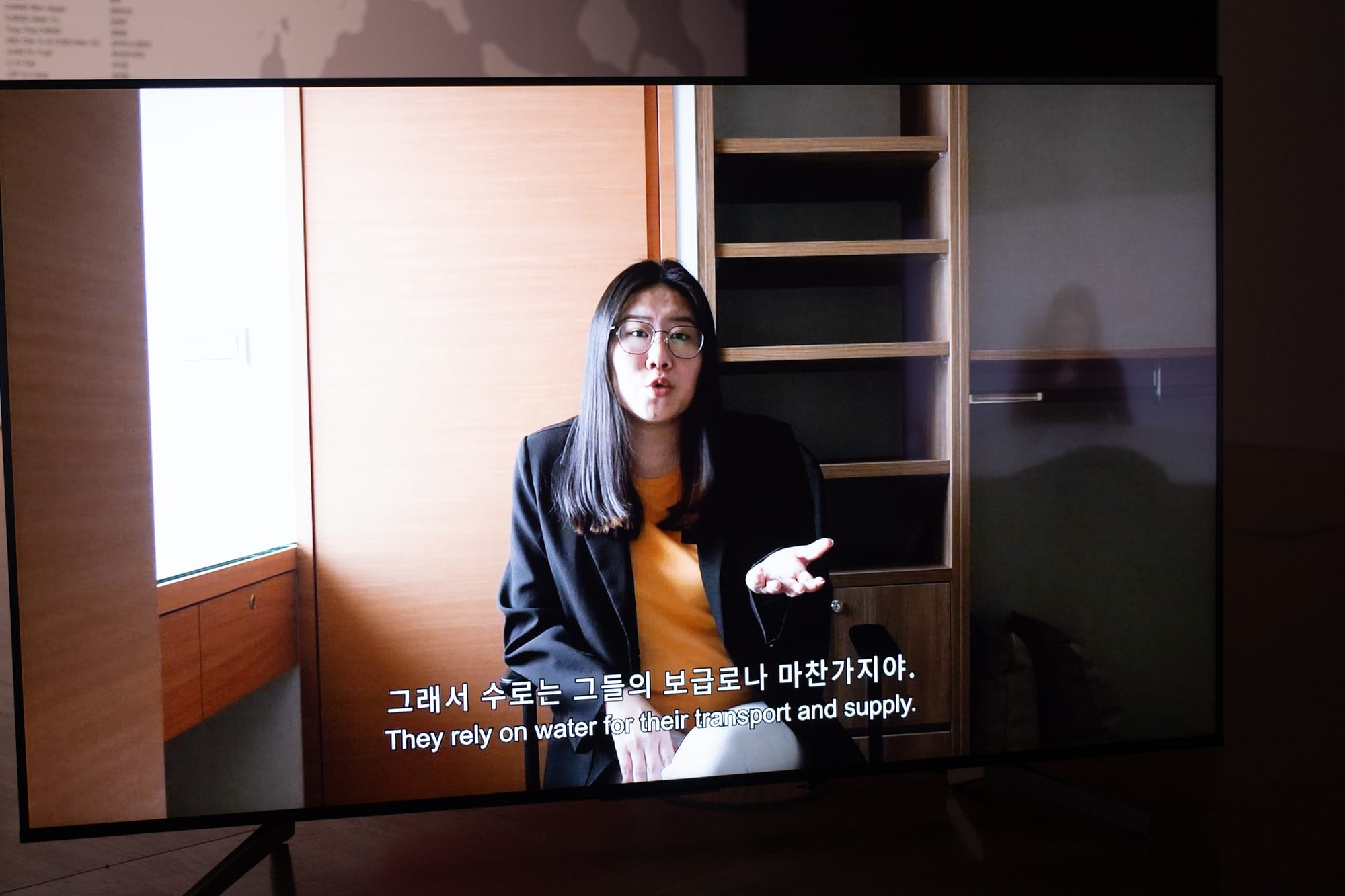
In Ting-Ting Cheng‘s three-channel video installation “Audio Description,” an unnamed war correspondent reflects on a career of gritty up-close filming in conflict zones and their current, quieter work at home in Taiwan.
It’s part of the Taiwan Pavilion exhibit at this year’s Gwangju Biennale, an international art festival that has been held in Gwangju for over 30 years. On opening day, I sat among other attendees in a collection of beanbag chairs in the center of a triangle of screens to watch Cheng’s video installation, turning to catch the scenes as they switched from one frame to the next.
Taiwan, the journalist says in the installation, is not at war but in “war footing” or “pre-war.” It’s hard to know what to photograph; China has been talking about war for “40, 50 years,” but life goes on. After decades, it feels odd to keep waiting for the other shoe to drop, “because you are photographing a war that hasn’t happened.”
It’s a notion that lands well as I cycle between alarm and cynicism upon hearing the news of the Gwangju Biennale changing the name of the Taiwan Pavilion exhibition. It changed the name to present it as an institutional participant rather than a representative of a country—then changed it back amid global pressure, addressing it as nothing more than a filing error.
Sometimes it feels like an unmissable geopolitical indication. Where does South Korea stand on the One China policy again, and did a perceived change in its stance influence recent tension flares, like a statement from China referring to the “two states” of North and South Korea?
Though South Korea’s Foreign Ministry has stated the country’s foreign relations have nothing to do with the Biennale dispute, the fallout has indeed bled into government.
According to the Korea Times, Chinese Ambassador Dai Bing met with officials from South Korea’s Ministry of Foreign Affairs as well as Min Hyung-bae, mayor of Gwangju (recently renamed Jeonnam-Gwangju Integrated Special City), objecting to the Biennale’s use of the Taiwan Pavilion name.
Then there’s the meta question: Are art-world suits really going to stay so mindful of their image when artists are working overtime to seek the truth? (When the theme this year is “You Must Change Your Life”?)
Other times, as friends in Gwangju have mentioned, it feels like details of censorship are destined to stay under wraps for years to come, given the forgetting power of art world giants.
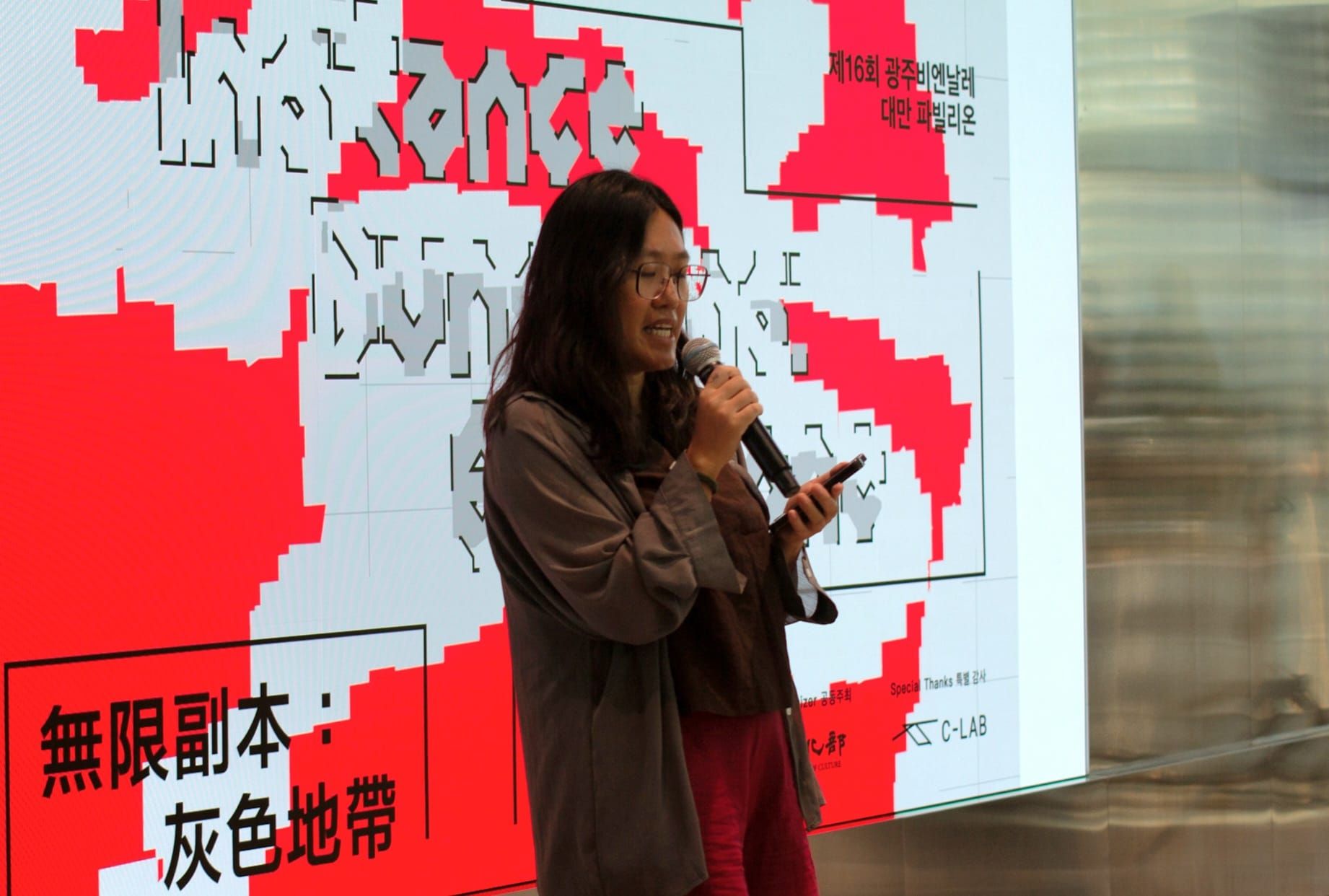
In the meantime, the show goes on. The Gwangju Biennale’s Taiwan Pavilion opened Friday, Sept. 6th, in an afternoon ceremony where the name “Taiwan Pavilion” rolled off the tongue naturally—and, after weeks of dissent, officially.
“I’m sure many of you know it was a struggle to reclaim our name,” said Ting-Ting Cheng, one of the artists from the Taiwan Pavilion, to the crowd.
“We didn’t give up, and because of that, we are able to stand here as Taiwanese artists.”
Missing from the Biennale’s Pavilion program across Gwangju on opening weekend were the China Pavilion artists and curators, who dropped out over the use of the Taiwan Pavilion name.
Cheng’s voice appears in the background of her installation, asking interview questions to the photojournalist. Absent, the viewer realizes as time goes on, is the actual journalist.
The installation’s three screens show three different speakers. When one stops, another starts, repeating in inexact language the last few thoughts the previous person left off with.
The original interview, it turns out, happened completely off-screen. What we were seeing was a recreation, made with three actors to protect the journalist’s identity. When the actors aren’t speaking, they’re reviewing their scripts, relaxing, and smiling.
“Can you do the ‘locals’ part again? The emotion was too high,” Cheng says to one of the actors. To a different one, she says, “Can you do this over again? A bit smoother this time.” They comply.
Even these interruptions are part of the script, Cheng told me later. In reality, she left the emotion level, and even the outfits, up to the actors.
“Taiwan is a small country,” the photojournalist says via one of the actors. The streets are narrow. Civilians might see a tank doing a military drill next to a noodle shop. In the photos, the journalist says they want to show the general mood, that “nobody is worried.”
The journalist used to crawl in the mud to take photos. Now, they get boxed lunches in a special press area while watching drills by the Taiwan military.
In the installation, they question the point of these exercises. At first, when they were invited to the drills, they would aim their camera toward the military performance. Now, they include the press in the photos. This is part of the story too.
When I showed up to the Taiwan Pavilion opening, I was one of many photographers and videographers. Even non-press attendees took pictures on their phones; it felt like something to record. The words “Taiwan Pavilion” stood tall behind the ceremony’s speakers.
Being able to use the Taiwan Pavilion name, Cheng said, “is something we appreciate for sure,” she said, noting multiple petitions and statements that helped turn the tide.
“Personally, I’m very happy,” said Cheng, before noting joy was just one of many emotions she had that day. The pieces, she said, “work really well together,” even with a shortened period of time for installation.
The install was delayed for about ten days, Cheng remembers. Woodworkers ready to set up the bones of the exhibit were blocked from entering the venue. “We were definitely worried,” she said, thanking the Korean team for their help on a tight schedule.
I asked if the Taiwan Pavilion artists got any explanation as to why their crew was not allowed inside at first.
“From what I heard,” Cheng said, their venue, the National Asian Culture Center, was “aware of the dispute between the Gwangju Biennale Foundation and the exhibition” and was unwilling to move forward until the issue was solved.
In her installation, Cheng asks the photojournalist if they have advice for people in conflict zones who want to record what’s happening. “I think just photographing everything you see,” they respond.
In Taiwan, the war is still a ghost made up of threats and uncertainties, so, in the photojournalist’s words (or the paraphrase performed by the actor), “I want to grab the chance to document Taiwan well.”
Sign up here to get Gwangju Midbrow email updates delivered straight to your inbox.