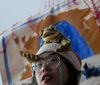
내 이름은 원덕기 (My Name is Won Deokgi)
Dir. 소중한 (So Junghan)
Screening at Phil Roasting House, 4th Floor
Gwangju
Oct. 30, 2026
(Jisu Sheen recently moved from New Haven to Gwangju, South Korea, where she’s covering local arts and culture for the New Haven Independent and Midbrow.)
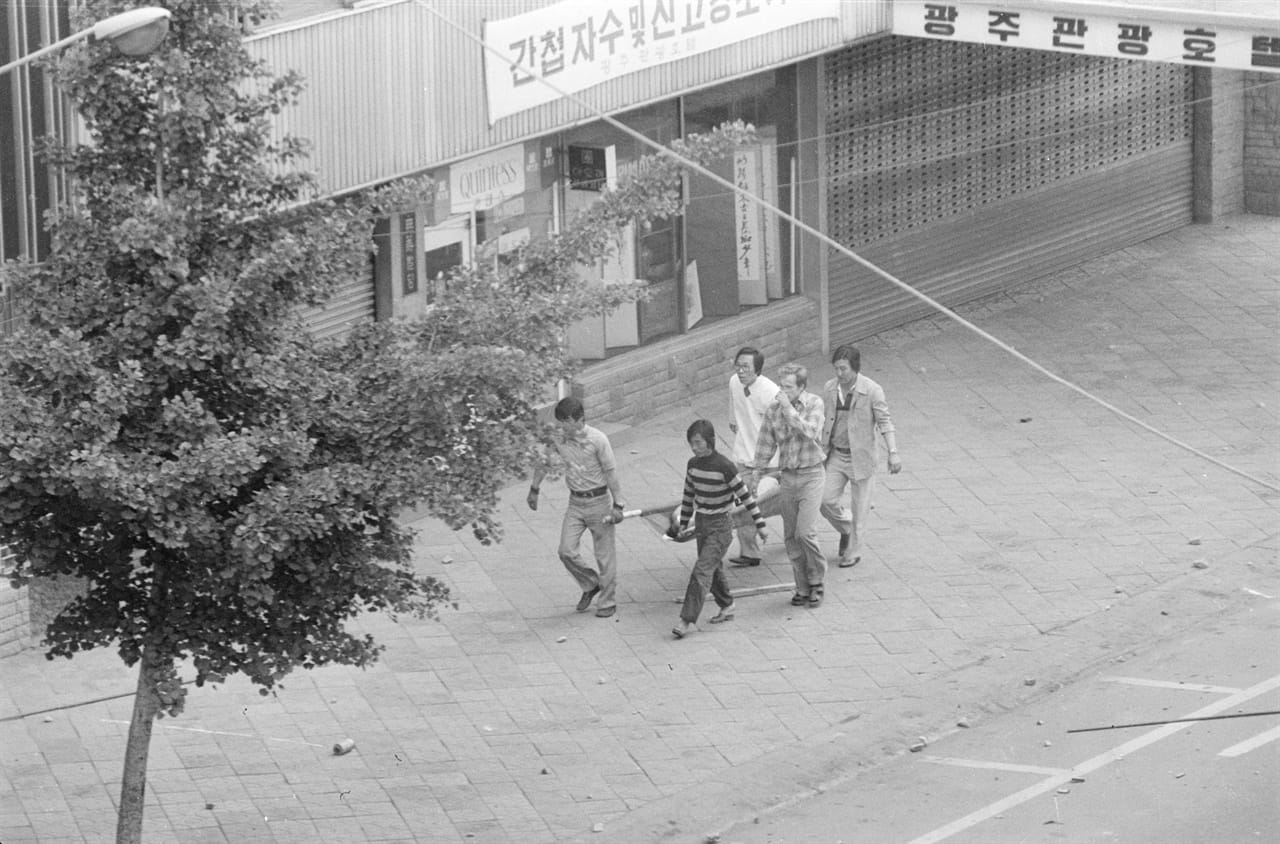
In the corner of a Gwangju bookstore on Sunday, within the pages of a book about the 1980 Gwangju Uprising, I saw a photograph of five men using a stretcher to carry one of the thousands of victims of violence enacted by military police on the country's own citizens.
It was an image that sparked an article, a discovery in Gwangju’s archives, and an independent film I’d happened to catch in a special screening just two days before.
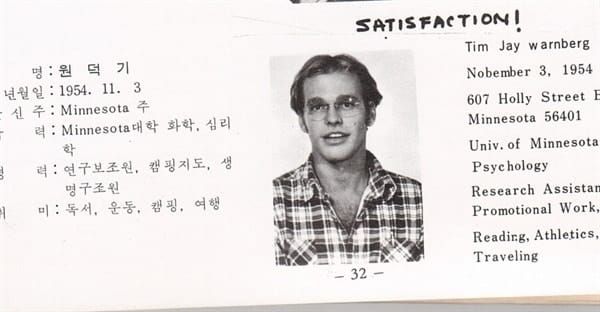
One of the men in the picture was a foreigner, a Peace Corps Volunteer from Minnesota named Tim Warnberg — or as he was known in Gwangju, I learned in the film, 원덕기 (Won Deokgi).
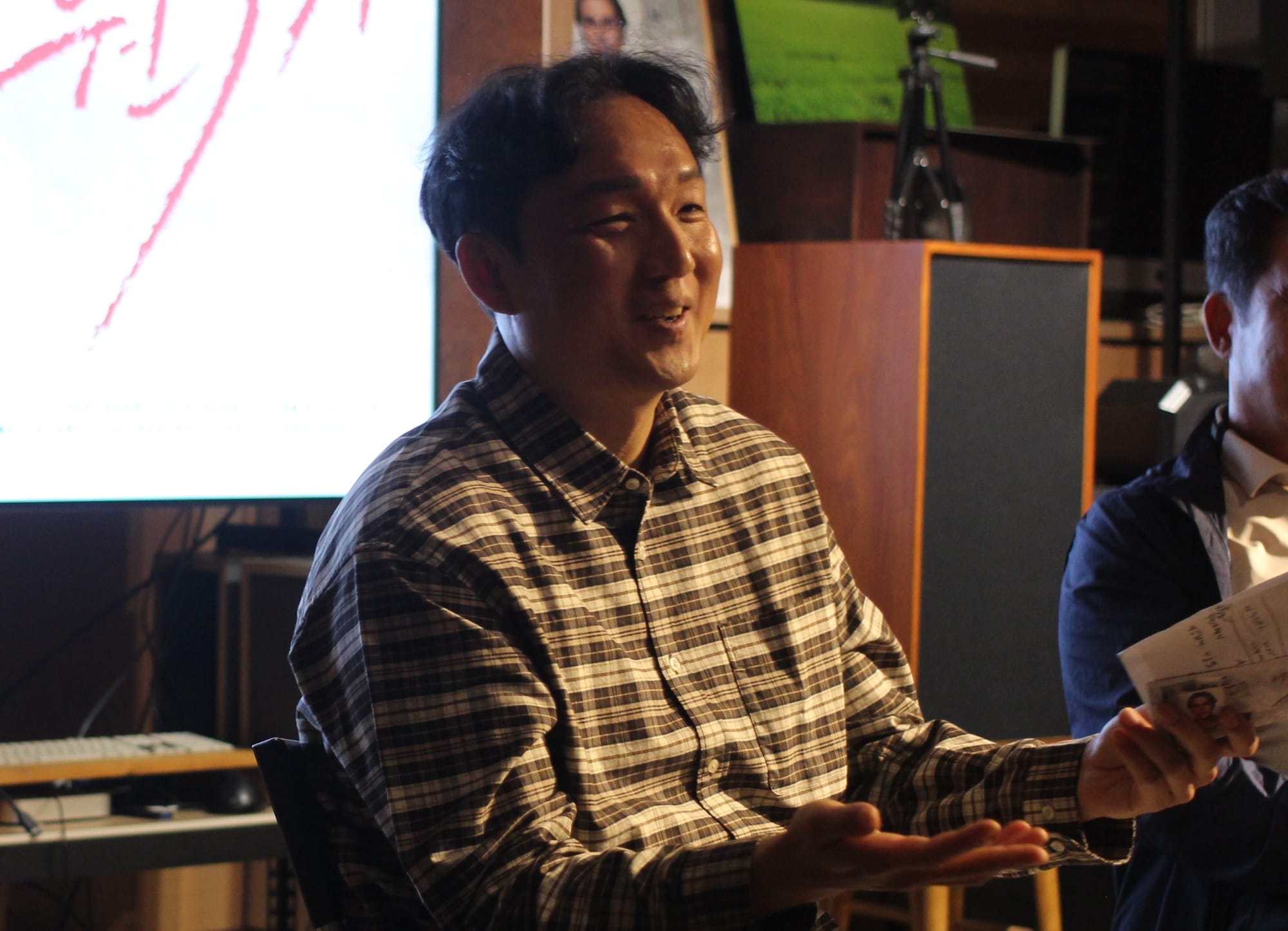
내 이름은 원덕기 (My Name is Won Deokgi) is a debut documentary from reporter So Junghan of Korean news platform OhmyNews. I watched it on Friday in the upper-floor music listening room of a cafe called Phil Roasting House in Gwangju's North District. Among endless shelves of books and stacked speaker systems, the movie played on a projector screen for a full house of 30 people. It was one of a handful of preview screenings, all with a director talk-back and most with special guests, before the team plans another round of community screenings and submits to film festivals.
On my way toward the cafe, I saw the glow of the Gwangju-Kia Champions Field baseball stadium emerge from the autumn night. Phil Roasting House was, it turns out, so close to the stadium I would later hear the audience's roars as if the game was on TV in the next room.
So's journey to the film started with that photograph of the men with the stretcher. He saw it in a photo album that had been kept hidden until 2019, when National Assembly member 박지원 (Park Jie-won) obtained it from the Ministry of National Defense and disclosed its contents to the public.
So analyzed the photograph's context, started learning about Warnberg, and published a report in 2020. Years later, in 2025, he got a tip about a video interview in Gwangju's May 18th Memorial Foundation, where Warnberg describes the uprising in his own words. After watching the video and confirming the interviewee was indeed Warnberg, So assembled a research team to dive deeper. He decided to turn his findings into a film.
나경택 (Na Kyung Taek), a photojournalist for the 전남매일 (Jeonnam Maeil) newspaper, had taken the picture, which was confiscated by the Defense Security Command before it had the chance to be published. Na was interested in the foreigner's choice to step in rather than watch from a distance. "He was doing that, knowing he could be hit by airborne troops," he says in Korean in the film.
The research team also gets the perspective of the person walking behind Warnberg in the photo, the DJ at a Gwangju music cafe he used to visit, and several friends who help flesh out the story of Warnberg's life.
In the film, the crew doesn't stay within Korea. They travel to Warnberg's home state of Minnesota, where they see signs with pictures of Alex Pretti and Renee Good, both killed by ICE in Minnesota in January, as well as Philando Castile, George Floyd, and other Black Minnesota residents killed by police over the last several years. As So put it later, via email in Korean, "The state-sanctioned violence perpetrated by ICE (Immigration and Customs Enforcement) in Minnesota earlier this year had similarities with Gwangju 46 years ago. Not only that, the people's response to that state violence was also very similar to Gwangju's."
Part of this is about the sharing of food. In Gwangju in 1980, people shared rice balls and other meals with each other in the face of danger. In Minnesota in 2026, interviewees in So's film explain how they coordinate food deliveries for people who can't leave their houses out of fear of abduction by ICE. It's a practical effort that fills one of the most basic human needs. It's also a step toward community-led social infrastructure when the people have been abandoned.
I think often about the generation of activists, dissidents, and critical thinkers growing up in the '60s and '70s. In the U.S., many of them were targeted in political campaigns meant to provide the grounds to break up their communities. Others were traumatized overseas in a war they opposed or manipulated at home in covert government operations. Today, their ideological descendents — writers, philosophers, activists — work to make up for what was lost. What’s hard to recover, or even to see as important enough to recover, is a way of speaking.
“...and most of them ended up getting their heads split open,” Warnberg says in the 1980 interview featured in the film, describing how military police massacred activists in Gwangju. He’s not sensationalizing the scene, but he also makes no effort to downplay it. He’s saying what he saw.
In another part of the interview, Warnberg says, "The martial law commander was lying to the people in Seoul and the people in Gwangju." Straight up. If he were alive, he'd be much older than me, but the time warp of the film medium meant I was watching someone in his mid-twenties. I felt proud of him.
In fact, Warnberg's trust in his own observations led him to publish a thesis called "The Kwangju Uprising: An Inside View" in 1987, in the journal Korean Studies from University of Hawai'i Press. The film shows a printed copy of the journal in the Minnesota home of Warnberg's sister, Roxanne Warnberg Wilson.
In the essay, rather than relying on credentials or official statements to make his case, Warnberg draws from eyewitness accounts — his own and those of the people he met — to explain how "the events in Kwangju represented an indigenous, immediate response to military and police violence, rather than a planned provocation manipulated by outside forces."
Warnberg died of a long-term illness five years later, in 1993. The film describes how, in his time after witnessing the Gwangju Uprising, Warnberg switched career paths from the medical field to Korean Studies, kept a Korean flag alongside the Minnesota flag at home, and worked to protect the truth of what he had seen. "Gwangju was an awakening for Tim," Wilson says.
In a story recounted by a friend in the film, Warnberg uses his position as a foreigner to intervene while the police are beating a group of people, and they actually do stop. The film refrains from using details like these to paint Warnberg as a unique hero. Instead, as So explained via email, Warnberg was "an ordinary young man you might meet in everyday life."
It’s natural to make friends. It’s natural to care if they live or die — even if authorities tell you not to. To me, the film’s depiction of the life of an "ordinary young man" reveals the unnatural, constructed identity behind authoritarian rule and its enforcers.
Before the movie played, we watched a video recap of a previous screening. Warnberg's friend David Dolinger, who had witnessed the uprising as well and came for the screening, teared up talking about Warnberg's love for Gwangju. The word “Minnesota” rolled off the tongue of a young Korean audience member talking about the movie's description of current U.S. state violence.
It is the kind of exchange I hope to see more of as disparate societies find each other amidst the fog of government cover-ups. We might think we live in a globalized world, but how much of that “connection” flows through one national capital of industry to another? How much is brokered through sites of political gain and censure?
Warnberg's message to the camera is an example of a more human-to-human way information can flow. The independent, crowd-funded documentary about his time in Gwangju is another. Most of the audience at the Phil Roasting House screening were individual backers of the making of the film. Through their efforts, So could take Warnberg's story from the page to the screen without having to appeal to a major production company or distributor.
As I was leaving the screening, I watched crowds of Kia Tigers fans split into smaller streams, following varied paths toward their next destinations. I started walking on a bridge, then retraced my steps and walked down, toward the water. There, people made their way along a riverside path, crossing just above the water's surface on a low walkway. I walked until I saw another river, crossed again, and found my way back home.
Sign up here to get Gwangju Midbrow email updates delivered straight to your inbox.
A preview published this year on May 18th, ahead of the hour-long film's completion and official release.


