
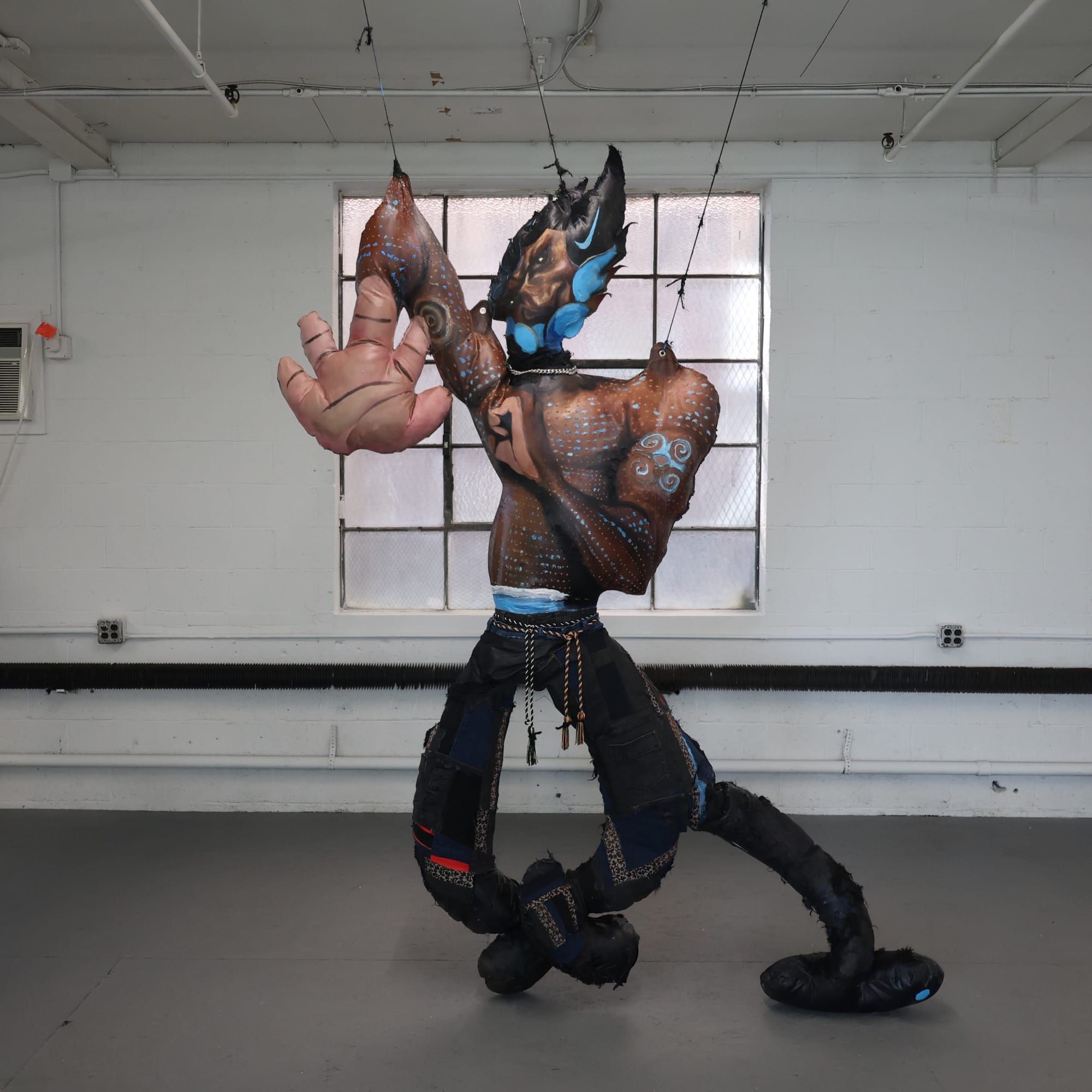
Between Worlds
Ely Center of Contemporary Art
New Haven, CT
Through Dec. 6
Lowcountry King towers over the viewer in the gallery space. Its otherworldly appearance sends the mind in different directions. If we settle on the idea that it's a monster, its pose might threaten us, as if it's about to attack. But what if the monster is afraid of us? What if its posture is defensive? We might also think of it as less monster than cartoon character, its appearance intriguing, even enticing. What if its pose is a greeting? What if it's dancing? The figure allows for all those interpretations and more. It's visiting from another place after all, and what we think about it is as much a reflection on the distance we perceive between us and the figure as it is about the figure itself. Do we find it alien? Or do we see ourselves in it, maybe more than a little?
"Lowcountry King, a power figure and guardian of South Carolina's coastal region, treats anime, Gullah/Geechee traditions, and pop culture as generative references to become a symbol of Black multiplicity," the artist, Kevin Hopkins, writes. His playful approach gets at deeper themes, of "belonging, survival, and imagination, contextualized within the Black American experience. By weaving together his Lowcountry upbringing and pop-cultural influences, Hopkins's work contributes to a diasporic search for pathways to healing as he imagines liberated realities and charts strategies for their actualization." In its tone, Lowcountry King gets at an important point. Healing is recovery from pain, and we often think of healing itself as a tender, painful process. That may always be true, but Hopkins reminds us that at least parts of it can also be fun — a taste of the joy to come.
Lowcountry King is part of Between Worlds, curated by Larry Ossei-Mensah and running now at the Ely Center of Contemporary Art at 162 James St. through Dec. 6. As accompanying text relates, the work of the show's 25 artists "explores the spaces where identities, histories, materials, and worlds meet. Working across painting, photography, sculpture, video, installation, and mixed media, the artists consider migration, memory, spirituality, ancestry, belonging, and transformation. Across the exhibition, abandoned family photographs are painted back into being; diasporic landscapes are reunited across time and ocean; prophetic figures are constructed from gifted clothing and jewelry; e-waste and perishable materials become contemporary reliquaries; and botanical forms, archival fragments, paper, aluminum, ceramics, and paint become vehicles for histories in motion."
Overall, the text continues, the show is "less interested in resolving the in-between than in asking what it might mean to inhabit it. What do we carry when we move? What remains when we arrive? And what becomes possible when we allow ourselves to be changed by the crossing?"
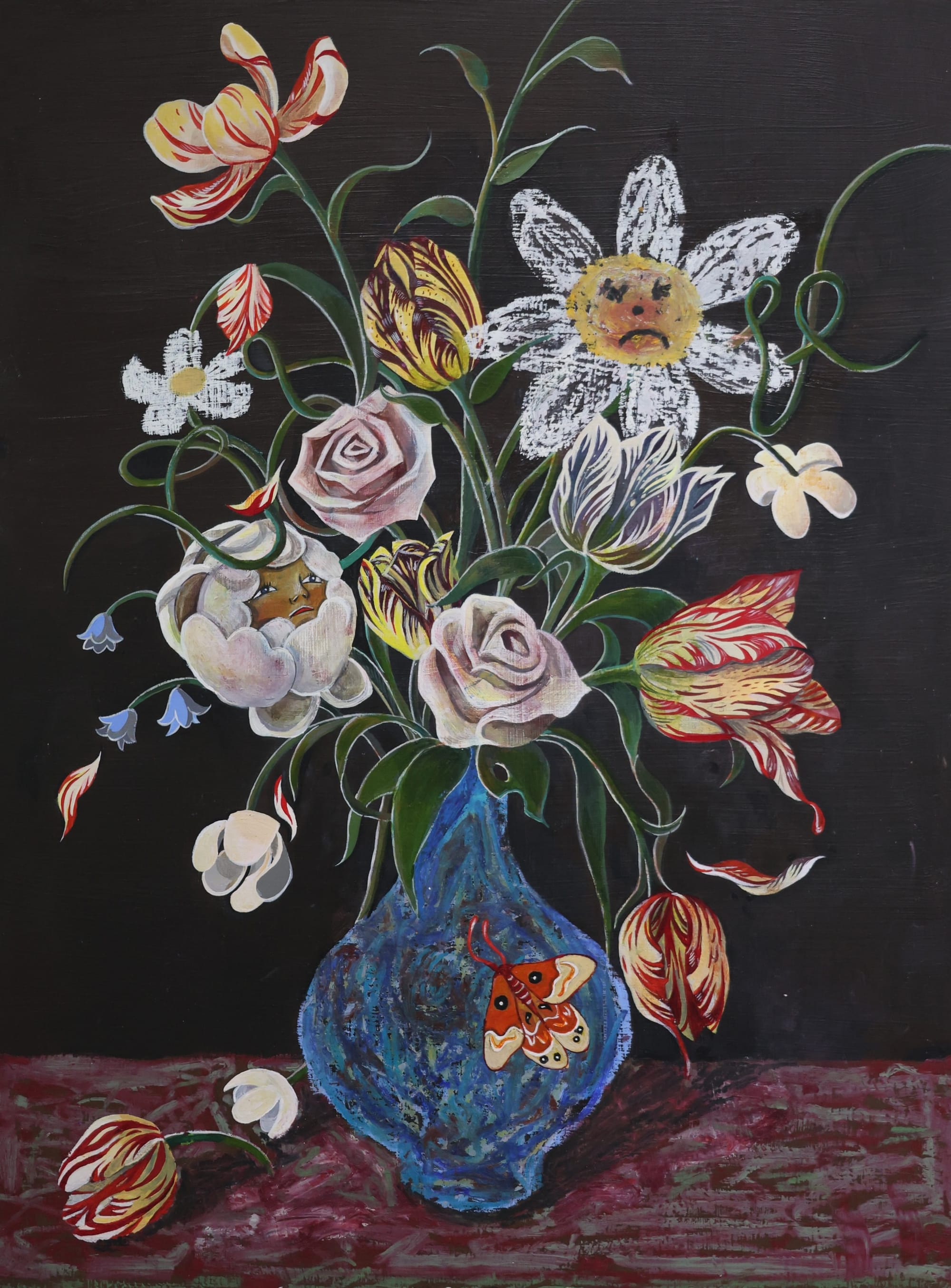
The curator's concept of the show is a potent frame to approaching the art. If Lowcountry King is about moving through an in-between place, on the way from one space to another, Angela Wei's work is about what it can be like to stay in that undefined area. For Wei, it's fraught ground. As Wei writes, the art "transforms the still life into a site of concealment. At first glance the exhibition appears seductively decorative: luminous tulips, theatrical bouquets, hyperreal blossoms rendered with lacquered precision. Yet every painting withholds something. Revolvers disappear among stems. Faces emerge from peonies. Clinical instruments masquerade as botanical studies. Flowers become stand-ins for bodies under surveillance. Meaning is never announced outright: it is encoded into motifs, buried beneath paint, and discovered only through sustained looking. One of These Things Is Not Like the Other stages a hyperreal arrangement against theatrical black; inside it, a worried face hides in the peony and a chalky, childlike daisy frowns straight at the viewer, a self-referential wink admitting the whole arrangement is a costume."
A still life is often intended as a study, a way for the painter to practice technique. Wei makes it a dangerous, difficult place. But the meaning of the still life remains intact. Artists take what they learn from painting still lifes and apply it to bigger, more meaningful work. Wei is doing the same; embedded in the painting is the promise that the techniques learned in it may find their full flower somewhere else, when the artist is ready to move.
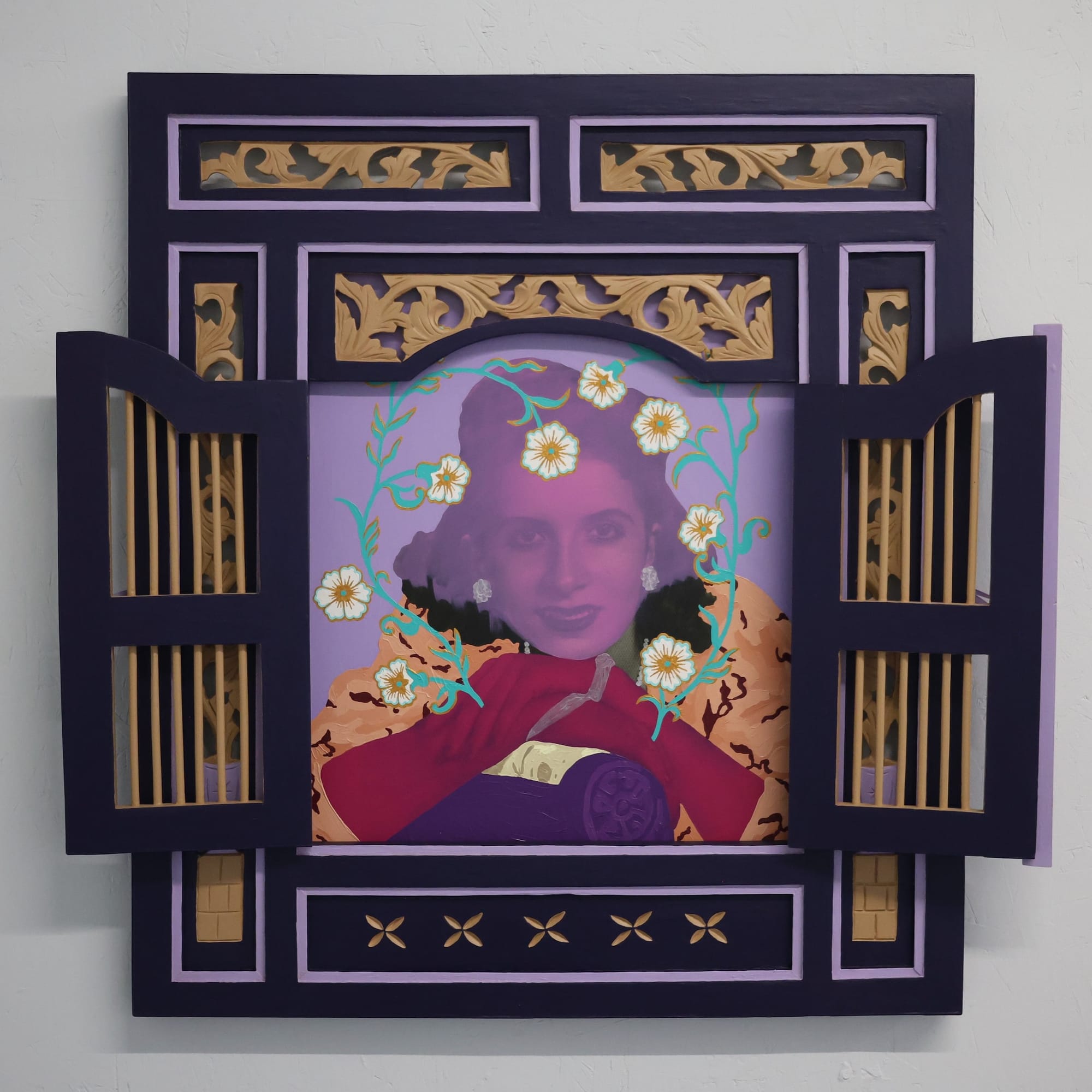
Daisy Patton's piece is likewise about tension roiling beneath a placid surface. "Who do we remember and why?" the artist asks. "I collect abandoned family photographs and enlarge them to life size, painting over to re-enliven and transfigure the people into our present moment. Through the intertwined histories of painting and photography, I paint to extend the lives and memories of these individuals to create a living archive of memory. The works evoke the ornate intricacies of Persian miniature, the narrative richness embedded in tapestries, and the sacred intimacy of altars. Adorned with rewilded botanic patterning, these paintings fracture time and space—here, the flowers are always blooming, bursting from their rigid repetition to give life to the people in each image, melding us to the natural world. These monumental works invite potential connections between the painted subjects and viewers: they gaze at us as we gaze back at them, recognizing our shared humanity despite time separating us."
For Patton, the concepts got very personal. "This series began during a period of estrangement from my mother, the parent that raised me, over my curiosity and search for the parent I never met, my Iranian father," Patton writes. "From an early age, I longed for photographs of him, objects I lacked, while trying to locate my place in a diaspora I did not yet know I belonged to. By painting over the images of mostly unknown people, I am repairing the erasures in my own story and tending to the disremembered lives of others. In this way, nearly forgotten people are momentarily restored, reminding us that each person is a whole world unto themselves, bound to us and worthy of care."
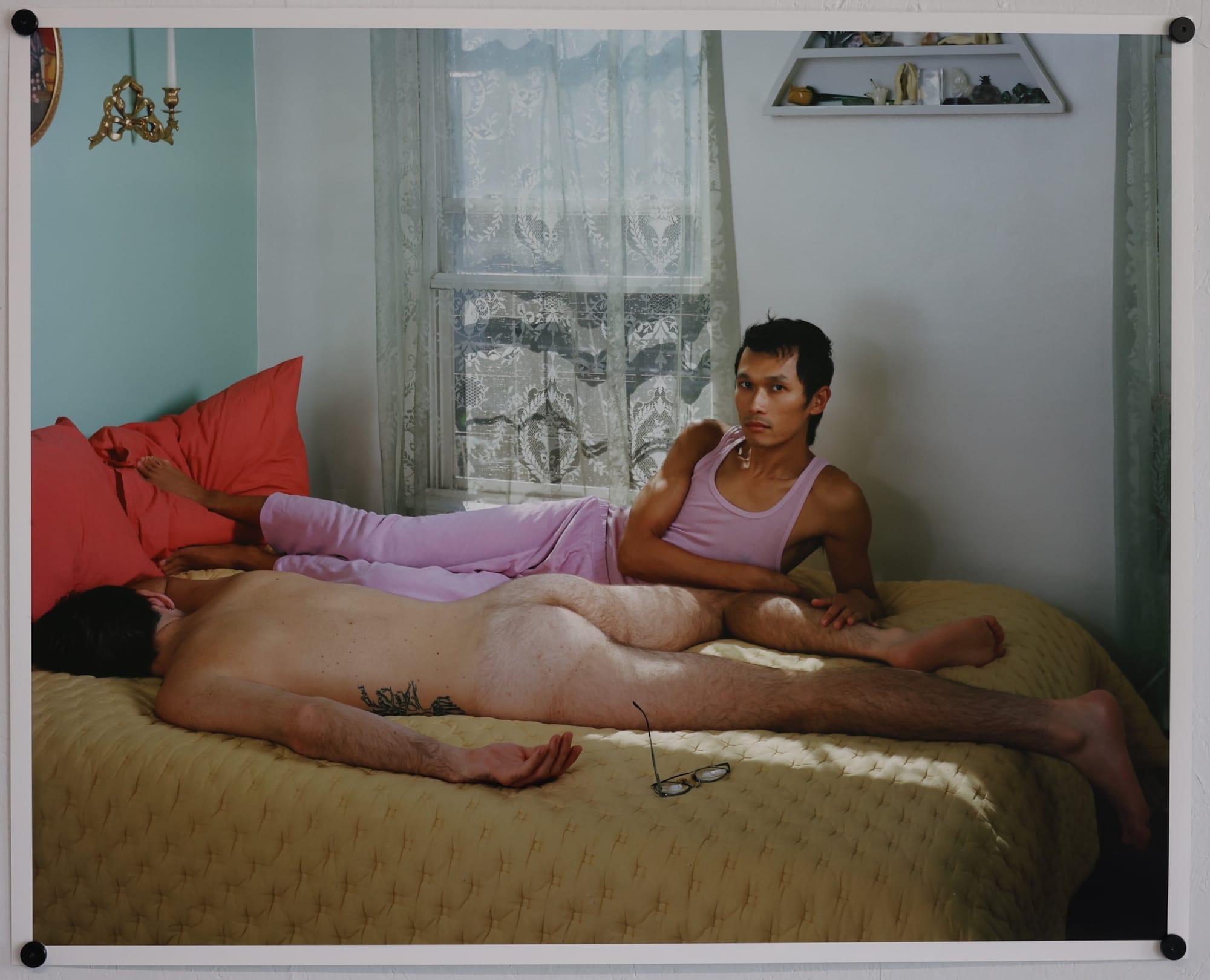
In the context of the show, Hopkins, Wei, and Patton can all be understood as responding to pain. The in-between spaces the pieces inhabit are places where, maybe, it's impossible to avoid confronting that pain. But they're also, perhaps, safe places to do it. The artists have found quiet spots where they can do difficult work. That friction appears in Chen Xiangyun's Bed Stay. "My work employs photography, sculpture, video, installation, collaboration and archiving as strategies for queer world building," the artist writes. "Rooted in my experience as a queer immigrant, my submitted portrait project features psychologically probing portraits of my diverse queer community in the U.S."
If Hopkins, Wei, and Patton are making visible what building a new world can feel like on the inside, Bed Stay offers a glimpse of what that looks like on the outside. In the photograph, so many of the details suggest how the subjects are living precarious lives. The face of the man in the pink tank top wears a complex expression: The camera isn't unwelcome in the room, but that doesn't mean the subject lets their guard down completely. Maybe they can't afford to. The other person may be naked, but they're also protected: hiding their face preserves their anonymity. Yet, in the moment, both of them are at rest.
All four artists, and many others in the show, are caught in that kind of suspense. They show how being in between comes with difficulties, whether you're just passing through or staying for a while. But those fractious places also offer possibilities that others don't have, to imagine something new, something better than what we have, and to move toward it in ways that people in less complicated places can't see.


