
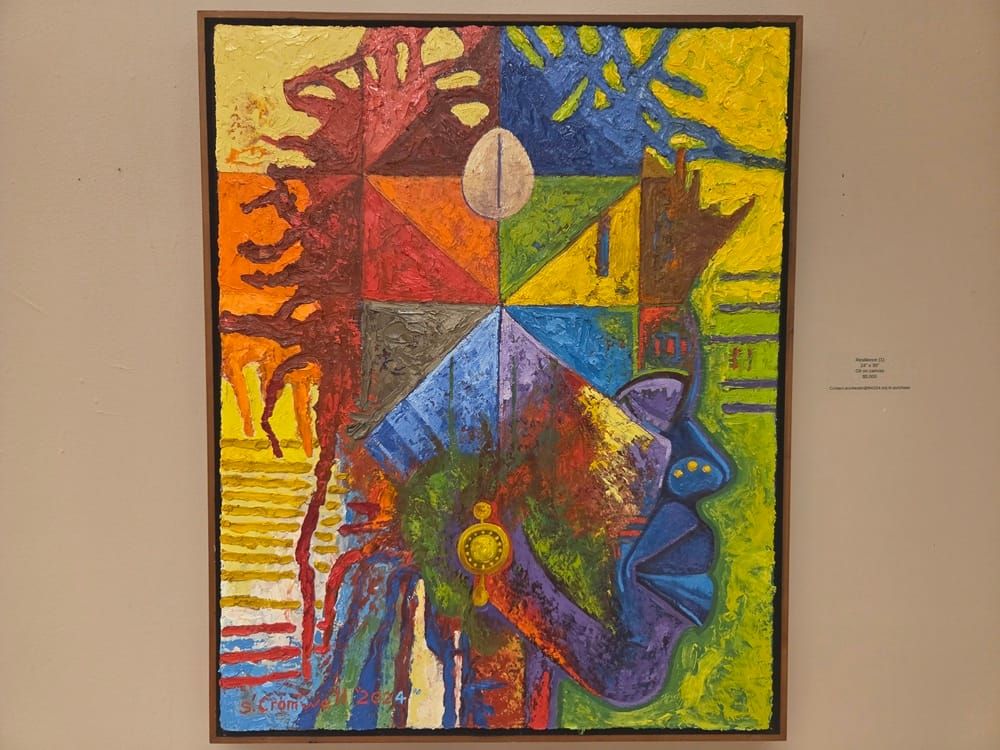
Conversations in Color: A Renewed Consciousness
The 224 Ecospace
Hartford
November 3, 2026
Artist Stanwyck Cromwell’s latest exhibition, Conversations in Color: A Renewed Consciousness, is a visual explosion that finds itself right at home behind the purple and teal walls of The 224 Ecospace in Hartford.
Cromwell’s work is a daring collection of self-reflective works that contemplate his position as a Guyanese-born artist who has spent most of his life in the United States. Color is critical to his work; he explains in his artist’s biography that his memory of Guyana provides a “visual kaleidoscope” he draws from for his art.
I’m just so glad Cromwell’s gallery is about actual color, and not the ham-fisted way galleries name their exhibitions that feature nonwhite artists. It’s so bad that if I see the word “color” in the name of an exhibit I’m 99 percent sure the artist is nonwhite. It’s crazy that of all words, “color” in relation to visual art has become a stifling term that’s not used to describe art, but people instead.
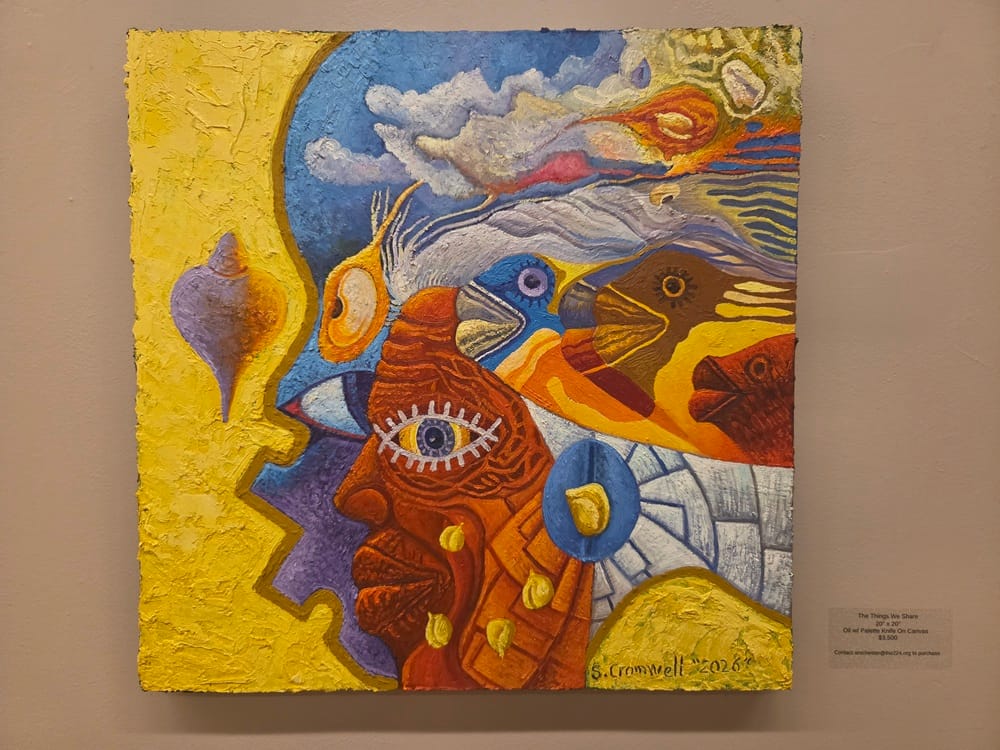
Cromwell's philosophy of the kaleidoscope is on full display in The Things We Share. Instead of relying on any of the tropes and colors commonly used in African diaspora art, he shocks the eye with generous amounts of yellow and orange, setting a foreground and background that sandwiches blue, indigo, silver and other colors between them.
His approach works because we are a people filled with color, not people of color, another absurd term to theyify us. From Eddie Murphy’s red jacket to Prince’s purple rain to Cam’ron’s pink outfits and beyond, our use of color– for flash, for respect, for style– has helped define American culture since we were brought here against our will.
Thank goodness for Cromwell, who uses his art to connect our skin and our inner being to color and hue beyond the Caucasian-imposed view of us as Black people.
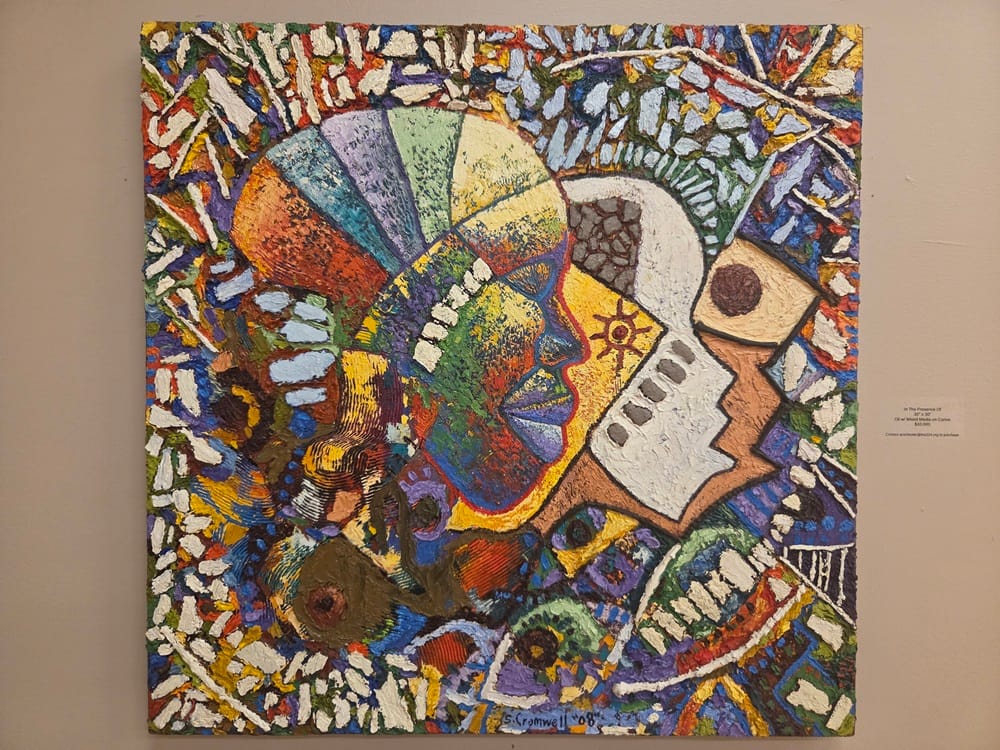
Of all the works on display, In the Presence Of struck me the most because of the way Cromwell captured the essence of the African diaspora. We see white speckled throughout, white used to represent the physical body. The layering of color in the other human form, transitioning across the head, the seat of human intelligence, like a rainbow showing the multifaceted nature of our existence. The use of other media gives the work a great sense of feeling too, as if one could touch the painting and feel connected to our history and present. His work is proof that there's more to being "Black" than being black.
I hate being called Black. I’ve tried to make this point multiple times to multiple groups of people, and it never goes over well; I don’t expect it to go well here either. Whenever I say it I get peppered by incredulous questions: Aren’t you proud of your heritage? Do you want to be white?
It’s a line of questioning I resent, because it refuses to engage with the reality of what Black means when applied to a human being. First it’s literally untrue– I’ve never seen a person colored black. And yes, black does have all of its negative connotations for good reason. It is scary; it is threatening.
But that’s not the color of any human’s skin, so why do we have to take on those connotations?
Or let me put it like this: Do you think the native peoples of Africa called themselves Black before Europeans and other colonizers showed up?
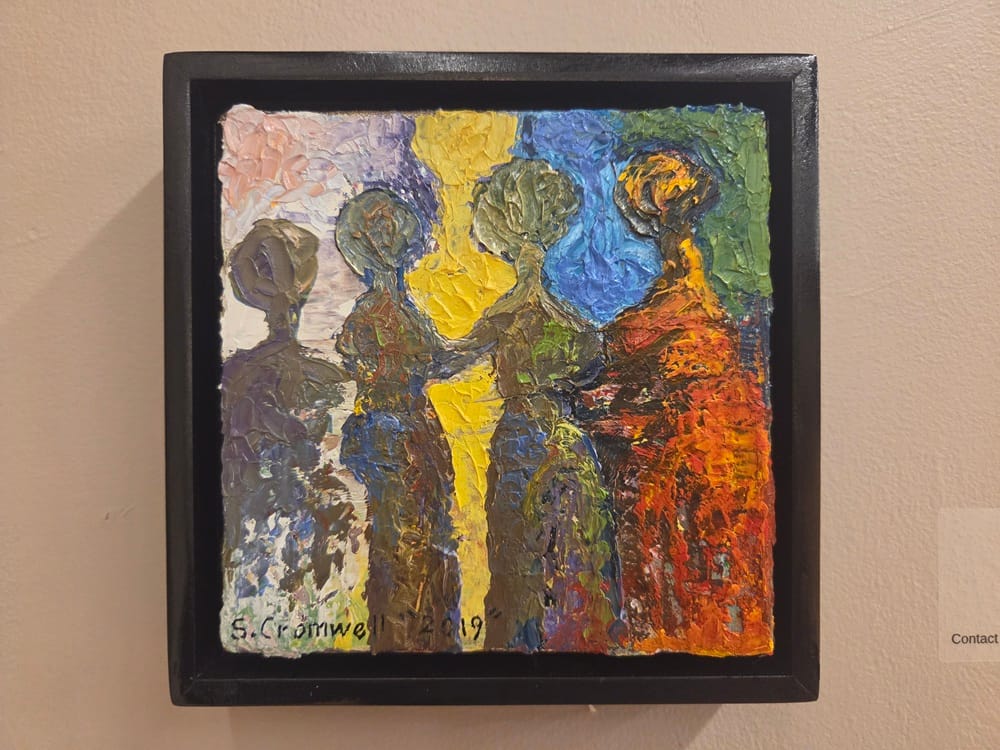
The great irony is that even as I write about Cromwell and his art, I’m forced to jump through linguistic hoops to avoid flattening his experience, my own, and the rest of the African diaspora with the word Black, because how else can I describe him? The terms decide the discussion and reinforce themselves. Heck, Cromwell might not be talking to me at all, as I’m not from Guyana. But I live in a place where all brown people are Black, and all Black is the same, so here I am, writing as such.
Cromwell’s color is the strongest possible statement against that flattening. Go see his work to see real people of color.
NEXT
Conversations in Color: A Renewed Consciousness will be on display at The 224 Ecospace through Jan. 3.
Jamil goes to the Old State House for Audio Feed’s latest concert.


