
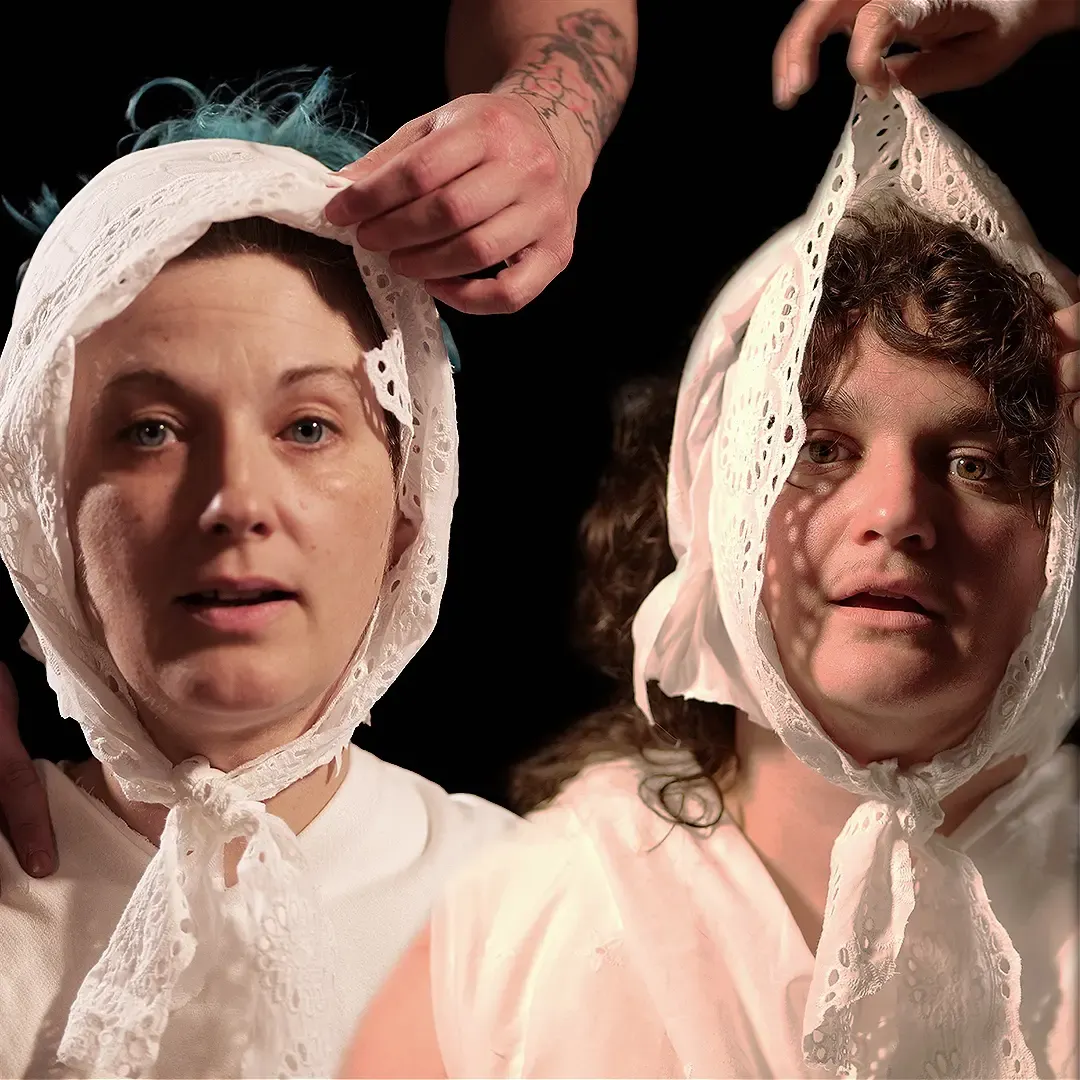
Dickie, Dickie, Dicky, Donnie
Asian Arts Initiative
1219 Vine St.
Philadelphia
Sept. 22, 2026
It's the last two nights to see this Fringe show. Buy tickets here.
In middle school were you given a sack of flour to teach you responsibility? Maybe you were a 2000s kid and your school had those fancy robot babies that would cry loudly at night to remind young teens of the importance of abstinence. This all seems mild compared to the domestic economics practices of the 1950s, when universities would loan babies from orphanages for students to practice mothering upon. It was a bizarre experiment in the scientific field of the family unit — and now it’s the subject of the Philly Fringe Festival show, “Dickie, Dickie, Dicky, Donnie.”
I caught a showing of that production at the Asian Arts Initiative last week. Created by MK Tuomanen, Shelby Richardson and Paul Kruse, “Dickie, Dickie, Dicky, Donnie” manufactures its own kind of domestic experiment through the language of play and sibling attachments. The show wonders at their internal world: What might it have been like to be raised a practice baby?
Played by Toumanen and Richardson, Dickie and Dicky share a crib and several mothers. Their circadian rhythms are built around the schedules of the women who care for them. The actors crawl around in an oversized crib with a tilted mirror above it so that we can see them as they play with blocks and stuffed animals. The pair act entirely in the nude, with the exception of their adult-sized cloth diapers; the piece takes the embodiment of babyhood very seriously.
Their grasp of toddling mannerisms and developmental patterns are striking in their accuracy. The Dicky/ies walk with a wide and low center of gravity, gripping the railing of their crib intensely and shaking their bodies against it. In calmer moments, they gently readjust their grasp. Shaking their fists, screaming without inhibitions, and struggling to share with each other all build the validity of their performance. Infancy is not the butt of the joke, but the subject of comedic exploration.
Poop and pee are the main things on a baby’s to do list, so it’s a big part of the piece. At one point, when waiting for a diaper change, the pair begin to panic scream: “This is forever and never stopping!” In the same way babies have to learn that they are separate from their mother, they also have to learn that they are separate from their poop — which can be frightening. Freud referred to this as the “anal stage.” This is probably one of the more experimental parts of the play; watching two adults in diapers imitate the strained facial expressions of a baby mid poo.
Throughout the show, while waiting for “a mommy” to arrive, the children conduct experiments of their own. They confer on what might get the mommy’s attention, trying different techniques and mimicking the adults around them. “This is what the mommies go for,” says Dickie while vigorously poking their belly. While testing an idea for how to impress mommy, Dicky declares, “We need her to like it a lot.” The veil of childhood naivety is lifted here for a moment. Their days are occupied by waiting for an adult, or imagining how to get their attention. Asking the audience again: how would that feel?
To find out, the show introduces us to the Dicky/ies all grown up as they type instant messages to one another on computer screens illuminating their aged faces. One Dicky/ie asked the other tentatively, “Do you think it messed us up?” to no reply. For one Dicky/ie, their experimental upbringing weighs heavily on them; for the other not, so much.
In a near-final scene, one Dickie turns to the audience to answer the question of this piece’s experiment. How would it feel? It might feel lonely. “I’m never quite sure what it is I'm missing,” Dickie says of their talks with a therapist. It might be confusing and more relatable than we realize: “Lately I long to be free of mother,” they say.
The show’s experiment does not find a unified conclusion. However, the actors are successful in creating an environment where audiences can honestly explore the feelings of early life. I was so charmed by their sincerity and accuracy that I allowed myself to sink into a world where pointing, shaking, screaming, dancing, and shitting on stage are all allowed.


