
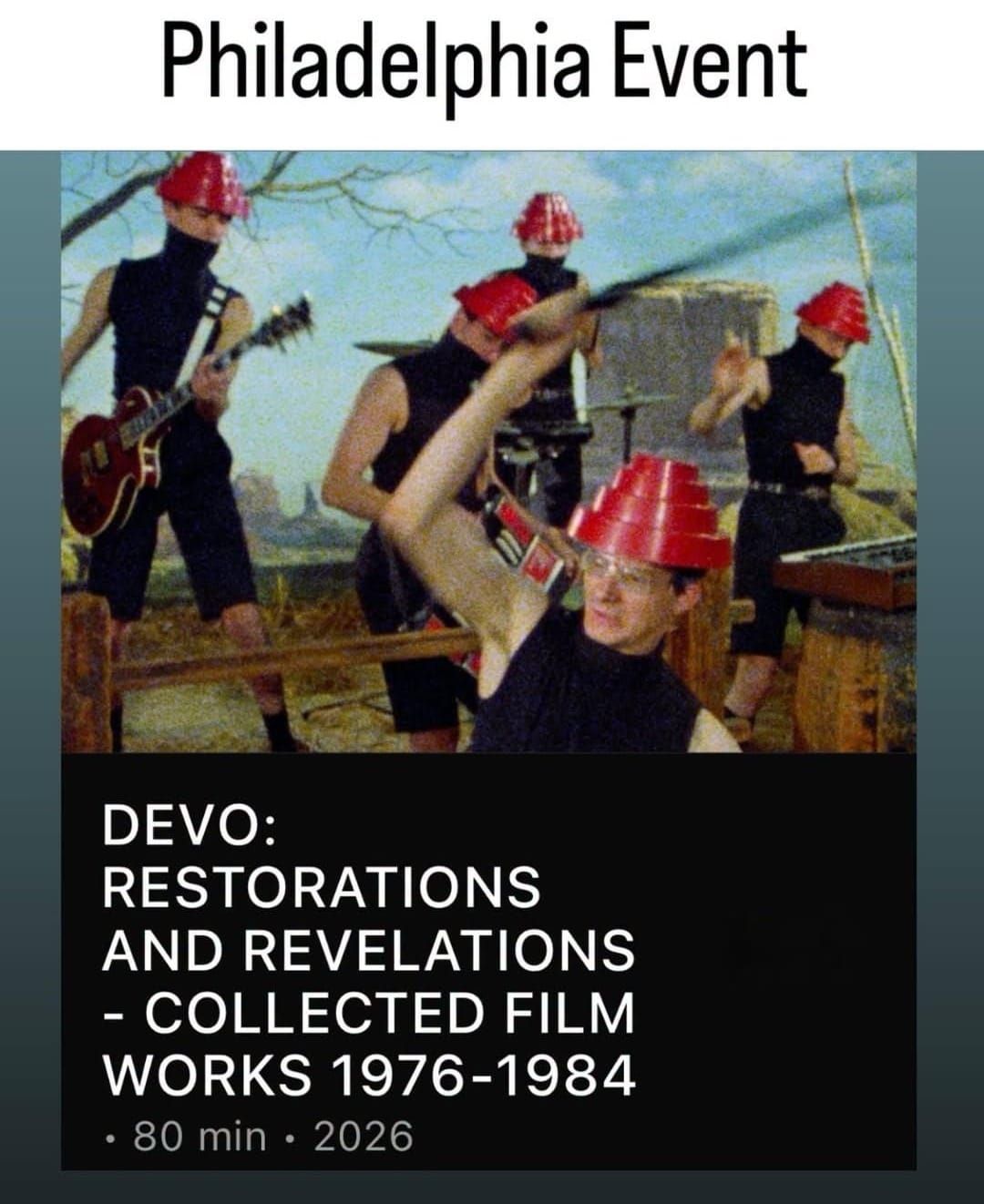
DEVO: Restorations & Revelations — Collected Film & Video Works 1976-‘84
Bok Auditorium
1901 S 9th St.
Philadelphia
Nov. 18, 2026
From its very beginnings, punk was a formula waiting to be broken and discarded. Amongst the first wave of bands that stormed out of New York and England concurrently, The Ramones and The Sex Pistols played the largest role in defining the sound and aesthetic of punk. Musically indebted to the lineage of stripped down rock n’ roll that spanned from Chuck Berry to the Stooges, both bands codified the sound and attitude of Punk. In 1977 — the year that most historians point to as ground zero for the punk revolution — the band Devo released the independent 7”, “Mongoloid / Jocko Homo.” Unabashedly weird, arty and funny, the single lobbed a grenade at punk’s orthodoxy the moment it was being formed. Born in the wake of the 1970 Kent State University massacre where the Ohio National Guard shot and killed four students at a protest against the Vietnam War, the concept of the gradual “de-evolution” of society was a central part of the band’s philosophy. Devo didn’t see the future as a frictionless utopia where technology aided in the comfort and well-being of humanity. Instead, they predicted a future that was violent and stupid, in which the technological tools that man created would be our ultimate undoing. This dystopian stance coupled with the band’s weird, synth-laced sound made them punk iconoclasts in the ‘70s and unlikely pop stars by the 1980s.
Last night, Lightbox Film Center hosted a screening of DEVO: Restorations & Revelations — Collected Film & Video Works 1976-‘84 in the auditorium at Bok. Curated by musician and film archivist Peter Conheim, the collection combines archival footage, concert footage, animation, interviews, music videos and news segments into an experimental anthology that presents Devo as one of the most ambitious bands of the era. With many of the films here being self-conceived, the most immediately striking thing about the collection is how diverse it is. There’s a great scene of David Bowie on stage introducing the band before a 1977 performance at Max’s Kansas City but there are also weird commercials and a performance of “Mr. DNA” that’s as bold and messy as any experimental noise-rock act. The videos for band’s hits like the 1980 New Wave smash “Whip It” shine when contrasted with the collection’s weirder, less-accessible moments. The surreal 1981 video for “Beautiful World” takes nostalgia for the 1950s and contrasts it with the realities of the Cold War and the fear of nuclear annihilation. There’s also a fantastic recording of Devo and Neil Young playing “Hey Hey My My (Into The Black)” from Young’s Human Highway film. It all illustrates the depth and breadth of the band’s vision. Devo’s reign at the top of the charts may have been a brief blip on pop music’s landscape, but this collection reveals that the band’s legacy points to something much stranger and more vital.


