
‘Portals of Possibility’
The Hendrie Salon
554 Hendrie St.
Detroit
Through Sept. 27
There’s a lot to be angry about these days — climate change, fascist governments, institutionalized racism, genocide. But what if focusing so much on anger only dampens our spirit even more? What if we focused on thriving instead? Lauren Hood’s “Portals of Possibility” is a quiet invitation to put down our woes and indulge in our dreams.
The exhibit is up at the Hendrie Salon during the Detroit Month of Design. It’s based on Hood’s research for “The Black Thriving Index,” which aims to recreate the conditions that have allowed successful Black people to “live their best lives.”
Hood has an urban planning and community development background, and conducted her research by interviewing Black people who are thriving globally in the areas of “agency, abundance, and audacity.” The work is part of the Institute for AfroUrbanism, which Hood founded in 2021 as a response to development in Detroit that didn’t serve Black residents.
“Agency means that people are activated in their own outcomes… People who are not complaining, but who saw something wrong and said ‘I can do something about that,” she said of her criteria. “Abundance is not necessarily sitting on piles of money, but people who have good relationships, good work-life balance, and a healthy outlook. And I also wanted people who centered the culture in their work.”
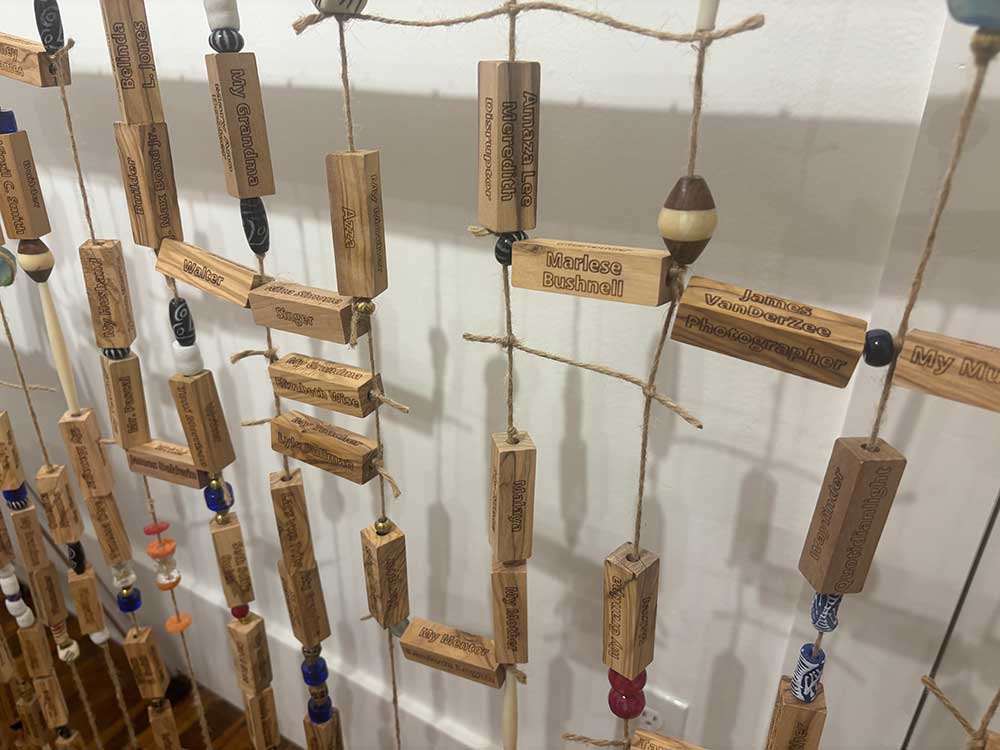
One room features an installation of strung beads and wooden blocks engraved with the names of people who participants in Hood’s research said inspired them, including Audre Lorde, James Baldwin, and Detroit muralist Sydney G. James. Hood noticed a lot of people named their mothers and grandmothers as sources of inspiration, which led her to conclude that our ancestors have the answers on how to live well.
“Everyone, within our respective cultural heritage, has the answers we need to live a good life. We just need to remember what they are,” Hood said. “I think colonization interrupted that in all our cultural lineages. When cooperative economics came up as a hot new community development term, I’m like, no, African people and villages have been doing this since the beginning. So what other ancestral technologies might we learn and apply from?”
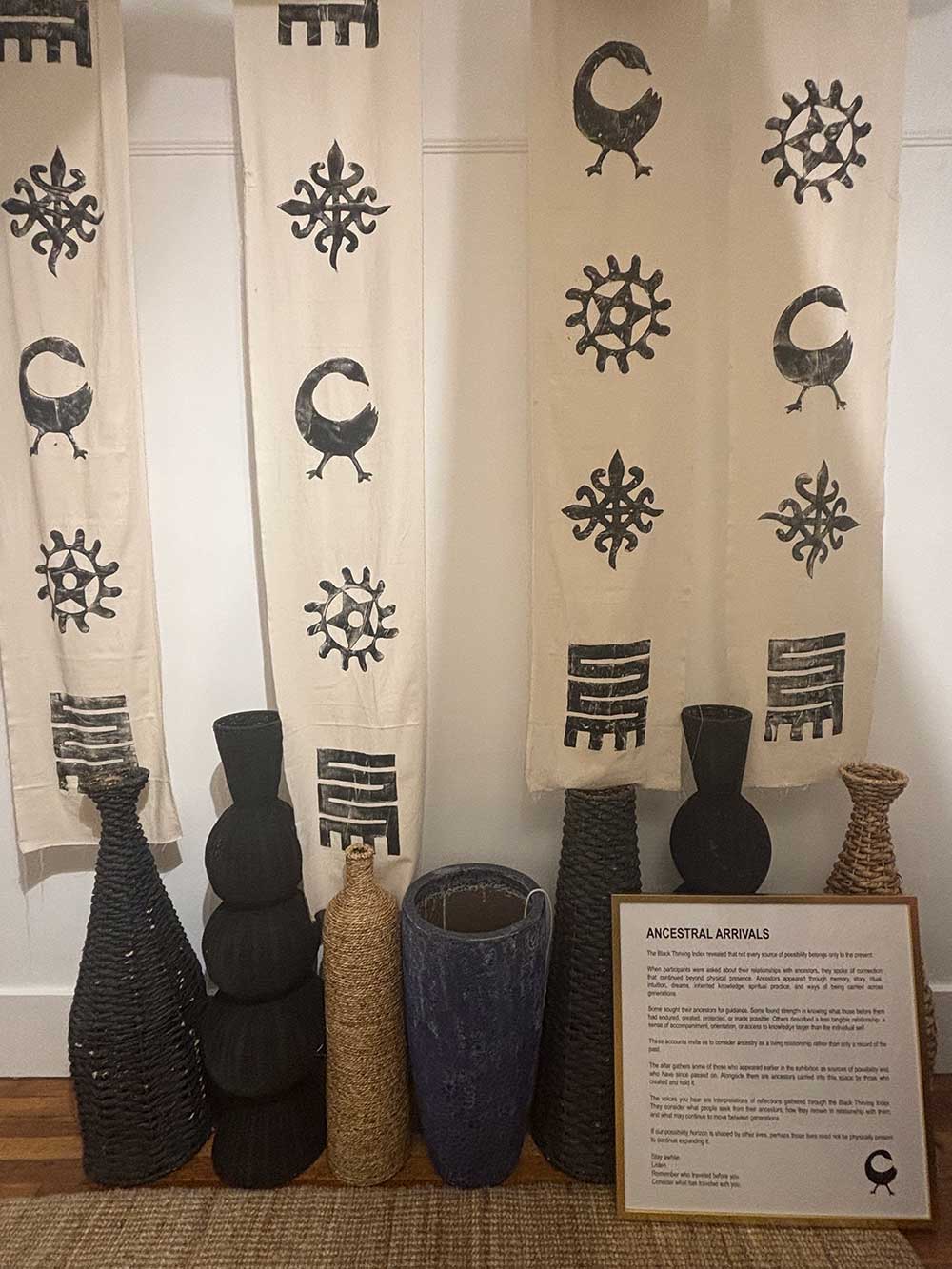
We also have to release self limiting beliefs inherited from our ancestors. Visitors are invited to write down something that is inhibiting them from living boldly on dissolvable paper and stir it into a jar of water to release it.
“I know I inherited my parents’ relationship with money, and I don’t want it anymore,” Hood said. “They have this thing that money is hard to come by and you have to save it. I gotta put that down. I’m trying to live a different kind of life. There’s something powerful about watching it dissolve.”
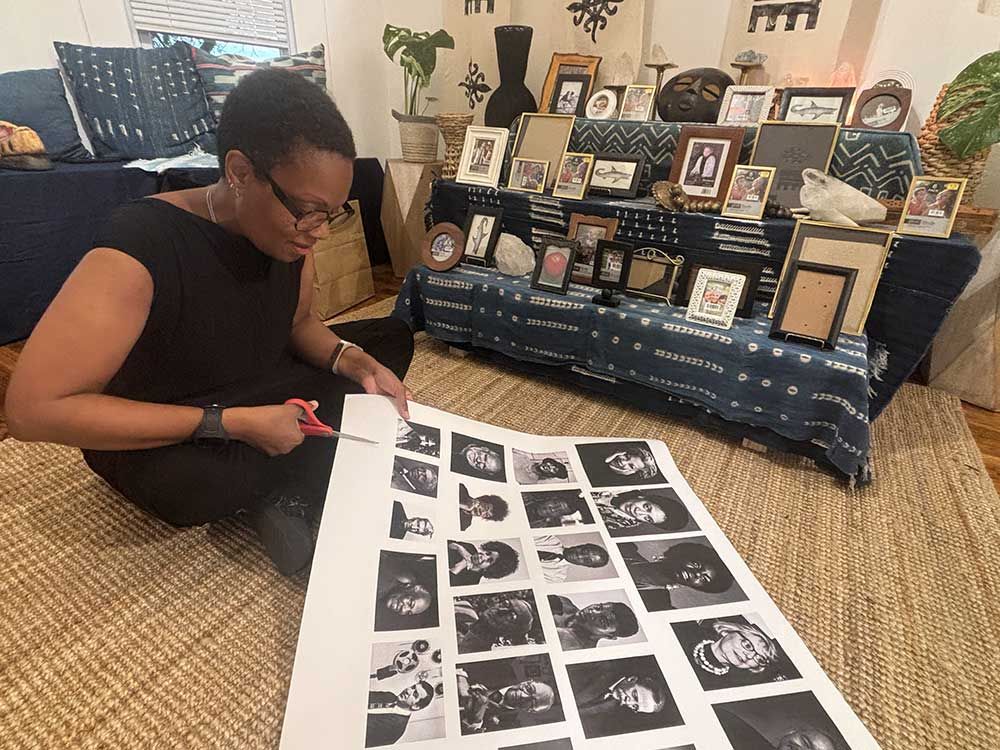
The installation includes an ancestor altar with images of people who interviewees said expanded their “possibility horizon,” which Hood said, helps us realize anything we want to achieve is possible.
“The more sources of inspiration you can have, the wider your possibility horizon becomes,” she said. “And I apply it not just to individuals, but I think of the city as well. It frustrates me so much because I feel like the possibility horizon for the city of Detroit is so big. We only think we can get this good, but there’s so much [more] that we could be inhabiting. We need to open our minds to it first.”
One room, “The Threshold of Transcendence,” asks, “tell me about the first time you realized something beyond your current conditions was possible.”
“That’s the signature question of the research study because what people talked about was growing up in poverty, limited resources around them, and they said, ‘I saw that these things were around me, but they weren’t me,’” Hood said. “Just because they were in those conditions didn’t mean it was their identity.”
The final piece in the installation asks visitors to place themselves among a constellation of artists, organizers, and scholars who were interviewed for The Black Thriving Index. The constellation categorizes people as a witness, translator, catalyst or disrupter on an axis of envisioning change vs. actually building systems of change.
Hood noted that disrupters are people who fight against the status quo within their communities. This could look like protesting or making art that directly challenges racism. But being a disrupter can affect your physical and emotional wellbeing when the focus is always on how bad things are. That’s why Hood decided to focus on thriving.
“The disrupter is there to do the truth telling when everybody else is just smiling and nodding,” she said. “But I realized that I’m not a good carrier of disruption because I manifested an illness. As a disrupter, you’re always looking over your shoulder or people don’t want you in the room. So the disruptor can internalize a lot that can have a bad effect on their physiology. I was very anti-gentrification and anti-displacement, and I still don’t like those things. However, I’m moving toward thriving instead of away from gentrification. It’s the same direction, but my true north is not away from, it’s toward. When the work gets to focus on how people thrive, that feels good.”
Follow Midbrow Detroit on social media:
Bluesky, Facebook, Instagram, Threads, TikTok, X.


