
Spatial Essays in Room 106
Real Art Ways/56 Arbor Street
Hartford
September 19, 2026
“I wanted to radically imagine another way of being for those lines.”
That’s how Hanieh Kashini described the motivation behind her exhibit Spatial Essays in Room 106. Presented by Real Art Ways, the exhibit premiered Saturday afternoon at its location at 56 Arbor Street.
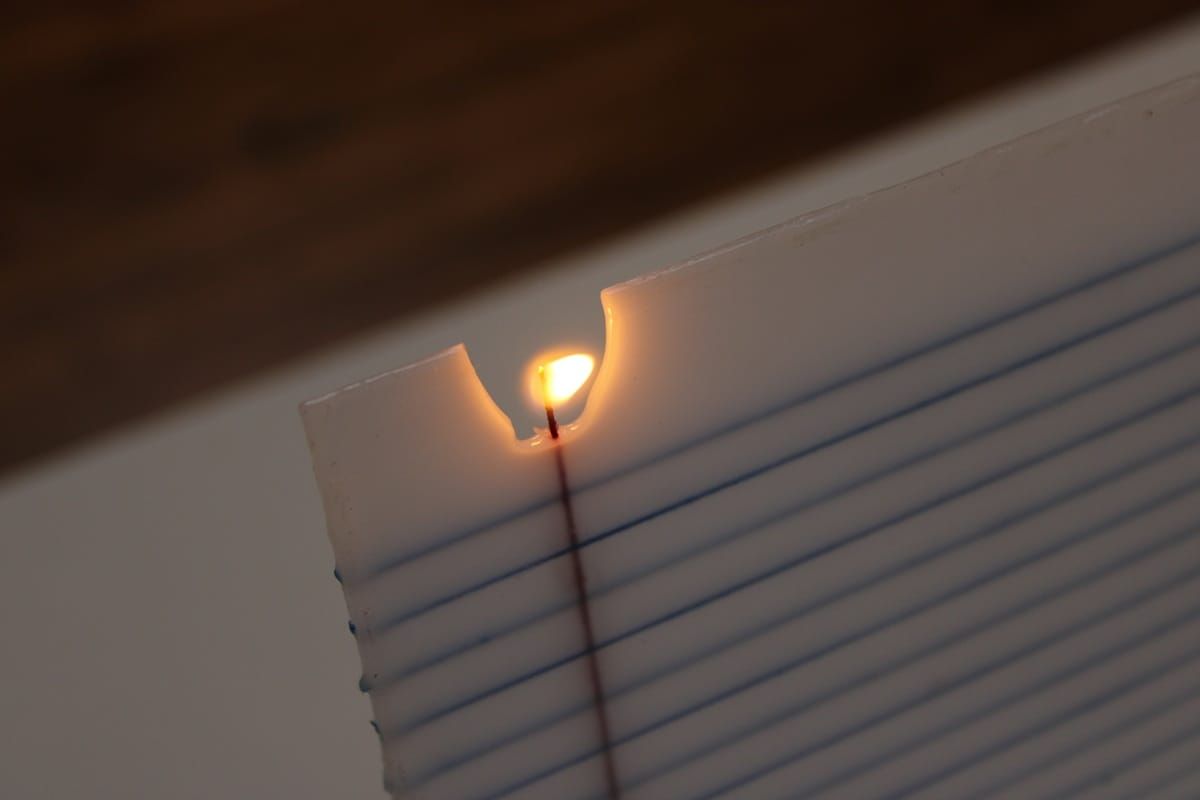
Kashani’s exhibit features two styles of artwork. The first centers on pieces of “paper” spread around the gallery, including one placed on a central pedestal. The paper is in fact made out of wax, and the lines are essentially long wicks. As the gallery filled with viewers, Kashani lit the paper on fire.
“The lines are a metaphor for the community members and the relations,” she explained to me. “So the lines themselves are less of a subject than the relation between the lines, and these works embrace that different way of being for the lines and relations.”
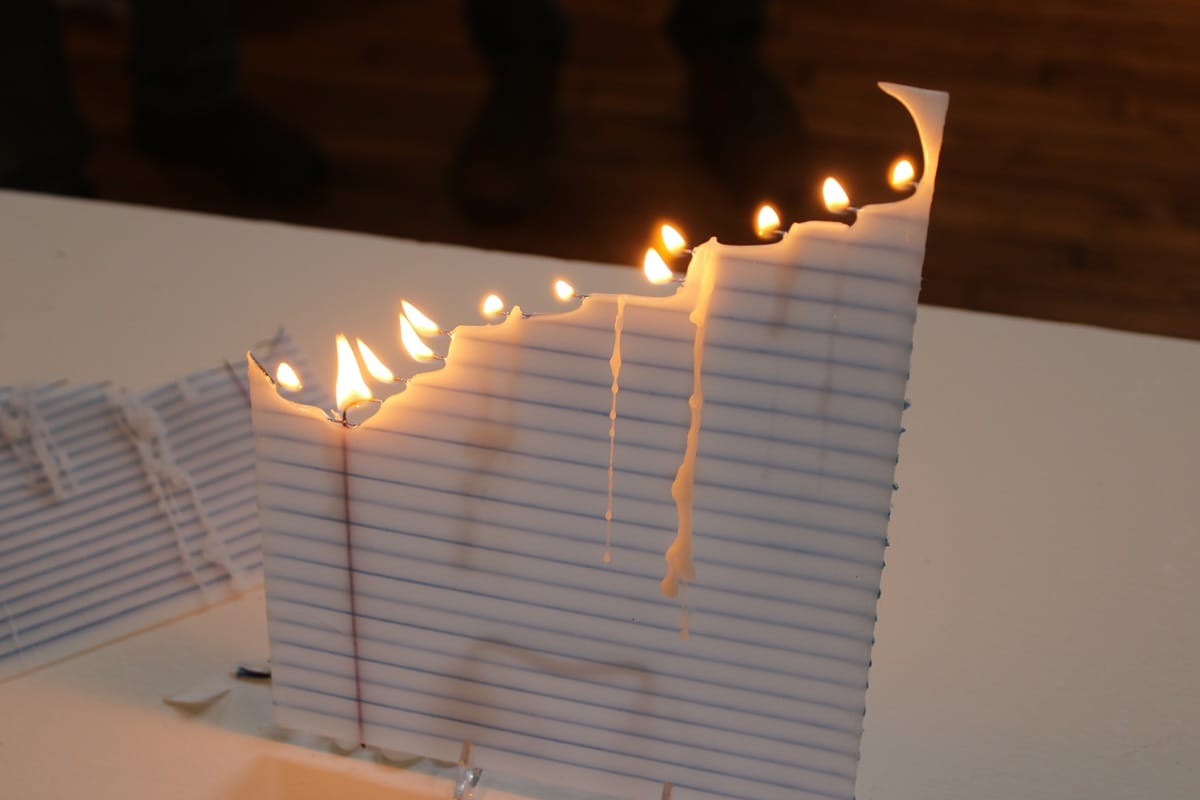
Seeing a piece of “paper” burn is a difficult image for me. As the rapper Prodigy put it, “I put my lifetime in between the paper’s lines.” That goes for me too. I don’t exist without writing, and I can’t write without something to put words on.
Of course, technology has changed how I communicate; I don’t think I’ve published on paper professionally in over a decade. But I still write on paper every day, taking notes for articles, jotting down story ideas, venting into an impromptu journal. I can’t help but see my paper in the gallery, and it feels like memories are going up in smoke along with the parchment.
As Kashani pointed out though, the point of the gallery is not the paper; it’s the lines. There probably is no better visual metaphor for escaping the controlling influence of others than setting lined paper on fire.
Don’t the lines mean something too? After all, if I don’t write my words in straight, sequential lines, it becomes extremely difficult to understand my meaning. The style of writing I engage in has a certain set of rules. I’m not writing novels, I write news, and the guidelines there are as unyielding as the blue lines on a sheet of paper. Heck, even the word “guidelines” contains the word lines. These lines exist for a reason.
But what if they didn’t?
I think that question is what I found most challenging about Kashani’s work, because it dared me to think of a world without those lines, and ultimately for myself, without those memories. There’s a lot of great times contained in the thousands of handwritten pages I have lying around my room, but there’s also a lot of pain and sadness. If I burned those, then who am I? If I don’t follow the guidelines of journalism, what am I? How do I define myself if not by the rules?
The other half of Kashani’s exhibit is like a visualization of that question. Four rooms adjacent to the paper room contain large string displays she designed. Kashani has a background in physics from her undergraduate days, and it helped her in building the elaborate structures. Each artwork is made with only two strings, a blue one and a red one (except the last one, which contains two red strings), and were designed for the specific space in which they’re hung.
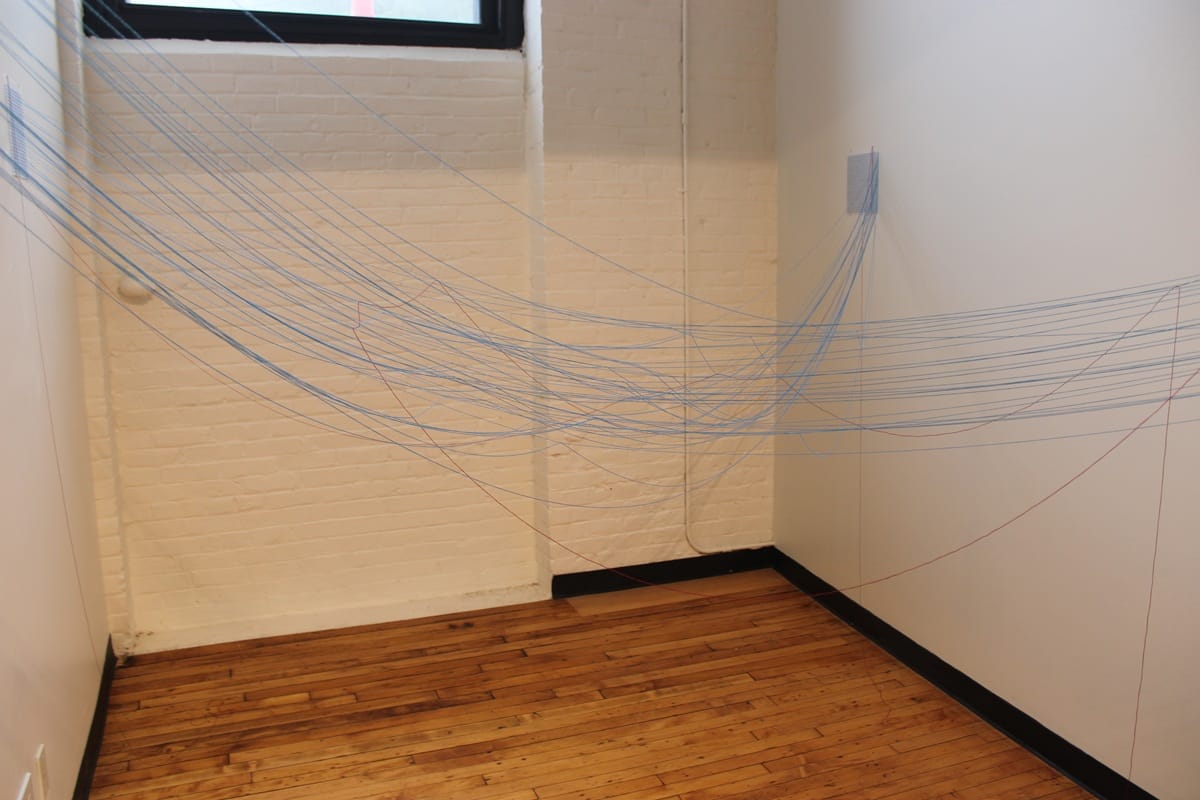
The threads run and connect through sheets of Kashani’s paper, and it felt like she’d designed exactly how I see my life: a series of connections anchored through my writing. It’s hard to imagine burning all of that down. I know that’s not what Kashani is attempting to represent, but it might be what I need to see anyway.
NEXT
Spatial Essays in Room 106 runs through September 24.
Jamil goes to see a new exhibit at the Hartford Public Library.


