Hangawi Talchum performance
정통연희놀이연구소 (Research Institute for Traditional Performing Arts)
Gwangju History and Folk Museum
Gwangju
Sept. 27, 2026
(Jisu Sheen recently moved from New Haven to Gwangju, South Korea, where she’s covering local arts and culture for the New Haven Independent and Midbrow.)
This weekend, a fantastical creature descended from Gwangju's tallest mountain to dance for families celebrating Hangawi, the native Korean name for Chuseok, Korea's harvest holiday. It was the Mudeungsan tiger, borrowing its appearance and moves from the traditional lion dance of Gangnyeong in Hwanghae Province, in what is now North Korea.
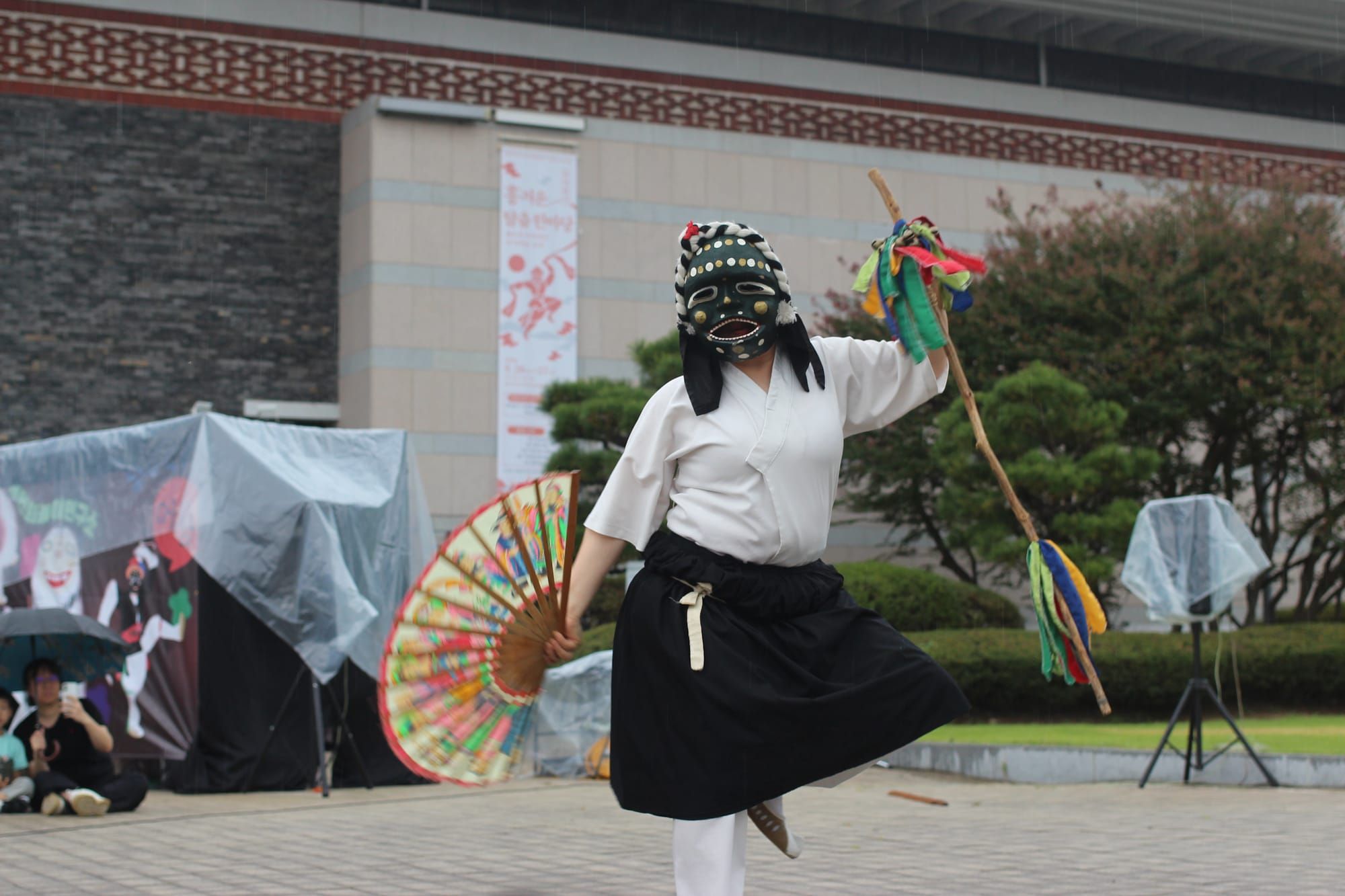
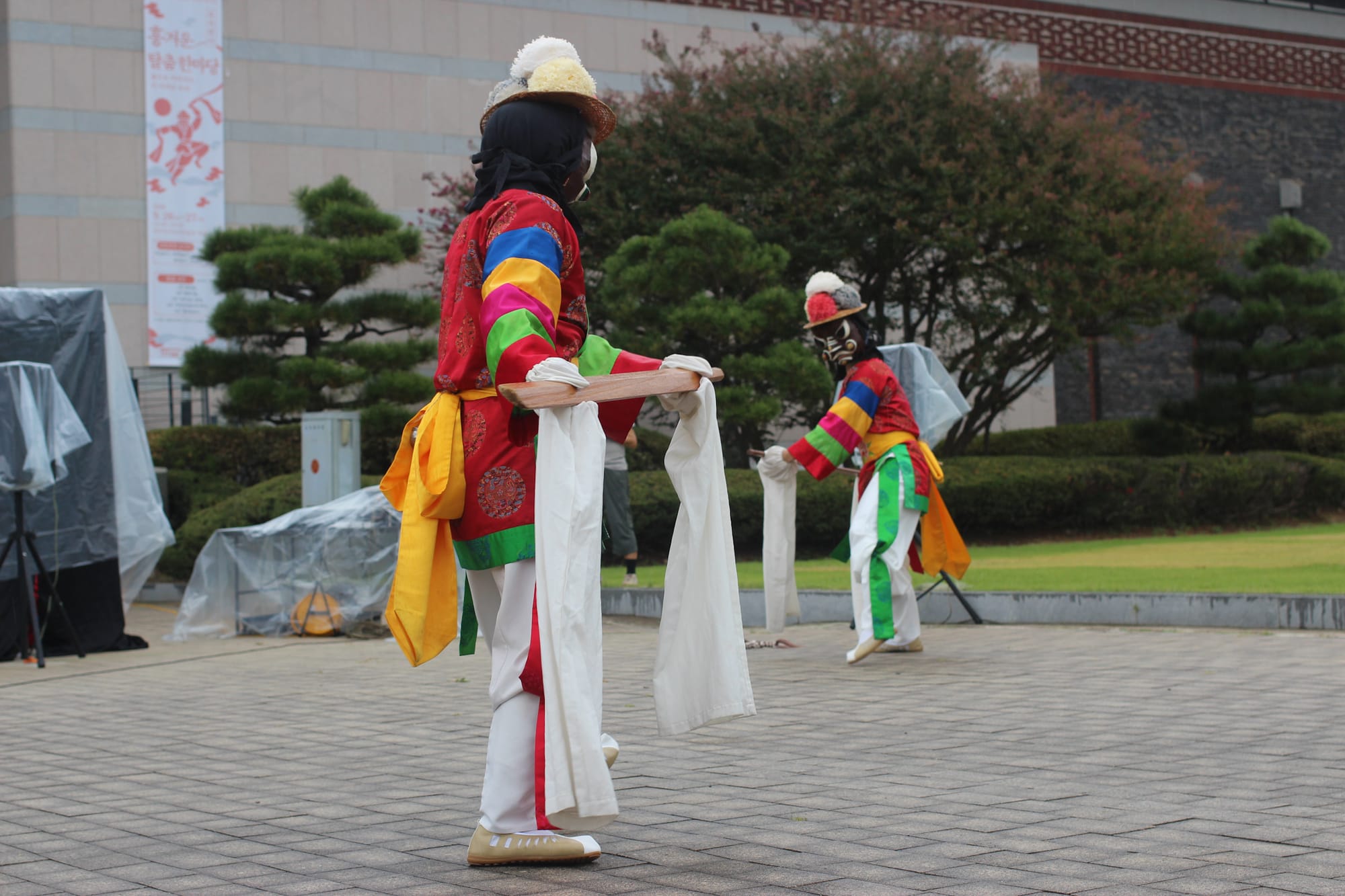
The fictional big cat was part of a performance by Gwangju organization 정통연희놀이연구소 or "Jeontong Yeonhyi Noli Yeonguso," the Research Institute for Traditional Performing Arts. For over 20 years, the group has been performing and teaching talchum, Korean folkloric mask dance, around Gwangju and beyond.
Making its entrance to the sound of live Korean drums, the Mudeungsan tiger greeted the audience and played 'rock, paper, scissors' with its tongue, represented by a human hand popping out from the creature's mouth. Under the tiger's painted smile, ringing bell eyes, and shaggy yarn "fur" were two dancers in fringed white pants, bringing the whole operation to life.
When I entered the museum grounds, walking past the curved branches of Korean pines, I wasn't sure if the festivities would go on as planned. There was a hint of rain in the air. One of the dancers, already in her mask, squatted to shield kids from the drizzle with her unfurled fan as the performance proceeded with its first two chapters. She would come out later to dance and search for a talented tiger, a role the Mudeungsan tiger was happy to fill.
By the time the tiger stomped into the scene, the show had moved inside the museum's doors, a rain relocation that went off without a hitch. Just a few steps beyond the dancers were exhibits of farming implements, clothing, and traditions native to Korea's southern region. To the side were the paintings and sculptural installations of "Devorações do Amanhã: Brasil em Rebento" (Devourings of Tomorrow: Brazil in Sprout) exhibit from the Brazil Pavilion, part of the Gwangju Biennale art showcase currently spread throughout the city.
The musicians in the talchum performance weren't just the background. They participated in the show, in their outfits and position near the dancers as well as their hearty voices. A drummer playing the janggu, an hourglass-shaped drum, shouted back and forth with the "old woman" character as the performance went on.
The dancers showed with their movements that the costume wasn't the only thing that made the Mudeungsan tiger the animal it was. Once the audience was securely on board with the dance-drama, the tiger leaped into another level of pretend. The dancers switched up their role, no longer just performing a tiger but performing a tiger that was playing other creatures.
As the drummers built up suspense, the Mudeungsan tiger showed off its tricks.
Hunching its back into two humps and walking through an imaginary desert, the tiger became a camel. Then the dancers dropped to the floor, flattening the tiger into a snake. The dancer in front held out a hand from the costume's mouth, flicking it like a snake's tongue. After listening to audience suggestions, the Mudeungsan tiger jumped up to become a puppy, rolling over in impressive two-person coordination and wagging its tail.
The talchum performance wasn't just a recreation of a time long gone. With their local mythical creature and enthusiastic crowdwork, the dancers maintained the folk practice of using play to engage with the real world.
When the Mudeungsan tiger faced the crowd for its final stunt before the next chapter of the show, I tried to snap myself out of the realm of make-believe. The tiger was standing on its hind legs, and I told myself, okay, but that's not really an animal; it's two people in a suit.
Then I realized what that meant. Only one pair of legs touching the ground meant one of the dancers was standing on the other's shoulders. The tiger was now twice the height of a human. It turned in a circle, still on its hind legs, and I lost track of the distinction between the magic of Gwangju's mystical mountain tiger and the real-life magic of the performers' acrobatic feats inside the costume.
Sign up here to get Gwangju Midbrow email updates delivered straight to your inbox.