
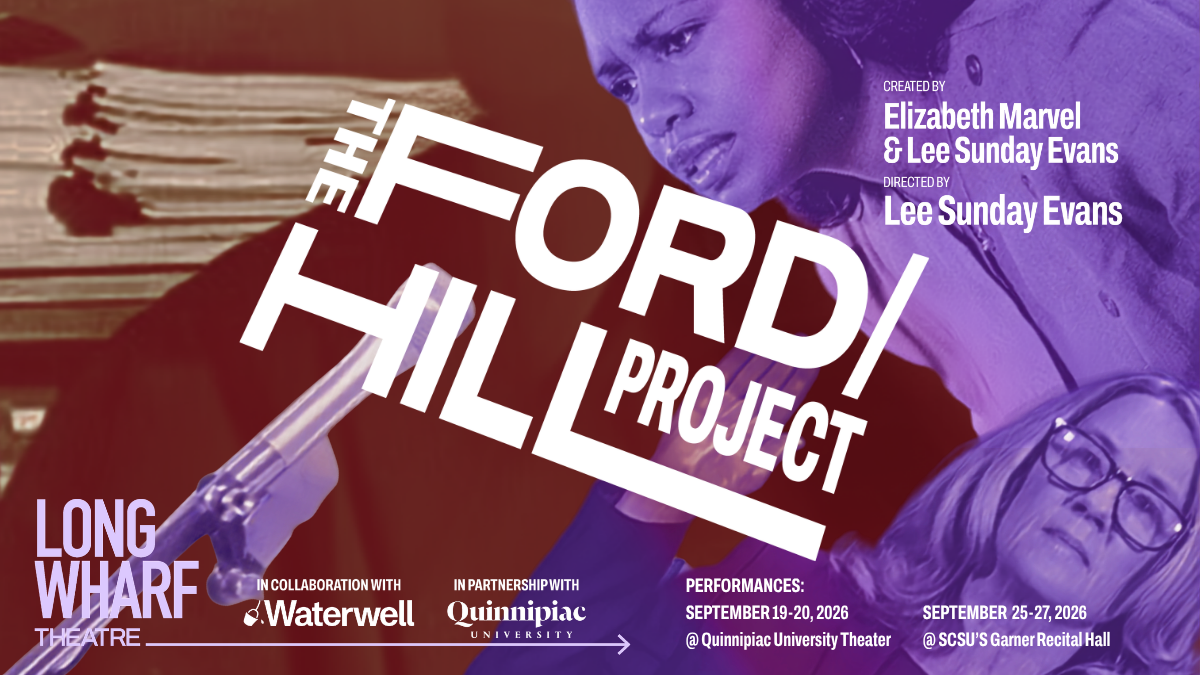
The Ford/Hill Project
Long Wharf Theatre
515 Sherman Ave, Hamden (Sept. 19-20, 2026)
501 Crescent St, New Haven CT (Sept. 25-27, 2026)
“Shakespeare would love this,” one performer notes during Long Wharf Theatre’s The Ford/Hill Project, speaking verbatim Sen. Alan Simpson’s own words from the 1991 Senate Judiciary Committee hearing wherein Anita Hill testified to workplace sexual harassment perpetrated by now-SCOTUS Justice Clarence Thomas.
It is uncomfortable and even emotionally triggering to experience the testimonies of Hill and Dr Christine Blasey Ford, whose words are performed in parallel in this play. But Simpson’s remark illustrates one of the many painful ironies resurrected by this brilliantly evocative piece: our legislature made a dramatic spectacle out of some of the difficult experiences of these women’s lives long before Elizabeth Marvel and Lee Sunday Evans dared to stage them.
The Ford/Hill Project, the first production in Long Wharf’s 62nd season, themed “The State of the Union,” is a specific kind of verbatim play in which each performer has an in-ear monitor feeding them text live, which they are then meant to immediately repeat. In this piece, the “texts” are transcripts of testimonies Anita Hill and Clarence Thomas gave during a 1991 Senate Judiciary Committee hearing that preceded Thomas’ confirmation to the Supreme Court; and transcripts of testimonies of Dr. Christine Blasey Ford and Brett Kavanaugh during the 2018 Judiciary Committee hearing that preceded Kavanaugh’s confirmation to the Supreme Court.
The mechanics of this kind of performance are no easy feat to manage, even before considering how emotionally charged and vulnerable the material itself is; high praise is in order for the entire cast of The Ford/Hill Project. Mayaa Boateng brings a grounded composure to the testimony of Hill, befitting of someone who had then built her whole career around government work and knows that environment well. By contrast, Chirstina Kirk brings a raw edginess to the testimony of Dr. Ford, determined to speak her truth about a sexual assault perpetrated by Kavanaugh, but doing so in a forum that is not entirely familiar or comfortable for her. Amara James Aja and Roderick Hill exude self-righteous indignation as Clarence Thomas and Brett Kavanaugh respectively, as Thomas likens his hearing experience to a “lynching,” and Kavanaugh likens it to something “worse than hell.”
While each of the performers is credited in the program only as the individual listed above, each performance track is, in reality, more expansive than those credits imply. Some statements and questions from the senators and personnel facilitating the hearing are woven into the performance, too. At times, the testimonies of the core four figures are given by someone other than their primary credited performer. These judiciously crafted moments provoke surprising insights: One audience member noted that brief section where Aja and Hill speak Hill’s and Dr. Ford’s testimonies aloud made them wonder what would happen if men were the ones to bring allegation of sexual harassment and assault before the Senate Judiciary Committee.
Lee Sunday Evans’ direction of the piece, which she co-created with Elizabeth Marvel, serves to magnify and interrogate the dynamics of identity and power that are reckoned with in The Ford/Hill Project. On the nine-chair set, reminiscent of the nine seats on the U.S. Supreme Court, Evans’ staging features a series of simple, still, and symmetric tableaux, arranged to maximize performer eye contact with the audience.
The staging keeps the audience focused on the text of the testimonies themselves and the inherent power dynamics that exist between the performers giving them. The cast of four includes one Black woman, one Black man, one white woman, and one white man. Evans evokes mountains of meaning from the pairing of differently gendered and racialized bodies onstage, especially in the moments where different combinations of privilege and power deviate from the original identities of the individuals in the transcripts.
Even while knowing the synopsis of the The Ford/Hill project going in, I found the piece to be an unexpectedly intense experience. Seeing the news headlines is a wholly different experience from having the testimony shared live directly in front of you. While I knew the circumstances of the 2018 hearing with Dr. Ford pretty well, I knew far less about the 1991 hearing. I was therefore unprepared for Boateng to stand in front of me and reveal through testimony that Hill and I share a birthplace, Okmulgee County, Oklahoma.
Thankfully, the audience is not left alone to tend to the bruises that The Ford/Hill Project’semotional sucker punches may leave. A decompression space is available to audiences before, during, and after each performance. Every performance concludes with a facilitated public conversation with community partners. At my performance, the public conversation was facilitated by social workers Dr. Robert Nesbitt and Rev. Martine Gloria Bruno. Dr. Nesbitt led us in a grounding and guided breathing exercise before the conversation began.
I’m glad that Long Wharf and their partners chose to create that space for the audience to process and unpack The Ford/Hill Project together; it’s an example of the kind of community engagement and community care that reflects the company’s values as it continues to present work in its itinerant producing model. In their curtain speech, Managing Director Meredith Suttles and Creative Producer Jacob G. Padrón lauded the theater as a place to share in a collective experience that can promote dialogue with impacts far beyond any single performance. The Ford/Hill Project easily lives up to that ideal.
The Ford/Hill Project runs through Sept. 27; tickets are available here. Tickets are free for students K-12, and $15 for college students.


