
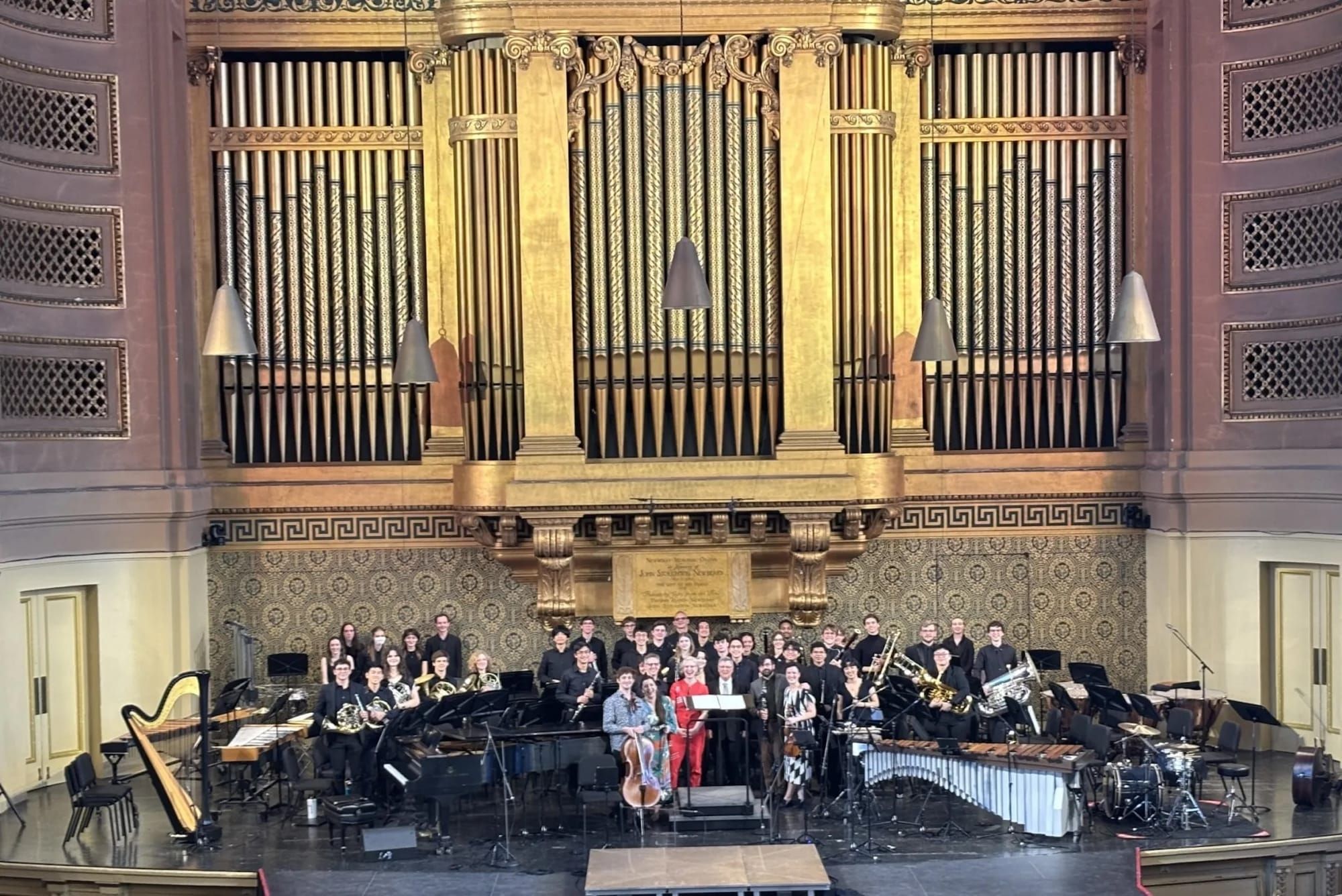
Yale Wind Ensemble featuring Eighth Blackbird
Woosley Hall
New Haven
Nov. 15, 2026
As Matthew Duvall, Eighth Blackbird’s percussionist, switched from striking the xylophone to beating the drums, the wind instruments joined in, and a grand wall of sound ascended in Woosley Hall.
The rest of chamber ensemble Eighth Blackbird stood at the front of the stage, each playing their instruments with fervor. Maiani da Silva’s movements were gracefully precise as she swept her bow across her violin’s strings. Zachary Good bent at the knees, swaying, as he coaxed notes from his clarinet.
Lisa Kaplan’s fingers flew over the piano keys, her head shaking in time with the rhythm. Aaron Wolff seemed to vibrate with the sonorous notes streaming from his cello and Lina Andonvoska’s upper body bobbed to the tune weaving from her flute.
With the accompaniment of the Yale Wind Ensemble, the lush sound in the ornate space swelled to cinematic heights. Their playing was so clean it sounded like a highly produced recording.
After all, Eighth Blackbird are four-time Grammy Award winners. It was awe inspiring to witness their virtuosity at Sunday’s performance.
Eighth Blackbird joined Yale Wind Ensemble (formerly Yale Concert Band) to perform the concerto “Vital Sines,” which was commissioned by the US Navy Band and composed by the Grammy-nominated Viet Cuong. Called “wildly inventive” by The New York Times, Cuong’s work has been performed all around the world.
Based in Chicago, Eighth Blackbird was founded decades ago by artistic co-directors Kaplan and Duvall. The sextet is known for pushing the boundaries of classical music, shaping new soundscapes. In addition to performing all over the world, Eighth Blackbird has initiatives such as the Blackbird Creative Lab, a professional development program for artists. Cuong was actually a Lab Artist in 2017 at their first intensive for the program.
The title “Vital Sines” is a play on the phrase “vital signs,” as Cuong’s father was gravely sick in the hospital when he wrote it. Cuong would hold his father’s hand in the hospital and feel a response when he played his music. The song is dedicated to his father’s memory.
In addition, in the musical sense, sine waves are the purest waveform in audio, containing only a single frequency with no harmonics or overtones, resulting in a smooth, clean tone.
Eighth Blackbird has played “Vital Sines” with over 30 different bands all over the country, fitting as Cuong grew up as a band kid. What makes the concerto so special is that Cuong wrote it with an intimate knowledge of each ensemble member’s playing style. Their parts in the song were made specifically for them. They performed as if they cherished the privilege.
As they played, bright notes soared over the audience, pealing around blocks of intense chords. At one part, the sound turned sparse with only bell-like notes ringing out in a hypnotizing rhythm. Then the drums kicked back in, adding a grit that darkened the edges of the song and undergirded by the forceful bellows of the wind instruments.
The sound eventually meandered down a serene route, the xylophone adding an ephemeral flair. Then staccato notes rang out as the music faded before it swelled again, sounding like a wave overtaking the room. Throughout the song, there were brief pauses in between chords that built up anticipation for the melodies that followed. “Vital Sines” had a rhythm like a pulse in its cyclical nature. The song conveyed a sense of bleakness undergirded by hopefulness, like the oscillation of circumstances that comprises life.
“I’ve been dreaming about a collaboration between my two work worlds,” exclaimed da Silva, Eighth Blackbird’s violinist. da Silva, who recently released a solo album, has been a Yale University professor of contemporary chamber music performance since 2021. She made sure her bandmates took full advantage of Yale during their six-day residency.
In addition to a performance with Yale Symphony Orchestra, the world class musicians attended seminars and classes, coaching students.
According to da Silva, a concerto grosso such as this, with multiple soloists and a larger band, is rare. And “Vital Sines” was not an easy piece to put together. “It’s challenging for [the students]. They learn many, many, many new things.”
Judging by the seamlessness of the performance, the students learned well.
As the song came to a close, the strings gently faded and the clarinet’s notes softened, leaving a single, luminous note to ring out in the final moments.
The audience rose in applause.
“We always hope that the response is that we move people. That is the hope of any artist,” said da Silva.
Such is the transcendent power of art. Transforming a composer’s private loss into a profound display of collaboration and collective expression.


