Embodied Coloniality Open Discussion
Untergang Books
Gwangju
Aug. 2, 2026
Jisu Sheen recently moved from New Haven to Gwangju, South Korea, where she’s covering local arts and culture for the New Haven Independent and Midbrow.)
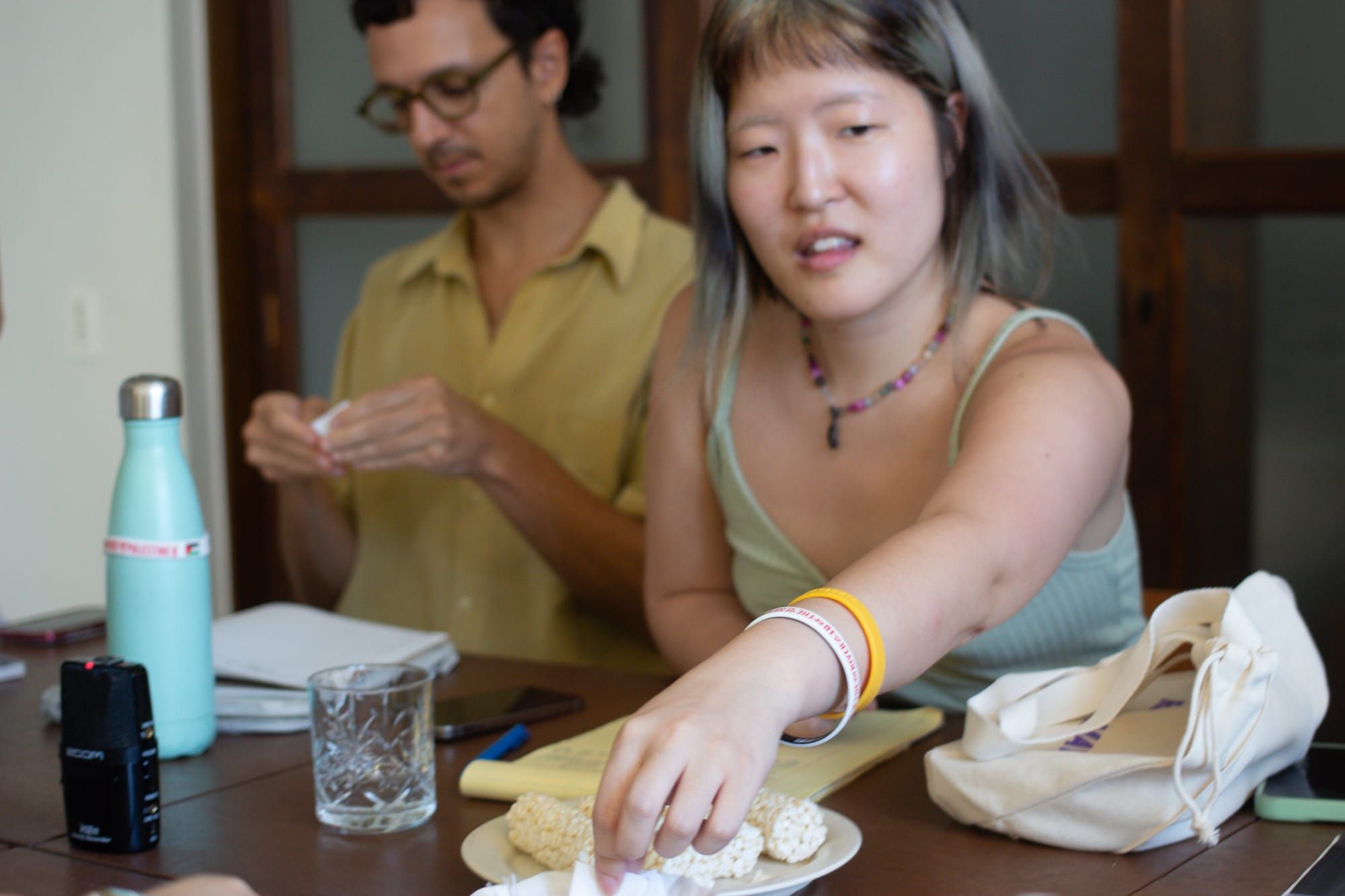
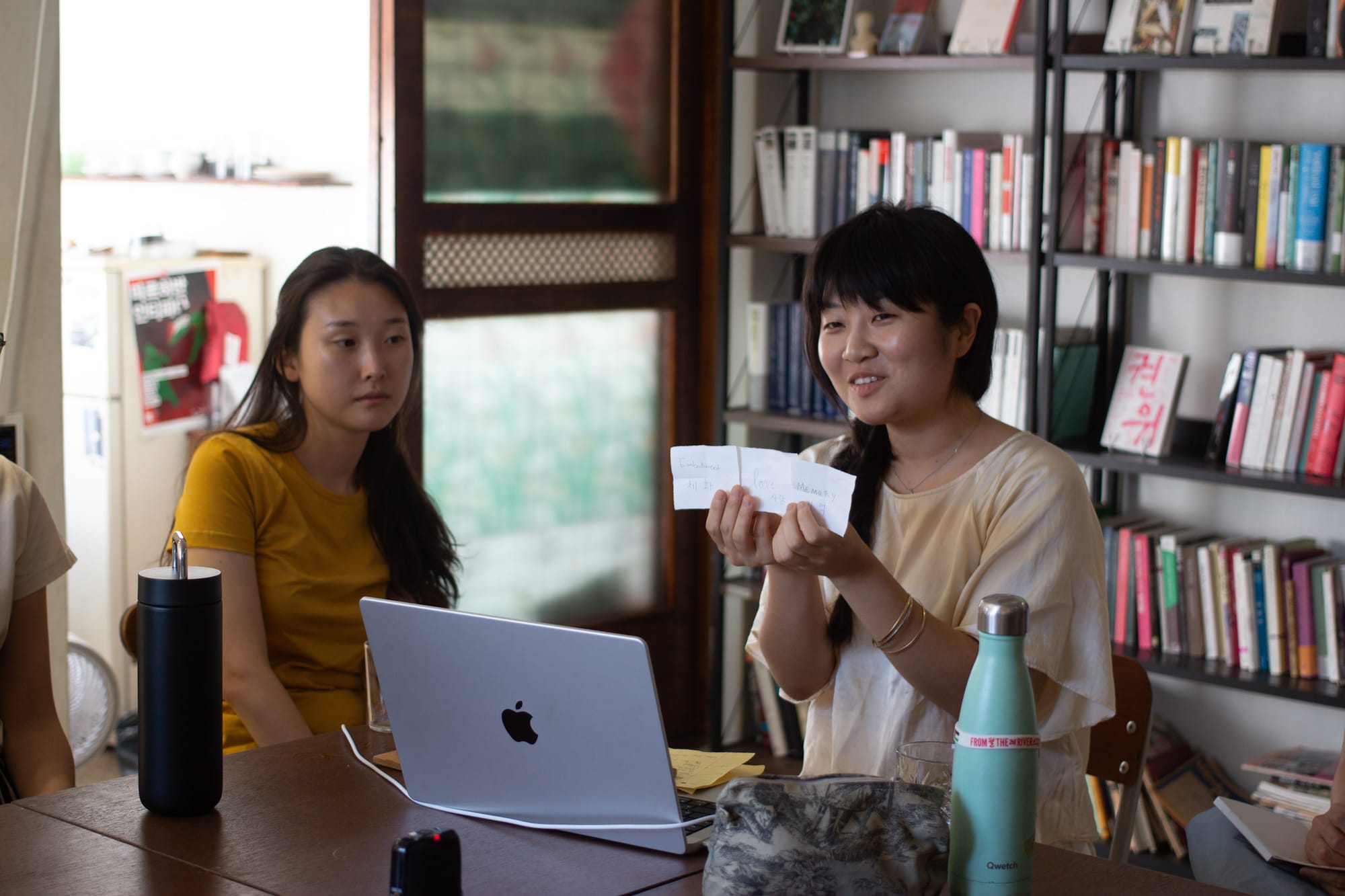
In a small bookstore of radical literature and philosophy on a quiet corner of Gwangju's Buk district Sunday afternoon, a dozen people sat around a table, speaking in multiple languages about colonialism, memory, and what it means to keep records across generations.
French artist Franck Blais paused while explaining his views on the subjectivity of archives. He searched his mind for the right words in English.
Marwa Manai, a theater artist from Tunisia, suggested Blais say it in French. So he did, and Manai translated his message to English.
"Who is creating these archives, for what reason, in what context?" she began.
Korean theater artist 우지안 (Woo Jiann) listened in. After Manai transmitted Blais' conclusion about how an archive "can continue to be revisited from our current position," Woo repeated it in Korean.
The moment wasn't a planned performance, but it worked like one, illustrating Blais' point as his words traveled from one set of language rules to another. It was the quickest way to establish understanding among the assembled group.
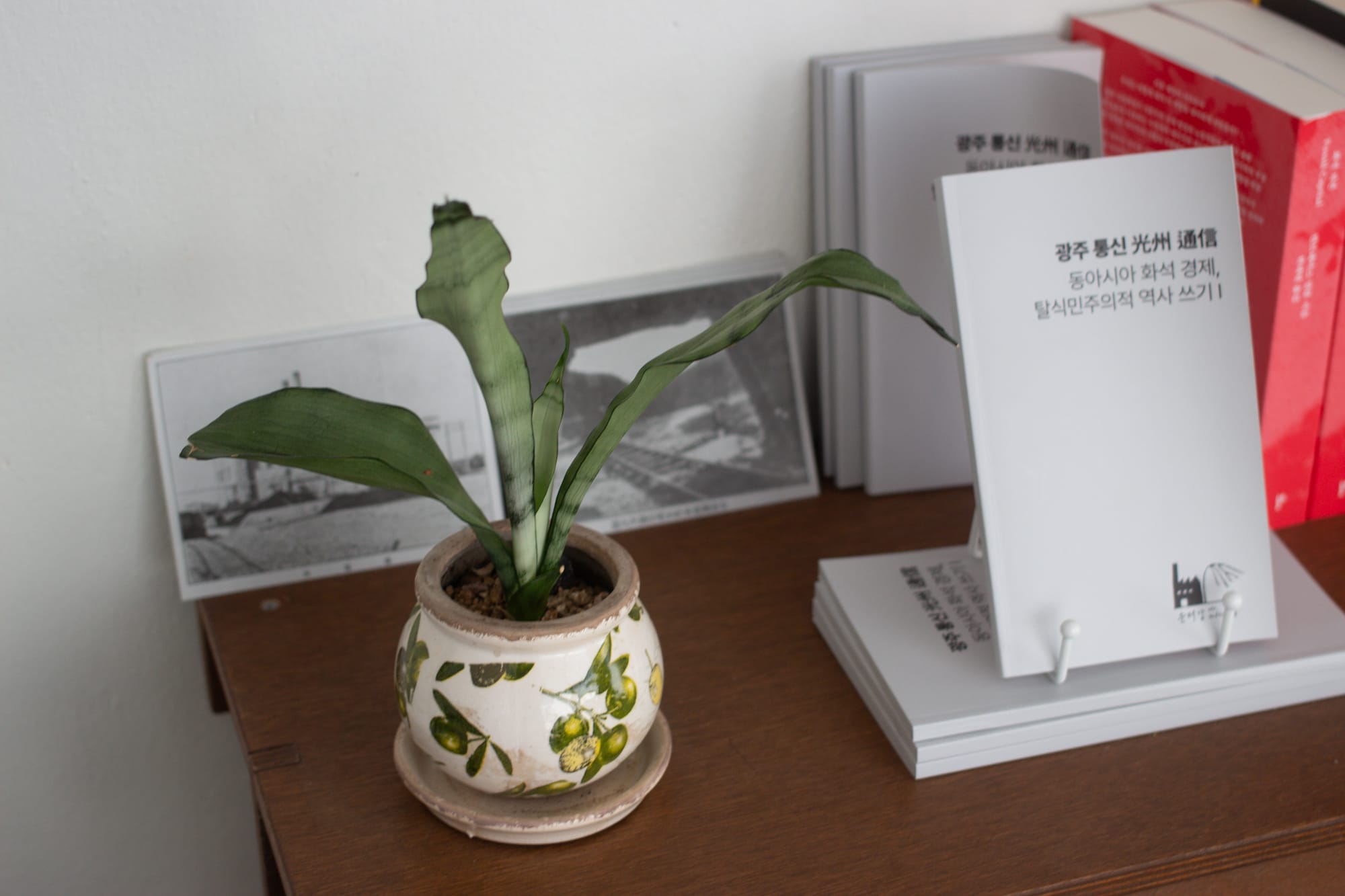
Along the shelves of the bookstore, called Untergang Books, I recognized the names of authors Mahmoud Darwish, Ghassan Kanafani, George Jackson, and Angela Davis. There were pamphlets and zines on solidarity with Palestine from Japan, China, Aotearoa (the Māori name for New Zealand), and Korea. Some of the attendees were artists-in-residence staying in another district; others were Gwangju citizens, interested in ecology, labor, and their city's hard-fought history. The hosts were a group of four performing artists: Manai, Woo, Romain Beltrão Teule and Nowwar Salem. They had just wrapped a series of workshops in Seoul as an artistic laboratory they called Embodied Coloniality.
Sunday's discussion started with a word association exercise. The hosts had written words on strips of paper and placed them in a bowl. Everyone chose from the bowl and, in groups of three, discussed how their words might relate to one another.
My group's words were: silence, lies, and trauma. I looked at my two partners. Need we say more?
We forged ahead.
"You transmit the trauma by silence," said French Armenian fashion designer and sculptor Karine Arabian. Lies can, at least, invite a fight. When you're met with silence, "you don't know, and it becomes bigger and bigger in you," she continued.
Salem, a dancer from Palestine, agreed, noting the lies and silence from global media about her own country.
Arabian described a three-generation pattern from silence to curiosity. Two generations before her, many survivors of the Armenian genocide did not want to speak about the horrors they'd experienced. Then came their children, who started to ask questions. Now, Arabian says she is in a generation of descendants who "try to think about it."
Our conversations throughout the afternoon continued to flow like this, from the personal to the geopolitical and back again.
Later, discussing record-keeping among the larger group, Salem talked about a Palestinian activist who takes videos of houses around Jerusalem and other cities in occupied Palestine, asking people across the world, "Do you know if this house belongs to you?"
Someone might reply, "Ah, this is where my grandmother used to sit," Salem explained. They could then compare the video to their own family photos and tell stories about their relatives' lives before the Nakba, the mass exile of Palestinians by Israeli forces in 1948.
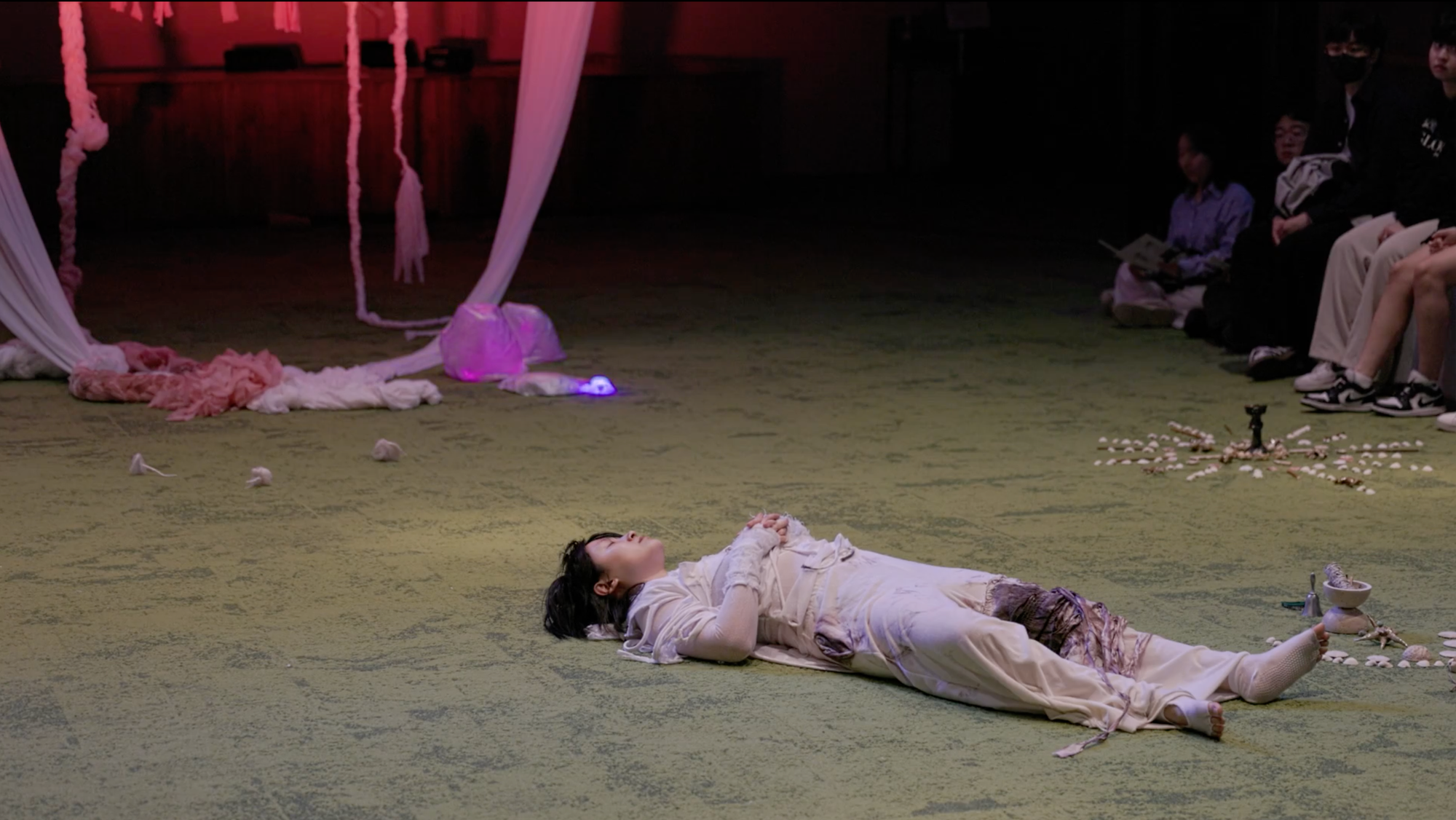
Time stretched and folded inside Untergang Bookstore. Woo and artist Oh Sera, meeting for the first time that day, realized their art had met months before. In May of last year, Oh's ceramic pieces took the stage in an experimental play Woo directed, called "긴 밤 지새우고," or "Awake Through the Long Night." Though both artists are based in Seoul, it took coming to this bookstore in Gwangju to finally cross paths.
The conversation narrowed into the practice of keeping records. It wasn't lost on us that we were discussing this in Gwangju, where records are a sensitive topic; the facts of the Gwangju uprising and subsequent massacre in 1980 still face systematic denial by those who have a stake in undermining the role of protest in modern Korean democracy.
Untergang Books owner 해수 (Haesu) read an excerpt from an essay she wrote about living in "An Age of Archive." Here in this bookstore, theory and practice seemed to move together. Artists were reporting on projects underway in the world, and theorists were proposing frameworks for the future.
As the group shared parting thoughts, Arabian emphasized the importance of having archives at all. I thought back to what she shared about the Armenian genocide; records were burned, and generations later, it can be hard to even know what was lost.
"You need to relate to the history," she said. "Your history and the world history."
Sign up here to get Gwangju Midbrow email updates delivered straight to your inbox.