
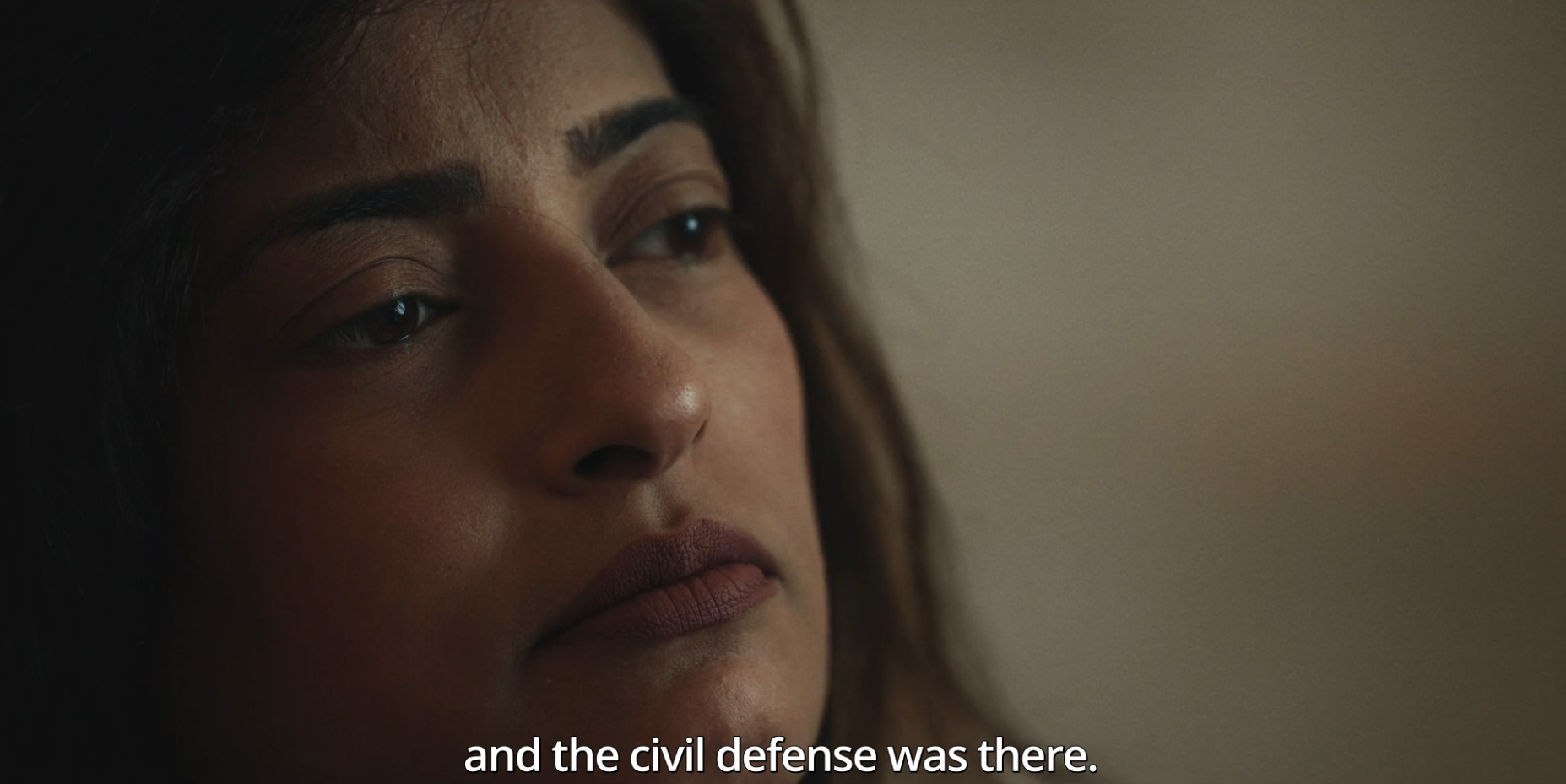
"Inside Gaza," "Toxic Fumes: Gaza Under Seige," "Sudan: Narrowly Escaping Death," and "Who Killed Shireen?"
Screening of Winners of the 2026 Hinzpeter Awards
Gwangju Independent Film Theater
Gwangju
Nov. 7, 2026
(Jisu Sheen recently moved from New Haven to Gwangju, South Korea, where she’s covering local arts and culture for the New Haven Independent and Midbrow.)
We live in an era of well-documented horrors, one where absorbing reality is enough to shake the core of a viewer's being in a way fiction could be condemned for. Still, making the effort to understand may be less taxing than accepting the logical backflips of the status quo.
In the documentary "Inside Gaza," photojournalist Mohammed Abed recalls capturing an image of a father in Palestine holding his dead son.
The Israeli army claimed the body was a doll. The next day, Abed was overwhelmed with calls from the Washington Post, the New York Times and the Wall Street Journal, asking for evidence the boy was not a doll.
I watched "Inside Gaza," along with three shorter documentary films, at the Gwangju Independent Film Theater this weekend in downtown Gwangju, one of two free screenings of the winners of this year's Hinzpeter Awards for video journalism.
The Hinzpeter Awards, organized by the May 18 Foundation and the Korea Video Journalist Association, are named after German reporter Jürgen Hinzpeter, who risked his life to capture footage of the 1980 Gwangju Uprising. I think of him as a figure in the middle of a press lineage.
Before Hinzpeter were the Vietnam War photographers. They published photos like "The Terror of War," where Phan Thị Kim Phúc runs from napalm burns—images that shocked the public, contributing to international outcry against the war.
After Hinzpeter came Palestinian journalists like Wael Al-Dahdouh, Anas Al-Sharif, Ismail Al-Ghoul and Hind Khoudary. One by one, their family members and colleagues were killed by the Israeli army. In the case of Al-Sharif and Al-Ghoul, they themselves were targeted and killed. At times, watching the news reports, I felt like viewers like me must be out of our minds for even expecting journalists to go through this level of violence. Why is one photo not enough? Was it ever?
The dead boy in Abed's photograph does not look like a doll. This is beside the point. Once major U.S. newspapers questioned the photo's validity—and what kind of proof would even be sufficient?—the story was derailed.
Throughout the afternoon screening in Gwangju Independent Film Theater, the framework of concern itself came into question.
"Don't ask about danger," says Tahseen Reehan in short film "Toxic Fumes: Gaza Under Siege." He is one of a group of people burning plastic to produce gasoline and diesel in Gaza. He knows it's harmful to the environment and his own body. "But it's not as dangerous as the bombs that fall on us!"
Another short, "Sudan: Narrowly Escaping Death" shows the compounding violence of genocide; several crises, each one devastating on its own, are layered on top of each other. In October of last year, the RSF (Rapid Support Forces) militia, backed by the United Arab Emirates, killed thousands in the three days following their capture of the city of el-Fasher. Sudan now has a displaced population of 14 million. The film interviews survivors, including thirteen-year-old Otour, one of a "generation of orphans" resulting from the genocide. She recalls her mother's words telling her to take care of her little brother.
"Inside Gaza," which focuses on journalists in Gaza, shows Al-Dahdouh continuing his reporting work even after the murders of his wife and children. There are scenes of press at funerals, in their press vests, there both to broadcast and to mourn.
Near the end of the film, Abed describes taking pictures he knew would not be published because they were, in his words, "so difficult." Still he, as a human, was forced to see what was in front of him.
"I was taking pictures, but I didn't know why. Was it to witness?"
He winces, explaining that the interview is making him relive the images in his mind.
I walked away from the screening less haunted by questions about the possibility of jolting a public into action and more certain of the importance of witness as a bare minimum. The fact that the films are shocking is a reflection of the genocide rather than the reporting.
The absurdity of profitable destruction in our current world means atrocities are fueled and refueled for years. Enough time to make documentaries, and for those documentaries to win awards.
In the case of the Hinzpeter Awards, the recognition is more than an accolade. It is a way of connecting the past and future. And of, at every level, getting a sense of what is real.
Sign up here to get Gwangju Midbrow email updates delivered straight to your inbox.


