
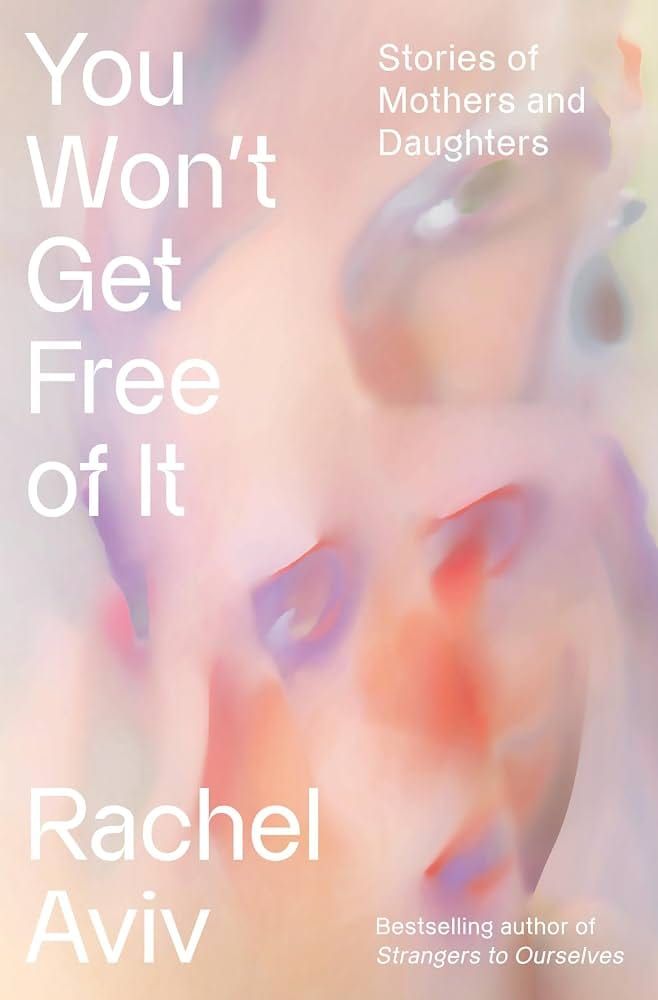
“You Won’t Get Free of It”
By Rachel Aviv
Alfred A. Knopf
“The essence of growing up is to play hide and seek with one’s mother successfully,” novelist Yiyun Li observed in her novel, “Where the Reasons End.”
This quote struck such a chord with Rachel Aviv that she put it in her most recent book, “You Won’t Get Free of It,”a collection of stories about mothers and daughters and their relationships collected and revised from her work as a staff writer at the New Yorker.
“I wrote some of these stories feeling, existentially, like a daughter,” Aviv writes in the preface. “And now I have returned to them with a different identification. It was as if I had failed to see the drama on the mother’s side, too — her particular longings and humiliations and needs.”
One story follows Hannah, a woman who disappears during her fugue states when she doesn’t remember who she is and the mother who tries to find her each time. Another is about a renowned writer who ignores and recasts her daughter’s sexual trauma for career success.
Aviv is no stranger to writing about mental health and complicated relationship dynamics. In fact, “You Won’t Get Free of It” feels like a spiritual sister to her first book, “Strangers to Ourselves” with six originally reported stories about people living with mental health conditions that don’t fit neatly into a box and the way it impacts the people around them, including her own. In both, Aviv carefully researches her topics and paints complex portraits of families going through hard things like mental health crises, sexual abuse, and breaking down in the face of societal pressures.
In “You Won’t Get Free of It,” the pieces were written as early as 2011 all the way to 2025, which begs the question: What is the benefit of collecting and reprinting them in a book now? In Aviv’s case, the revisiting gave the opportunity to rewrite and edit her work from before she became a mother. She reinterviewed and reworked her work, something few writers get to do after publication, and gets to set the record straight.
We all have blind spots when it comes to our family. When one is a child, the blindspot might be to the fact that our parents are people living life for the first time just like us. They are not the arbiters of all knowledge, not all too long ago, they were in our shoes. But as we age, there’s more and more lore that we uncover. Our parents lived whole lives before us, and sometimes even after running what feels like an impossible distance from our parents and their choices, we look down and find that we are more alike and more intertwined than we’d like to admit.
Aviv’s revision feels less pointed to the news cycle and more centered on the relationships. In an essay about a Filipina migrant worker named Emma who moved to the U.S. to take care of other people’s children, leaving her own behind, Aviv chooses to rework the ending to be more open ended, hopeful for a reconciliation between Emma and the daughters she hasn’t seen in 16 years instead of a quote from Emma about how she hopes that her daughters don’t follow in her footsteps because she wasn’t there to teach them how to do housework.
What happens when real hurt happens but you can’t get free of the relationship? Aviv’s writing is generous and nonjudgmental, yet it holds people to account for their behavior. Aviv is a generous and astute storyteller who has a gift for telling hyperspecific stories that point to deeper truths. Even the women who make what could be considered unforgivable choices are fleshed out and complex as Aviv lays the impact of their choices bare, and in doing so, she gives the reader permission to look at the complicated relationships in their own lives, the times that they’ve been failed and have failed. There’s something vulnerable about being seen, especially at your worst, but there’s something healing about knowing that other people are messed up and just figuring it out too. We might not get free of it, but maybe we can live with that.


