
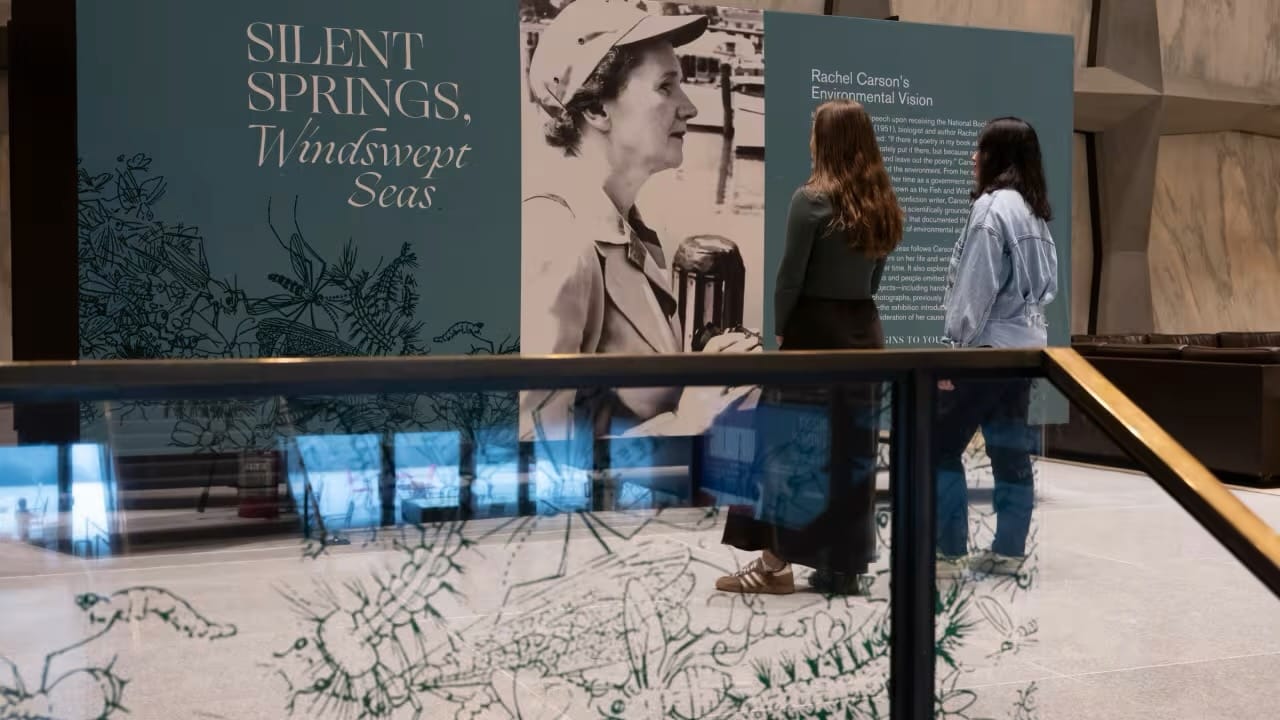
Silent Springs, Windswept Seas
Beinecke Rare Book and Manuscript Library
New Haven
Through Oct. 4
We remember Rachel Carson as many things — a scientist, an environmentalist, an activist. In Silent Springs, Windswept Seas, running now at the Beinecke Rare Book and Manuscript Library through Oct. 4, we understand just how much she was also a writer.
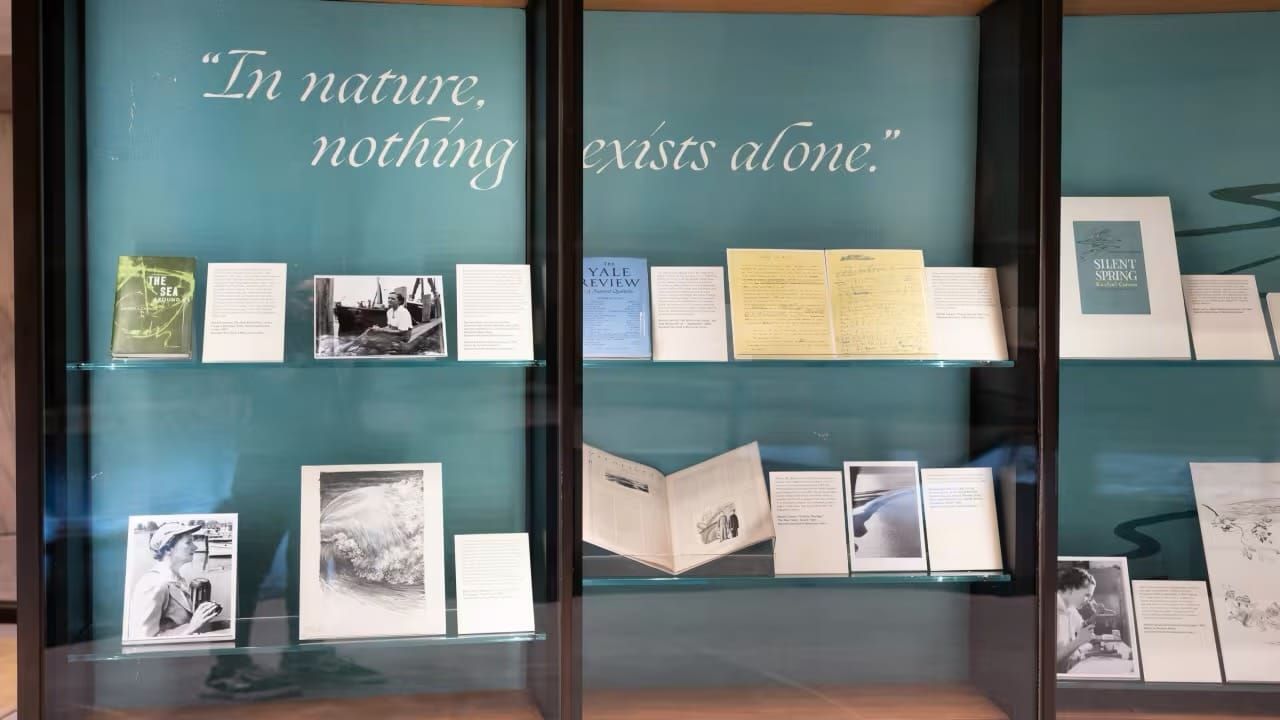
"In her acceptance speech upon receiving the National Book Award for The Sea Around Us," the show states at its beginning, Carson explained that "if there is poetry in my book about the sea, it is not because I deliberately put it there, but because no one could write truthfully about the sea and leave out the poetry." Making ample use of the Beinecke's astonishing collection of materials from the Rachel Carson Papers — letters, manuscripts, articles, and voluminous other artifacts — the exhibition offers a look at Carson's life and work that shows how a career dedicated to words can change the world.
Carson's mother helped her form "a deep, lifelong bond over the wonders of the physical world. By age ten," the show's text states, "Carson had already begun exploring her creative side by writing stories about the outdoors, for instance a prize-winning essay she wrote for the children's magazine St. Nicholas. In a speech years later, she noted, 'I can remember no time, even in earliest childhood, when I didn't assume I was going to be a writer.'"
The exhibition bears this out. It gives us Rachel Carson the scientist, who "distinguished herself as a brilliant and avid researcher, in time becoming a scientist of the first order with a rare talent for distilling complex technical matters into clear and vivid prose." But it also shows Carson as a very active and productive working writer, in a mode that writers today will easily recognize.
At the Pennsylvania College for Women (now Chatham University), she switched her major from literature to biology, explaining to her laboratory partner, "I have always wanted to write. Biology has given me something to write about." She graduated in 1929 and spent six weeks at the famed marine biology lab in Woods Hole, Mass. She then got an MA in zoology from Johns Hopkins University. While a student there, she started freelancing for The Baltimore Sun. In 1935 she got a job as a writer in the U.S. Bureau of Fisheries. One essay she wrote for that job, though, she got placed in The Atlantic. She published her first book, Under the Sea-Wind, in 1941.
Having established herself at her Fisheries job, she parlayed that into "permission for a cruise in 1949 to Georges Bank in the Gulf of Maine" — even though "no solo woman was permitted on board government research ships at the time." Material from that trip along with previous research she'd done became The Sea Around Us, her second book, published in 1951.
The Sea Around Us — the second in a trilogy of books about the sea she wrote — "launched her writing career" and earned her a national readership, the show states. Its success was due in part to her writing hustle. "Magazines and magazine publishing played a critical role in Carson's career," the show states. "In the mid-twentieth-century United States, a well-placed magazine article could change the world, and Carson knew it." She "and her literary agent, Marie Rodell, had extraordinary success at placing Carson's work in magazines." She published widely: "whether appearing in a literary journal or a consumer magazine, a glossy or a tabloid, Carson's writing seemed to be everywhere."
So The New Yorker and other magazines had already serialized The Sea Around Us "a few months before the book was released, earning Carson more money than her annual government salary at the U.S. Bureau of Fisheries." The book then "went through six printings, each of which sold out for a total of a quarter of a million copies, and it was translated into numerous languages. It won the National Book Award and earned Carson a Guggenheim Fellowship." The New Yorker serialized the entirety of her next book, 1955's The Edge of the Sea, the last in the trilogy.
All this set the stage for Silent Spring to have the impact it did when it was published in 1962. The show illustrates that it wasn't just the high quality of Carson's research and writing, or that she was telling the truth. It was that she was also at the top of the writing game, decorated, respected, financially successful—or put another way, powerful, and ready to deploy that power to serve change.
The exhibition's artifacts reveal other facets of Carson as working writer. Her projects had long germination stages. "In a spiral notebook for Silent Spring," a note states, "Carson jotted down sentences, trying to sum up the big ideas at stake, for instance: 'Violence toward nature is no less evil than violence toward fellow man.'" Also, like everyone else, she didn't get the words right the first time. "Carson's first Silent Spring drafts were prone to cliché," the show states, beneath a page festooned with rewrites. "In this early version, 'Once upon a time there was a town called Green Meadows' was a rhetorical device replaced in the final version by the following: 'There was once a town in the heart of America where all life seemed to live in harmony with its surroundings.'" The exhibition shows, through its manuscript pages on display, how Carson's changes got fewer and fewer over subsequent drafts. She worked it until it was right.
The New Yorker serialized chapters from Silent Spring across three issues in June 1962. In book form it was an international bestseller, published in 20 languages. Her clout as a writer was part of the reason why. But Silent Spring also had its effect because of the way Carson used language, and more important, because she was an excellent scientist telling the truth.
Silent Spring has the surface-level reputation as the book that saved the bald eagle. Yes, parts of it focus on how that species was ravaged by pervasive use of dichlorodiphenyltrichloroethane (DDT), a pesticide used to curb insect populations to make agriculture more productive. But in its lyrical and harrowing language, Silent Spring has a much larger and more terrifying story to tell, about collusion between government and business and the many ways those entities seek their own ends — control, profit, power — at the expense of the environment and human health. As the show states, "given the military origins of DDT, and the ensuing alliance of agribusiness and the U.S. Department of Agriculture in a vast series of aerial spraying campaigns, Silent Spring furnished a vivid critique of what President Dwight D. Eisenhower had called the 'military-industrial complex.'"
The pesticide and large-scale agriculture industries were outraged and campaigned to discredit Carson. The Kennedy administration "joined forced" with her. Carson, at that point in her career, was ready for both. "Life magazine described Carson as 'a shy, soft-spoken woman miscast in the role of crusader,' but Carson did not shy away from appearing on one of the biggest television news programs of the era, CBS Reports," the show states. She made an impression in popular culture, too. Peanuts cartoonist Charles Schulz declared her a "heroine." For the Beinecke show, cartoons are a way to get at some of the sexism that lay beneath support for and backlash against Carson's work. "Many of the more positive cartoon responses to Silent Spring featured women and children, while the more negative ones often featured skeptical male characters."
Carson's book can be understood as marking, and helping shape, a turn in environmental thinking in the U.S., away from contemplation and the preservation of "natural" places and toward political activism to protect the health of all places. As the show points out, "many environmental groups were created in its wake, such as the Environmental Defense Fund, the Natural Resources Defense Council, and Greenpeace, not to mention countless local, community-based organizations. Carson helped usher in a whole new environmental regime, encompassing the Environmental Protection Agency, the Endangered Species Act, and the celebration of Earth Day."
Her thinking feels formative in other ways, too. The idea of global warming was gaining steam in her time; a 1950 article in The Saturday Evening Post Carson saved asked if Greenland was "on the way to becoming as torrid as South Carolina." But Carson was one writer who "seems to some to anticipate our understanding of climate change as human-caused" in "pointing to melting glaciers and other evidence of Arctic warming" — even if she understood it as "cyclical" and "expected another Ice Age eventually to occur."
The show also notes a few of ways Silent Spring's effects weren't all permanent victories. "The 1972 US ban on DDT still left the chemical to the rest of the world market, and decades later it and other synthetic chemicals even made a return," the show's text states. "Both then and since, the use of DDT to combat malaria has been invoked to critique Silent Spring for removing a key tool for public health, especially in the non-Western world." Moreover, while Carson was adept at blurring the line between humans and environment to get people to understand their relation to their surroundings in a new way, the show points out that "her environmental vision overlooked people of classes and races other than her own, whose voices were likewise fighting to be heard," from Latino farm laborers to Black urban environmentalists.
But other people have taken up the fight that she started, and addressed the concerns that she didn't. Given Carson's insistence on science writing as literature, she might have been pleased to see Black feminist writer Audre Lorde put Carson's themes in a different light. "'The Brown Menace or Poem to the Survival of Roaches' offers a powerful metaphor of Black survival in the face of unrelenting racism," the show states, including Lorde's work in Carson's legacy. "Carson had pointed out the ability of insects to adapt to and resist DDT, and Lorde now turned the idea of such survival into an image of Black resilience."
Silent Spring's deeper critique about the damage to the planet in the name of amassing power can seem sharper and more forlorn than ever. Government and business today operate hand in hand and more out in the open than they did in the 1960s. Many of the environmental institutions Carson's work ushered in have been rendered toothless over time, and international environmental coordination has proven elusive. Some of the threats of climate change forecast years ago have manifested themselves already, with greater threats churning on an approaching horizon.
Yet at the same time, environmental problems are closer to the front of the public mind than they were in the past, and in lieu of dramatic action from governments and international organizations, people are turning more and more to local and state-level solutions. Carson's legacy won't be borne out in a single global document that changes the way we behave; would the author of Silent Spring have believed that possible anyway? It might instead find fruition in a million small actions, a million gardens, one person at a time.
That's where Carson's work, and the work of her intellectual and artistic descendants, have a role to play, to give voice to the struggle and the hope ahead, and the possibilities for change that lie in connecting with one another. "As an inheritor of Carson's legacy, the writer and activist Terry Tempest Williams visited Yale in 2006 to give a speech on the occasion of the Beinecke Library's first major exhibition of materials from the Rachel Carson Papers," the show states. "Her notes for her talk convey an artistic quality all their own. 'How did she do it?' Williams asks. 'I believe she did it through love — Do we dare to speak this word?'"


