
Interwoven: Sounds and Visions from the World’s Refugee Camps
Yale Institute of Sacred Music
New Haven, CT
Through Dec. 3
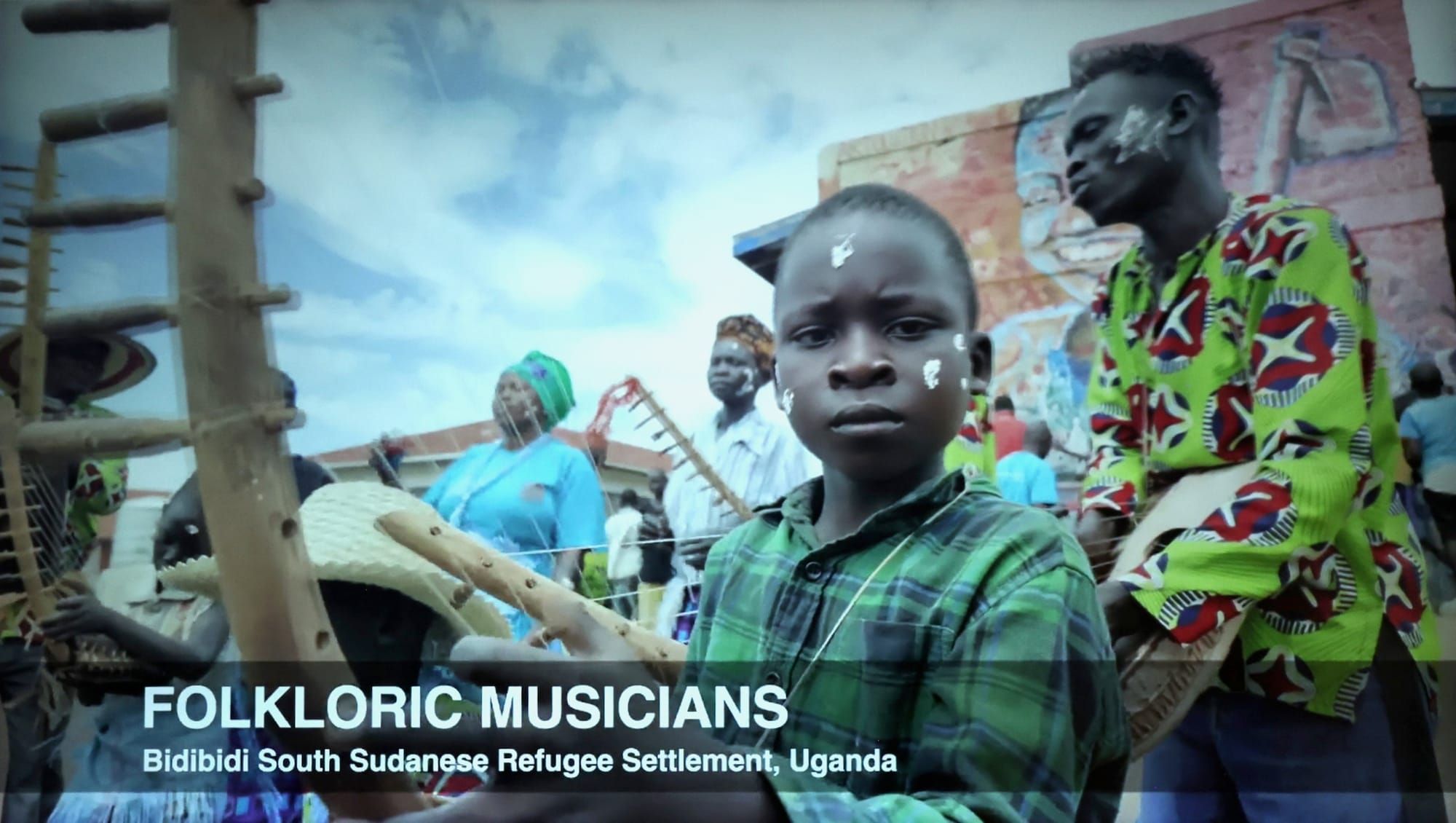
The music pumping through the headphones is all happiness: driving rhythms, pulsing chords, a single voice calling out, a chorus of voices singing a harmonizing response. The group of musicians, at a refugee camp for South Sudanese people in Uganda, stand close together, moving in time to the music, and the camera lets us see everything up close: the musicians' fingers working the strings of their instruments, the gleam in the singers' eyes. It's all full of light; even the camp behind them is clean and tidy. It looks organized, well-run, and there's no reason to think it isn't. Some refugee camps are.
Then the camera comes into the orbit of a kid in the band. He is playing right with the others, but as soon as he is aware of the lens, he stares right into it, and doesn't let go. His expression is ambivalent at best. He doesn't seem to like being filmed. And in an instant, we become aware of the camera too. How close was the cameraperson to the musicians? How close was the lens to their faces? How intrusive did it feel? The camera is, in turn, a proxy for us. Why do we get to see this? What is it doing for us? And what is the camera not showing us?
The complexity of the kid's gaze adds a layer of difficulty to Interwoven: Sounds and Visions from the World's Refugee Camps, running now at Yale Institute of Sacred Music through Dec. 3. The show is organized by Artolution, a "public arts, education, and mental health organization" that "works with communities around the world to use collaborative artmaking as a means of strengthening connection," an accompanying text reads. "Its projects center the creative voices of community members and encourage participants to tell their own stories through shared artistic experiences." Interwoven "explores how communities experiencing displacement and crisis use creative expression to preserve identity, share their stories, and build connections across borders. Together, the artworks, music, and artifacts ... demonstrate the ways creative expression can foster resilience, preserve memory, and forge connections among people separated by geography and circumstance."
The show makes these abstract concepts concrete, with the accompanying placards adding meaningful explanation. The Rohingya Blessing for the Future of the Seas by Amphitrite, Magwayen and Yemoja is a grid of vibrant drawings; this "collaborative artwork captures the shared cultural significance of water as a source of life, particularly poignant for Rohingya refugees who crossed the Naf river to escape genocidal violence in Myanmar," the text next to the artwork states. "The piece memorializes their connection to water, environmental challenges and displacement.... This is all connected through the symbolic imagery of three golden seahorses adorned with patterns representing global mythological sea protectors like Amphitrite, Magwayen, and Yemoja."
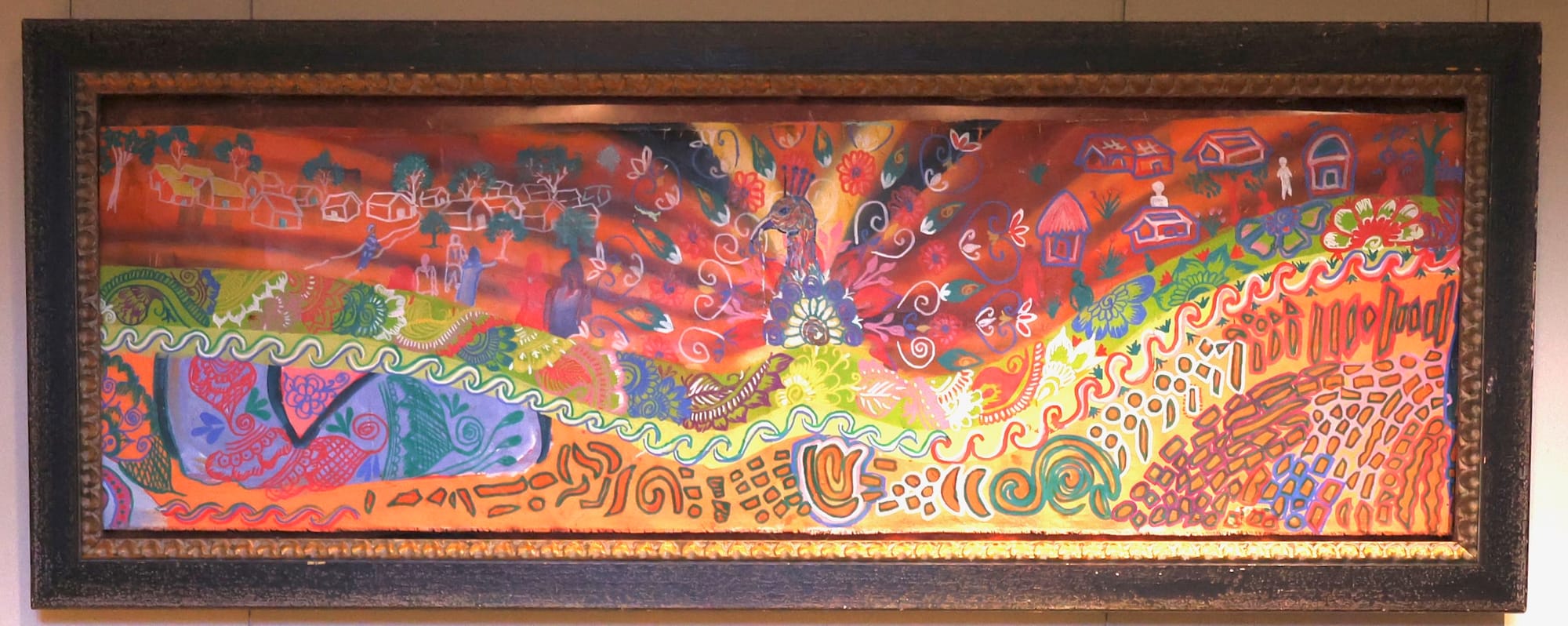
Some of the pieces make a literal connection between one group of refugees and another. The Rohingya and Syrian Peacock is "an exchange canvas between the Syrian refugee artists in the Azraq Syrian Refugee Camp in Jordan and Rohingya refugees in the Rohingya refugee camp in Bangladesh," a note states. "The peacock is a representation of the coming-of-age within the Rohingya community, as when a child comes of age, they are given a peacock feather which they're able to use to mark their place in the Quran. This was created as a structure for the traditional Hennah and textile patterns coming out of the center of the peacock as a unifying image that brought together over a dozen participants from Jordan and Bangladesh."
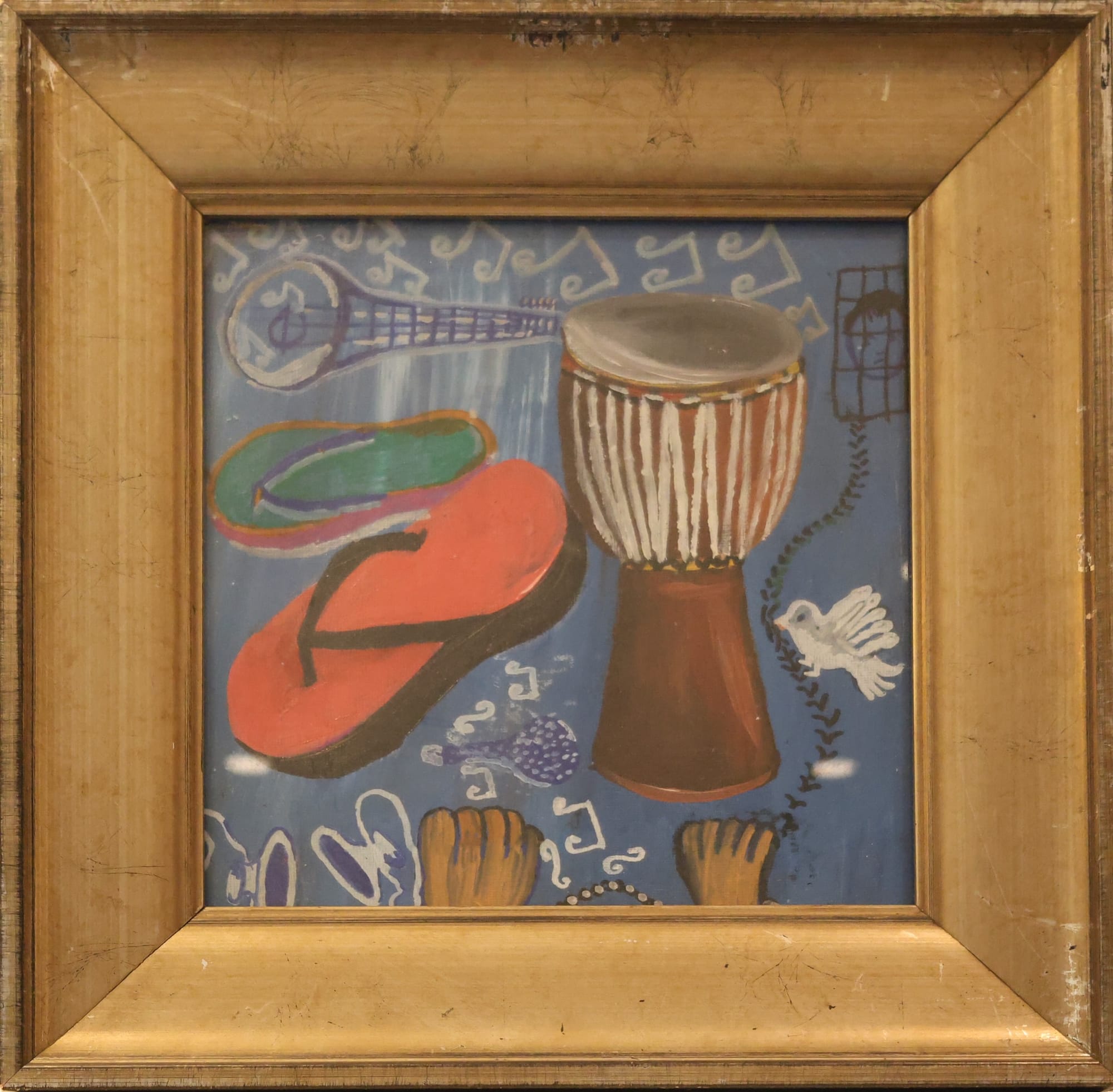
In another collaborative piece, The Shoes and Instruments of the past and present, "the traditional South Sudanese and Ugandan djembe drum was painted next to the universal shoe of the flip-flop. The Rohingya response was to create their version of the same flip-flop, as well as a traditional mandoline, traditional hand symbols and musical notes. We can see two hands on the bottom connected by the chain to being in a cage with the symbol of a dove emerging next to the drum. A symbol of how music and freedom are interconnected across the world."
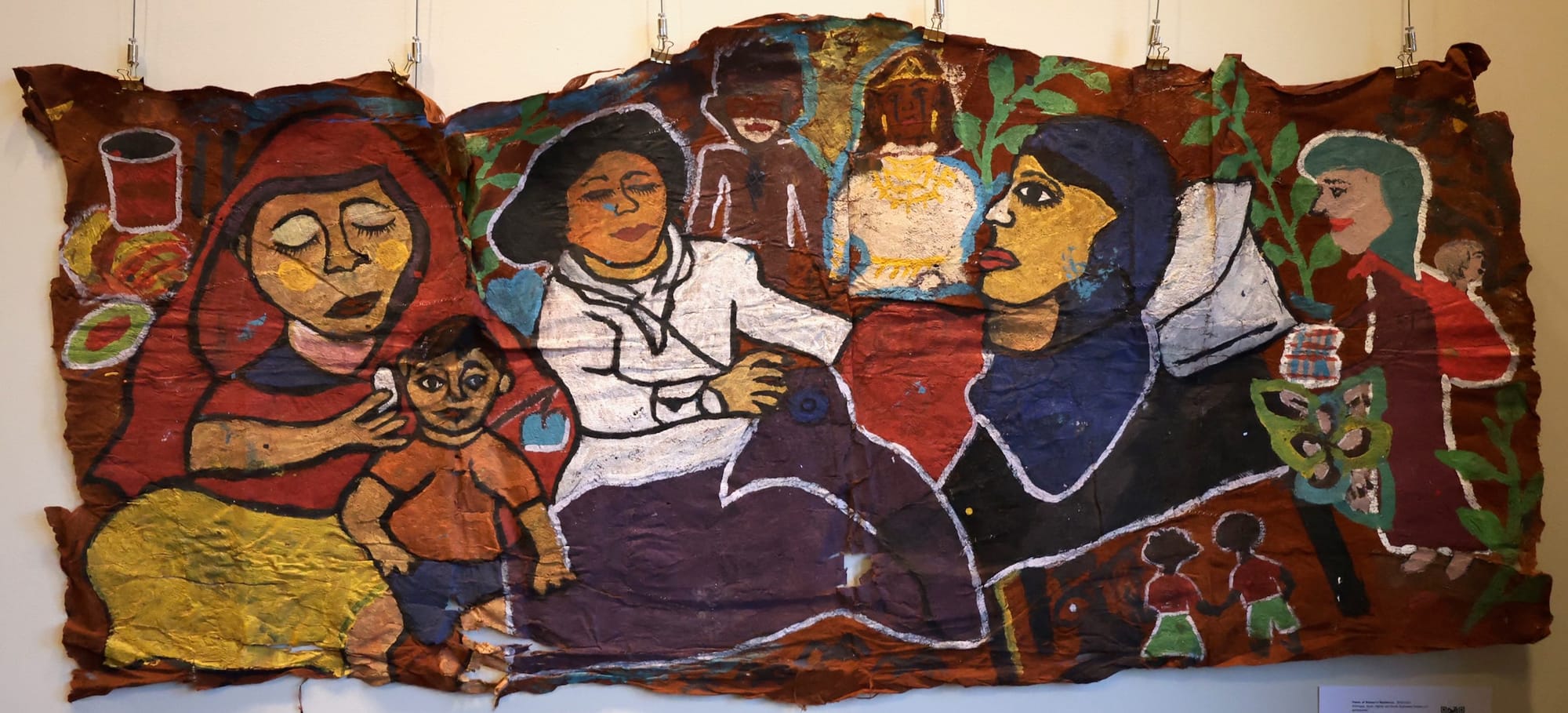
Fabric of Women's Resilience, we are told, passed through Rohingya, Syrian, Afghan and South Sudanese women's hands before it was complete. "Each location added unique stories, like promoting maternal healthcare in Bangladesh, challenging stereotypes in Jordan for women to continue education after having a baby, sharing personal narratives in Greece of child marriage from the voice of an Afghan refugee mother, and highlighting women's connections to nutrition their communities in Uganda. This collaborative artwork emphasizes the power of storytelling to unite diverse women, advocating for equity and providing a platform for their extraordinary lives and perspectives."
Artolution's work bringing attention to and connecting multiple refugee communities, and addressing the issues they're dealing with, is on its face unassailable. The work itself is full of joy and hope. But is it an issue that a viewer could get through the exhibition with no real sense of what made the artists in the show — whether Rohingya, South Sudanese, Syrian, or Afghan — refugees in the first place? No glimpse of the horrific scale of the violence in all four places? What do we get when we focus so much on just one part of the refugees' experience?
The problem isn't unique to Artolution; it's what any artist faces when they try to confront a mammoth, devastating thing. They gaze into a void the size of a planet and their art is a flashlight. Where do they point it? Twentieth-century director Stanley Kubrick wanted to make a movie about the Holocaust for decades but could never, to his satisfaction, find a way to encompass it in all its horror. It's possible he didn't think anyone else could do it, either. Asked once about Steven Spielberg's Schindler's List, he said, "Think that was about the Holocaust? That was about success, wasn’t it? The Holocaust is about six million people who get killed. Schindler’s List is about 600 who don’t.”
But a criticism that Artolution is softening the plight of its refugees in its approach gets flipped on its head when we turn to media that have confronted the horror head-on. Hubert Sauper's 1997 documentary Kisangani Diary shows what he and his film crew saw when, accompanying a United Nations mission, they found a huge group of refugees from Rwanda in the rainforest of the Democratic Republic of Congo, starving and hiding from militia groups out for their blood. Sauper doesn't allow a single minute for viewers to delude themselves with comforting thoughts. "This is a film about people on the run," he says in voice-over in the first shot of the film. "It is a count from one to ten. By the time you see it, most of those in the film will be dead."
So we know from the outset that the people Sauper filmed were massacred by a militia soon after the United Nations found them. The 44 minutes of the film, shot in a washed-out black and white, shows the refugees' near-total deprivation as they cling to life along a set of railroad tracks half-reclaimed by the jungle. It's hard enough as it is. Knowing with certainty that almost none of them are going to survive makes it excruciating. The importance of Sauper's film cannot be denied. Experiencing it is a leap into despair and helplessness. Artolution's pieces don't show us death. Kisangani Diary doesn't show us life. The creators of each chose where to shine their lights, on one piece of a truth, knowing there were larger pieces we wouldn't see. What does it mean for us to look at one versus the other — from where we are, most of us with jobs, roofs over our heads, money in our pockets? How could the artists capture more?
As a novelist, Senegalese author Mohamed Mbougar Sarr has the advantage of medium. With rare exceptions, a piece of visual art gets a viewer's attention for less than a minute. People consider a film over three hours very long. Readers start a novel prepared to invest many more hours than that. Sarr has a bigger flashlight for the void, and he shines it around a lot. So The Silence of the Choir, his 2017 novel about the refugee crisis, tells a story of what happens when 72 people fleeing North and West Africa wash up on the shore of the (fictional) village of Altino, Sicily. The book is polyphonic, giving us the perspectives of at least a dozen characters: new refugees, a few who arrived before the present cohort did, the relief workers tasked with helping them, a group of nationalists who don't want them there, public officials and religious leaders caught in the tension, and in a pretty meta move, artists trying to make sense of it all. Sarr draws out the real problems the refugees face, and the traumas they have endured, but also plunges into the problems of how refugees are understood and the extreme difficulties in even talking about them. Very early in the book, Sarr gives us a conversation among a couple of the relief workers — a doctor, Salvatore Pessoto, and three nuns, Sabrina, Maria, and Carla — that pulls no punches. The doctor begins:
"The problem, the only major problem, Sabrina, is the fact that they're here."
"Salvatore!" The third woman, a nun wearing a veil, scolded him. "You have no right to say that. Put yourself in their shoes! What would you have done?"
"That's a terrible trick question, one of morality. I don't know what I would have done. You can't put yourself in their shoes. No one can. No one is capable of — "
"You're talking as if empathy didn't exist!" Sister Maria said, beside herself. "You — "
"Ah, empathy.... Empathy... something we came up with to ease our own consciences.... Yes. To put up with the fact — or hide from it, it's all the same that you can never leave your own body and truly put yourself in someone else's place ... That's the oldest human illusion. Tell me, how could we hope to understand another person when most of the time we can't even make sense of our own feelings, not even the simplest ones? And on top of that, how can we possibly understand one of the most complex things that exists in a person — sorrow? What sort of arrogance is supposed to allow that? These men are in their place, and we're in ours. We know nothing about their suffering. And even less how to ease it. They shouldn't be here. It's that simple.... Yes, I know. It's terrible. What I just said may disgust you, Sister Maria. The sort of thing a nihilist would say. Or worse yet, a xenophobe or a fascist, I know. But. I wonder if there isn't some truth to their assessment. Their explanations and the consequences they draw from all this are wrong, of course, but the assessment ... the clear and simple facts, irrespective of ideology and hatred.... These men are here, and it's terrible. In this state, into the bargain: immense physical fatigue, with gashes and injuries; they haven't slept, they're dehydrated, stressed, hungry, and mentally totally exhausted.... But the worst part ... is that they still believe. A very strong belief. You can see it in their eyes. But that's something we're used to. We know how it will all end, don't we?"
Initially, the three women didn't reply. And their silence might have meant, "Yes, we know," if Carla, the young blonde woman, had not eventually spoken.
"No, nobody knows, Toto. Nobody knows how it will end. Not even you. And thank God for that."
Sarr's novel is full of this, wrestling with hard questions, without the luxury of landing on easy answers. But without spoiling the book, in the actions the characters take, something like a response emerges: that the first step in understanding, let alone helping, refugees lies in getting past understanding them as refugees, a category of people, and to see them each as individual human beings, with their own histories, despairs, hopes, weaknesses, strengths, nightmares, dreams. To approach them one by one. In the maelstrom of politics and hardship surrounding them, the task seems almost impossible. But maybe — as Artolution, Sauper, and Sarr are all in the end trying to impress upon us — we don't have any other choice.


