
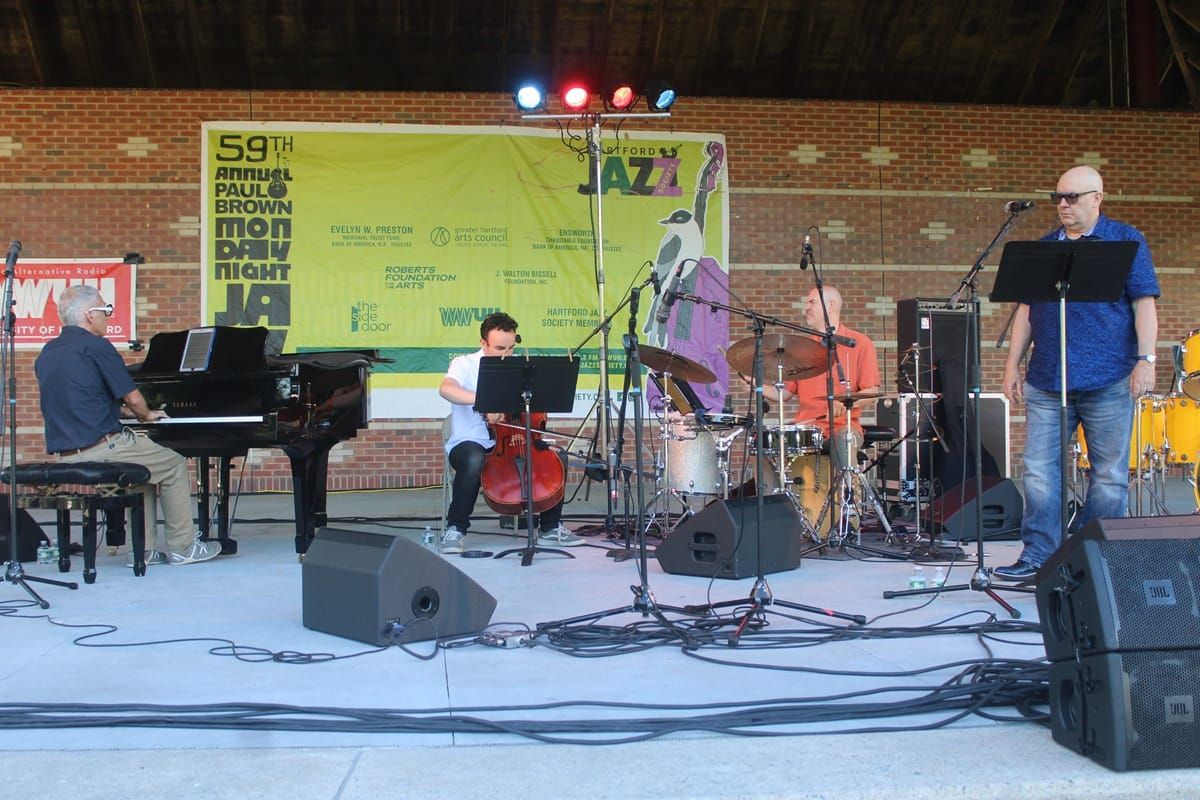
Earl MacDonald’s Black Square Ensemble
Paul Brown Monday Night Jazz Series
Bushnell Park
Hartford
July 20, 2026
One does not often equate jazz with protest music. The Paul Brown Monday Night Jazz Series, in its 57th year at Bushnell Park, flipped the script by making its third week of six a social justice-themed evening.
The opening act for the evening was Earl MacDonald’s Black Square Ensemble, a group that uses music as a way to respond directly to the social and ethical realities of the present moment. The group consists of Earl MacDonald on piano, Rod Nelman as bass-baritone vocals, Rogério Boccato on percussion and Adam Willson on the cello.
MacDonald explained that he has felt compelled to speak more directly to issues such as racism, migration, climate change and violence, so he’s begun adding poetry to the songs he creates. Rod Nelman, a trained opera performer, uses his rumbling voice to add to the sense of urgency that MacDonald’s compositions elicit through their use of musical movement and dissonance.
The Other Abortion is unique even among the eclectic set the Black Square Ensemble had planned, as its text doesn’t come from a poem. Instead, it’s a response to a project about the Sandy Hook shooting, written by a Catholic priest from Chicago. It pulls absolutely no punches in discussing how the social ills children face has the same effect as aborting them.
The Black Square Ensemble also tackled the need for love and understanding of migrants and immigrants, by taking the time to show what the world looks like from their perspective. Butterfly Eyelids uses a poem from V. Penelope Pelizzon, and the addition of music made its brief message even more poignant:
Close your butterfly eyelids and dream
of what isn’t flooded, infected, on fire.
Close your mothwing lids and picture
our family safe in a welcoming home.
Is our family safe in a welcoming home?
Close your mothwing lids. Now picture
a place not flooded, infected, on fire.
Close your butterfly eyelids and dream.
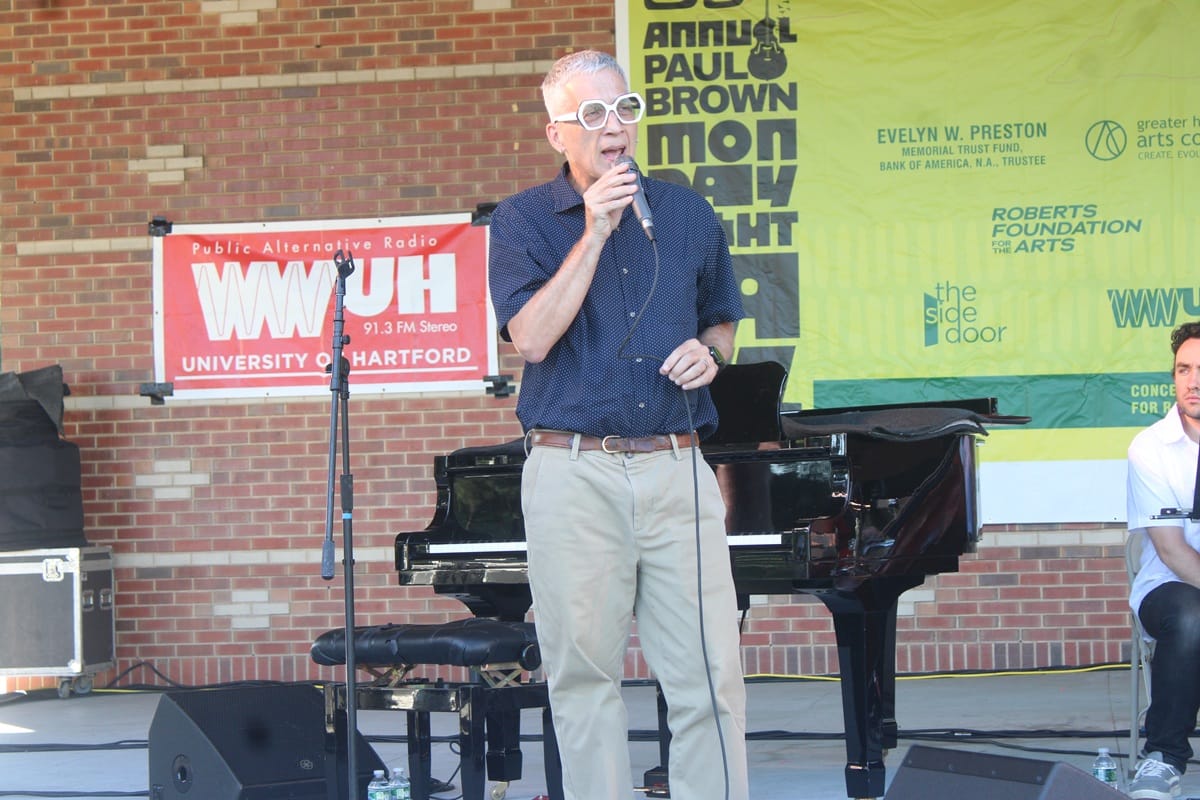
I’m not going to mince words here– it was a grim evening. It was the first nice day in over a week, thanks to the poisonous cloud of smoke from Canada dissipating, the unbearable heat breaking and the intermittent downpours ending. An early evening concert in the park is not the place where one expects to hear the word “abortion” over and over again, especially at a jazz concert, where there’s typically barely talking at all.
But that is the point of course, and perhaps what’s needed at this point in history. All of the woes the Black Square Ensemble shared are human-made ones, which means that there are human-made solutions to them.
I was talking to my brother about the concert afterwards, and he asked me how it would be possible to build a mass movement to confront the social ills we face. After some brainstorming, we came to the realization that the best model for social change is the complete 180 degree turn in public opinion regarding smoking.
We theorized what made that work was the immediacy of the harm (yellow teeth, cigarette smell, thousands of people dying from smoking-related illness) and the shocking ad campaigns of the '80s and '90s that showed people breathing through tubes and speaking with those scary machine voices.
It’s possible to make real, substantial change, and to do so in a relatively short period of time. The immediacy of the harms we face is clear, from smog-covered days to schools full of dead children. Perhaps what we’re missing is the shock, the grim confrontation of what the world is facing in the exact moments we’re trying to forget. Earl MacDonald and the Black Square Ensemble brought that Monday evening.
NEXT
Jamil goes to another of Hartford’s great parks for some karaoke.


