Ariel Chen heated water to the “goldilocks zone” — 176 degrees Fahrenheit — to start whipping up a matcha latte. At that temperature, she expalined the water dissolves the powder with ease, but doesn’t make it taste bitter.
Chen was behind the counter of the coffee shop BLISS: Matcha and Beyond at 98 Olive Street. Chen, who’s 24, owns BLISS with her husband, Norman Chen, 25.
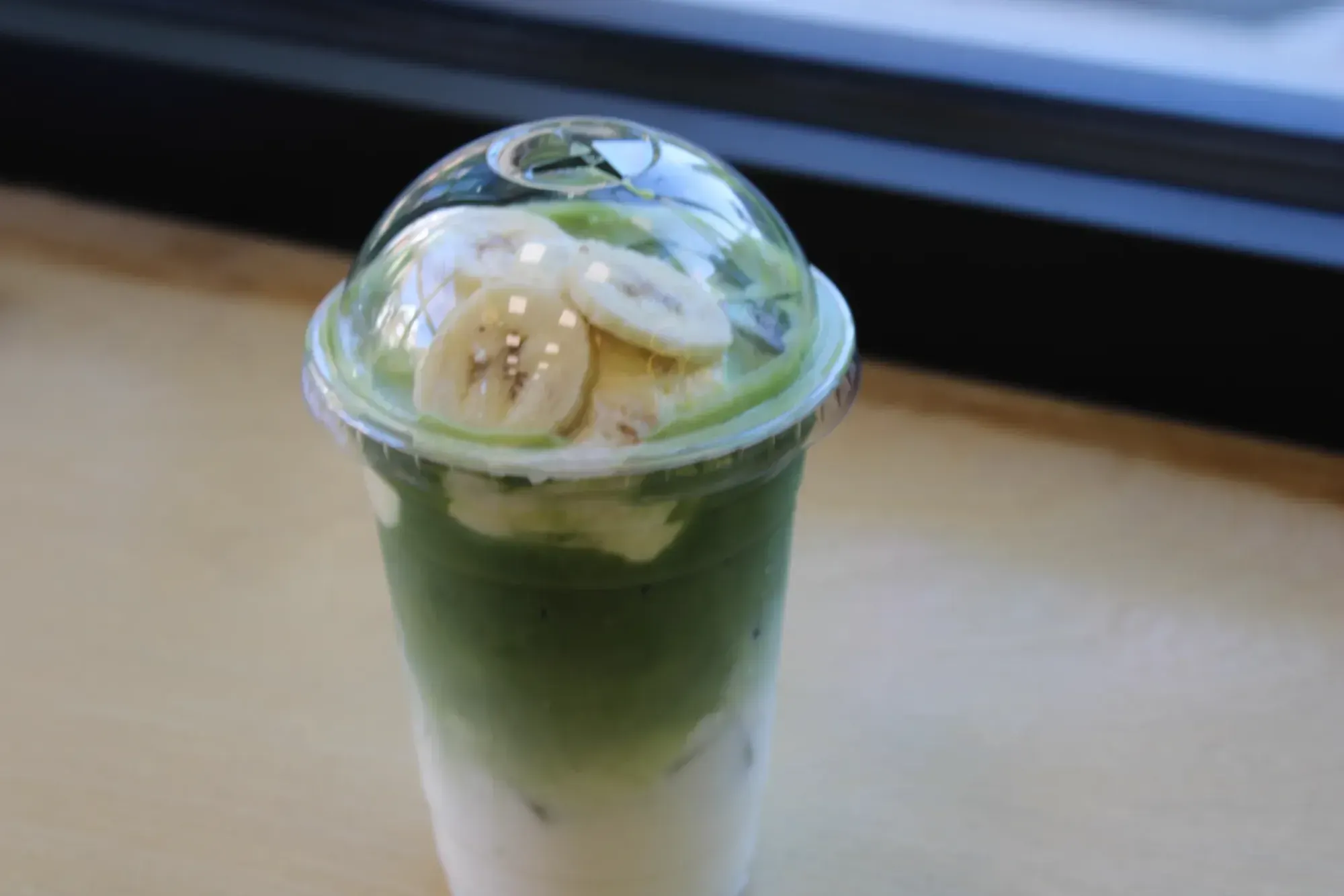
As the name suggests, matcha is a main ingredient of numerous drinks on the menu. On this evening she was whipping up a banana pudding matcha latte, one of the shop’s best sellers.
While the water was being heated in a cream-colored gooseneck kettle, Chen weighed three grams of a vibrantly green matcha powder into a shallow glass bowl. The bowl was made specifically for whisking matcha, with a gently sloping bottom and a spout at the edge. She then poured 30 grams of water into the bowl, drawing a circle in the powder with the stream. She got out a whisk made of bamboo with dozens of tiny tines that curled in at the end, and started moving it back and forth across the bowl.
The banana pudding matcha latte has been on the menu of BLISS for about two months, having been formally added to the menu due to popular demand.
“I had staff calling and asking ‘What do I do?’ and ‘How do I charge them?’ for customers that want pudding on their matcha,” said Ariel Chen. “It was the same call many times, so I was like ‘Maybe this is a trend.’ I looked online, and it was. People really like it.” She liked how quickly the shop could pivot to putting that request on the menu — unlike the extensive research phases required at her previous day job as a corporate consultant. (She still has a day job as an education consultant.)
Once the matcha was sufficiently foamy, and all chunks of powder had been dispersed, she scooped cubes of ice into a plastic cup. Then she mixed some syrup with whole milk, stirring the two together with a long spoon, before pouring it over the ice.
BLISS opened last October after two years of planning. The Chens had initially tried to secure other dfferent locations . Ariel said that New York City, where her husband had been a graduate student at Columbia University, was too crowded and had a lot of chain restaurants, so it would be hard to break onto the scene. They wanted BLISS to be “cozy” and “grounded,” rather than turning into a franchise store. They tried other college towns, like Princeton and Ann Arbor, where Norman completed his undergraduate degree. Those cities didn’t pan out due to a limited amount of available suitable spaces.
Ariel Chen said that she likes the Olive Street building, a good size but “not too big,” but wishes it waerecloser to Yale. “It is 15 to 20 minutes from campus, and we have a huge college population, so it isn’t ideal,” she said. “But, we do have group orders where each person can order what they want then we can deliver it.”
Meanwhile, she poured the matcha into the cup with the milk. The 1:10 ratio of matcha powder to water gets the suspension to the right density where once added to the milk, there are distinct layers of green and white.
Ariel hails rom a “family of tea drinkers.” She has loved matcha and boba tea since she was a teen growing up in China; every day after school, she would get boba. “My family has this big tea table made from one piece of wood, with a spout for water inside it; it was like a professional setup,” she said. “It is an important cultural part of me.” She added how matcha’s current trendiness, due to both the health benefits and how its caffeine differs from coffee, made it a good choice.
For the unacquainted, matcha is a bright green, finely ground powder of the leaves of a shrub called Canellia sinensis, which is the same plant that green tea comes from. Matcha differs from green tea in how it is both grown and prepared. Matcha is shaded while it is growing, so it makes more chlorophyll so it can absorb more light. If you’ll remember from high school biology, chlorophyll drives photosynthesis and is also very green. For green tea, the sliced leaves are steeped in water, but for matcha, since it is the whole ground leaf, it is suspended in water. Since you drink more of the leaf, it has more amino acids, polyphenols, and other antioxidants. Because of this, and the more stable caffeine compared to coffee, it has become popular globally.
The penultimate step of preparing the drink was to scoop some banana pudding on top. The concoction, made of vanilla pudding, bananas, and wafer cookies, dissolves into the matcha, making it just sweet enough.
Before opening BLISS, the Chens traveled to Japan and Guangzhou, China, to learn how to make matcha. “We learned the baselines, like how to make tea in a big bucket rather than how you would make it at home,” she said. “It is like chemistry. Once you know how to make a strawberry matcha, you can do it with mango or blueberries.”
They also discovered the kind of matcha they wanted to use: Ceremonial-Grade Uji. It is from a region in Kyoto, Japan; Uji is the name of a city. “China and Japan are the biggest experts in Matcha,” she said. “China is not in America, and they only really export to Japan and Korea. There is a warehouse here already, so we don’t have to wait for so long for it to ship.”
Chen added a final garnish to the drink: a quarter of a banana, sliced into little coins and stuck into the pudding. The finished drink resembled clouds, with the green matcha marbling the white milk, and the pudding leaving ephemeral streaks on the side of the cup. The pudding dissolved into it, adding to the creaminess and adding a secondary vanilla flavor. The fresh banana offered a nice textural contrast to the rest of the drink. Six p.m. was a bit late for me to drink a caffeinated beverage, but the taste made it worth it.