
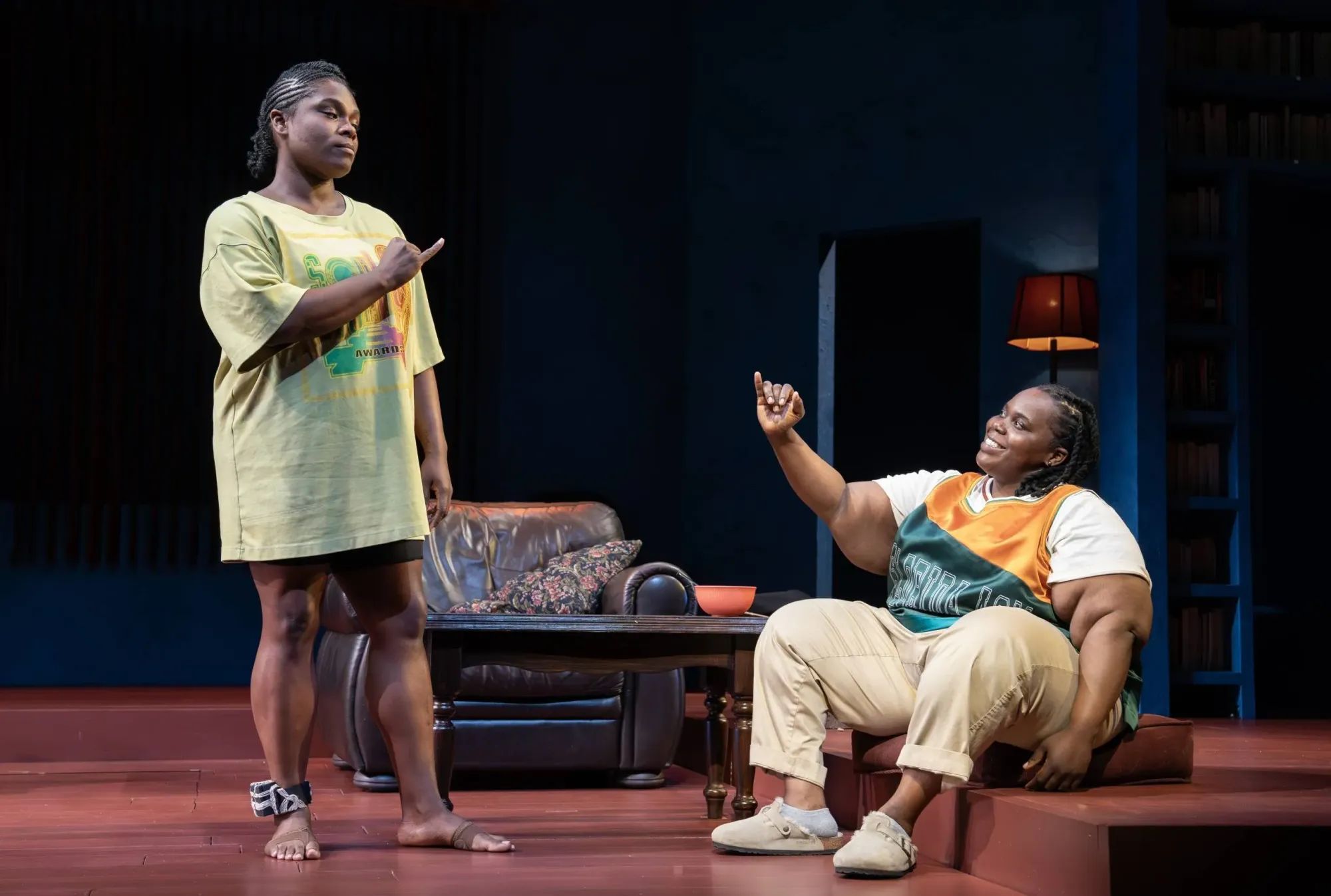
Furlough’s Paradise
Yale Repertory Theatre
Through May 16
“what y’all got in your utopia?”
This question sits at the heart of Furlough’s Paradise, the Susan Smith Blackburn Prize-winning play by Yale alum and artist-theorist a.k. payne. Throughout Yale Rep’s season-closing production of payne’s abolitionist two-hander, brilliantly directed by abigail jean-baptiste, two cousins discuss, imagine, and embody not just what their utopia is free from– policing, surveillance, the gender binary– but also what blooms there in abundance: care, accountability, stillness, and lots of “fresh fuckin fruit.”
The poetic Furlough’s Paradise follows cousins mina and sade as they reconnect for a weekend following the death sade’s mother, lashonda. With her passing, each cousin has one parent deceased and one parent estranged, leaving each other as their closest family tie. On the surface, they lead different lives: mina is an Ivy League-graduate who works at Google, while sade has returned home on a three-day furlough from prison. Their divergent circumstances quickly become a source of conflict, accountability, and most importantly, repair. Over the course of the play, the pair discover, or remember, that what they share – utopian dreams, haunting nightmares, and somatic rituals – has the potential to liberate them both.
Lauren F. Walker (sade) and Tiffany McLarty (mina) deserve all the kudos in the world for performing a piece and a relationship that holds so much, both physically and spiritually. Walker has a commanding stage presence as sade, and stunningly captures how one might hold both their rage and their joy together so closely. McLarty leans into a principled vulnerability as mina, expressing precisely how one might hold space for another without losing themselves. Together, their performances model some of the microcosmic work of abolition: finding ways to show up for someone with curiosity and care instead of discarding them.
Under jean-baptiste’s direction, Furlough’s Paradise frequently “snaps” between naturalistic and surrealist modes of expression, calling memory, ancestry, and dreamlike experiences into the space of the production. The Afrosurreal Manifesto by D. Scot Miller asserts that “beyond this visible world, there is an invisible world striving to manifest, and it is our job to uncover it.” This work of uncovering is one of jean-baptiste’s talents as a director. In Furlough’s Paradise and other works they’ve directed, jean-baptiste savvily and vividly visibilizes experiences that are not perceptible to the naked eye, yet are profoundly felt by the spirit. For a play so chiefly concerned with the work of radical imagination, jean-baptiste’s skills and sensibilities are a perfect fit.
jean-baptiste stages this shapeshifting production of payne’s play with a stellar team of collaborators. Ogemdi Ude’s choreography gorgeously integrates fun, gregarious moves with ancestral, ritualized steps, especially during the more surreal sequences of the play. Wiktor Friefeld’s warping projections cast on Anthony Robles’s towering blue set suggest comfort and safety at times, and drowning and submersion at others. Constant Dzah’s sound design and original compositions evoke both the sweetest of dreams and the most harrowing of nightmares. Rea J. Brown’s costumes fascinatingly offer a first glimpse at just how much grief and turmoil sade and mina must wade through and wrangle with just to make it to the first scene of the play. Alan C. Edwards’ lighting design snaps the play forward in time again and again as the end of sade’s furlough gradually, then quickly, approaches.
At the bittersweet conclusion of Furlough’s Paradise, the small utopian world that sade and mina create together is disrupted. The pair articulate ways to bring parts of that world into their future dynamic, and ideally into their relationships with others. In interviews about the play, payne has discussed the concept of fractals, of how the small impacts and is recreated in the large. Furlough’s Paradise leaves me with a strong understanding of how that can be true in practice from an abolitionist perspective, which is a testament to payne’s exceptional craft and incisive politic. Their play is a marvel.
In her program note, production dramaturg Ashley M. Thomas quotes Marime Kaba’s We Do This ‘Til We Free Us: “Changing everything might sound daunting, but it also means there are many places to start, infinite opportunities to collaborate, and endless imaginative interventions and experiments to create.” payne, jean-baptiste, and the whole team behind Furlough’s Paradise have offered the gift of one fully imagined starting point, opportunity, intervention, and experiment; I hope the production inspires many more.
Furlough’s Paradise runs through May 16; you can get tickets here.


