
By ALLAN APPEL
Unfolding History
Yale Peabody Museum
New Haven
Through October 2026
Forgive this reporter his naivete, but believe it or not, the ancient Egyptians actually wrote far more than the formal inscriptions on great pyramids and obelisks. For that very public writing on stone and on monuments they used picture writing, or hieroglyphics.
But for business documents, friendly notes of parental, avuncular, career advice, get-well cards, and, who knows, maybe even love letters, they wrote on papyrus and in a related cursive script called hieratic.
One such fragment among many in hieratic that has recently made its way to New Haven translates literally as: “May your condition be like living a million times.”
While that may sound like the punchline of a Yiddish joke — May you live to be 120, each year in a different hospital — it likely means something closer to: “I hope you are well.”
That time-traveling portal into what emotions ancient Egyptians experienced and how they expressed them in personal letters and informal documents to each other — in short, the development of writing and scribal culture in ancient Egypt — is the main focus of a fascinating one-gallery exhibition called Unfolding History. It just opened at the Yale Peabody Museum.
“Indiana Jones is not me,” said Victoria Almansa-Villatoro during a brief tour Thursday morning. She is an assistant professor of Egyptology at Yale and curator of the exhibition.
“I’m more like a detective nerd in the library,” she added.
What she is, despite her modesty, is the impressive presenter of samples of her painstaking assemblage and then study and translation of thousands of small, postage-stamp size documentary fragments on papyrus written 4,300 years ago in Elephantine, an island in the Nile in southernmost Egypt.
The authors are perhaps a family of scribes who kept the cache together over the decades, Almansa-Villatoro said.
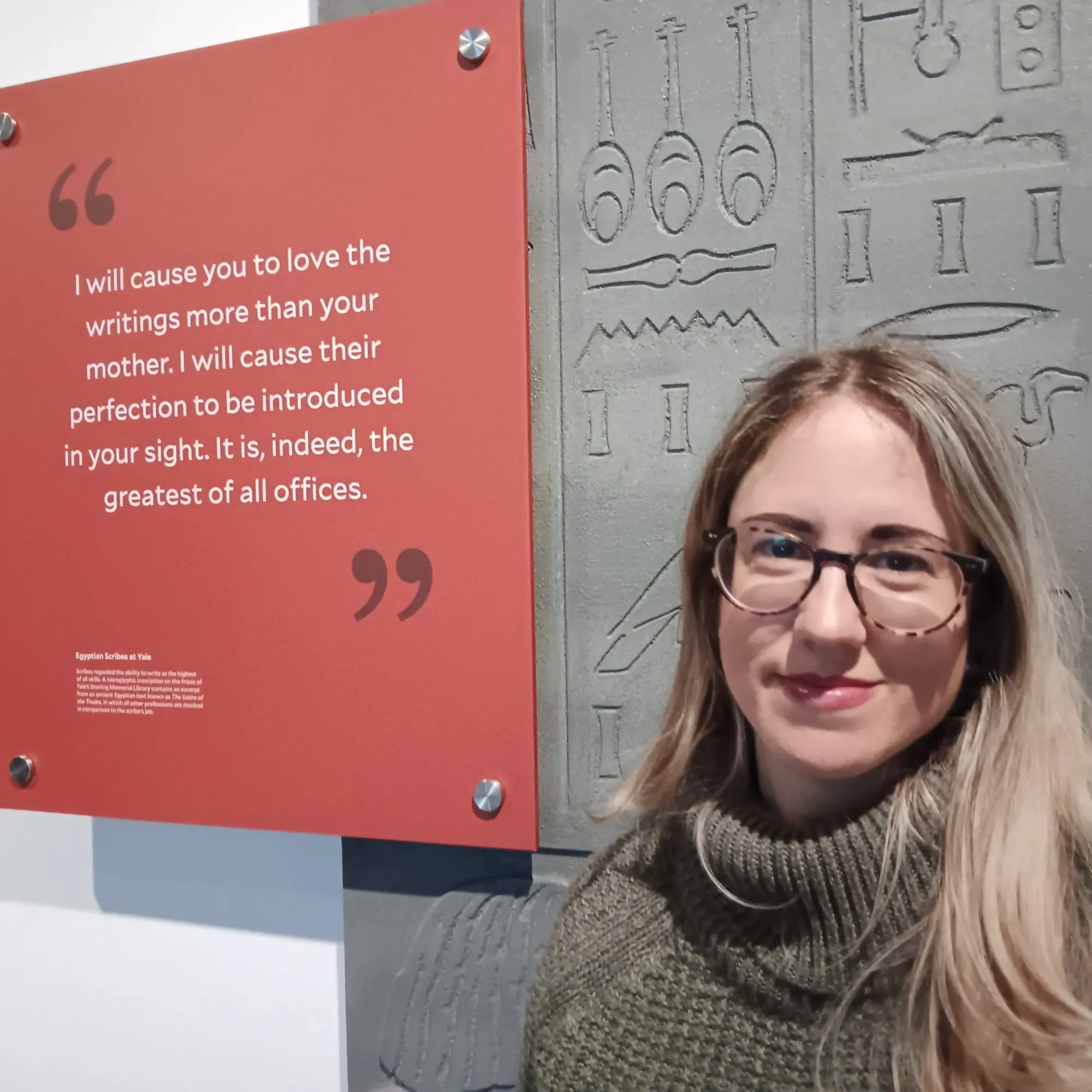
In a largely illiterate society, scribes were very highly respected, she added. There is a famous story or satire, referenced in the exhibition, but written some 500 years later, called “Satire of the Trades.” Its speaker tries to convince us that there is no better profession than being a scribe. It contains lines beginning with, “I will cause you to love the writings more than your mother. I will cause their perfection to be introduced in your sight. It is indeed the greatest of all offices.”
The fragments in the exhibition are all from the islands of Elephantine and were deposited, by an intrepid journalist, after he bought them, back in 1890.
Into a drawer at the Brooklyn Museum in New York City they went, and have not been examined until Almansa-Villatoro arrived.
“A lot of things had to go right for them [the fragments] to survive,” said Kailen Rogers, the museum’s associate director of exhibitions.
And, to begin with, it was the hot dry weather in the south of Egypt, where many more papyri are preserved than in the north.
And then someone must come along, like Almansa-Villatoro, she added, who builds on the work done at Brooklyn and among the Yale Egyptology faculty. “Unfolding Historyhighlights the way research actually works, building on existing knowledge and looking carefully, often in a new way,” Rogers added.
While the Peabody’s second-floor galleries on Egyptian and Mesopotamian culture have some material on the development of writing, this is a true first-time display of these fragments from this faraway Egyptian region as well as an intimate look into a different, humanizing aspect of ancient Egyptian culture, and how writing developed.
And it is the first time they have been displayed, along with the tales they tell, anywhere in North America.
Not the dictates of pharaohs, the more formulaic writing associated with monumental sites closer to Giza and the pyramids and locations where power resides, Almansa-Villatoro said.
She thinks these families of scribes — or interpreters, as they call themselves — may have had a role in interpreting and/or writing in relation to the kingdom of Nubia, on Egypt’s southern border, close to Elephantine. And it is one of the most surprising take-aways from her detective work that literacy appears to be flourishing in this far away corner of the kingdom, she said.
It’s particularly moving, she added, to come across the names of scribes (some can be confirmed or related to other known inscriptions) like Ib and Mereru and Wadji.
She spoke a bit about those names.
Actually “Ib,” Almansa-Villotoro speculated, “might not even be the full name of one of the scribes.”
If she is able to find another fragment that matches where the “b” ends, for example, as it appears to be running into something else, whose papyrus hieratic fragment is not yet located, the name may well turn out to have more letters.
And it is important to get the names right, she added.
That’s because “for Egyptians the name and the title is a very important aspect of identity. The name is always on statues and tombs, because they wanted their names to be remembered. And here I am restoring them! It is very cool to read their names for the first time in thousands of years.”
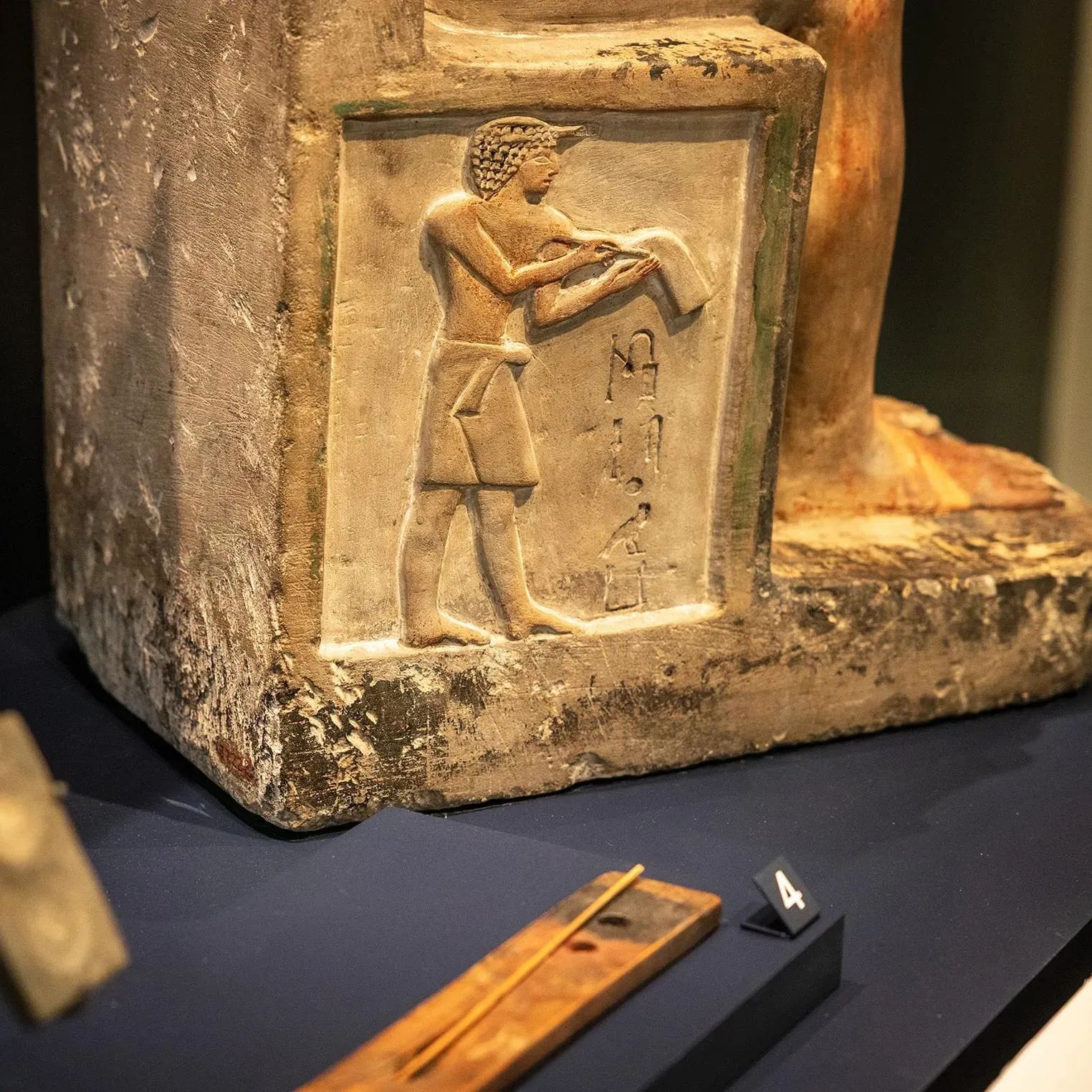
And, contextualized by pottery (on which the first signs that became sounds, and then words appeared), along with small statues of scribes at work, and their tools, and other artifacts, the exhibition is also kid-friendly. It has interactive features to show students how papyrus is made and how you jigsaw-puzzle-style decipher ancient manuscripts.
“Writing continues to evolve in non-linear ways,” Amansa-Villatoro also observed. “Emojis, like hieroglyphs, harness the power of images to communicate.”
Because Almansa-Villatoro is the only one working on this cache and it is so extensive and each success of linking one fragment to another to create a word or phrase is so painstaking, the top of her wishlist includes a computer Egyptologist trained to follow patterns and to bring like fragments together more efficiently.
Her digital Egyptologist would likely follow, said Almansa-Villatoro, not the similarities in handwriting but more likely the distinctive fibrous patterns in the stalks of the sedge plant from which the papyri are made.
That would move the jigsaw aspect along far more rapidly than one person at work alone, and save vast amounts of time for the translation work.
Here is a link to the exhibition’s full story.
And here is a link to a spot for teachers to sign up for tours.
The exhibition runs through the end of October.


