
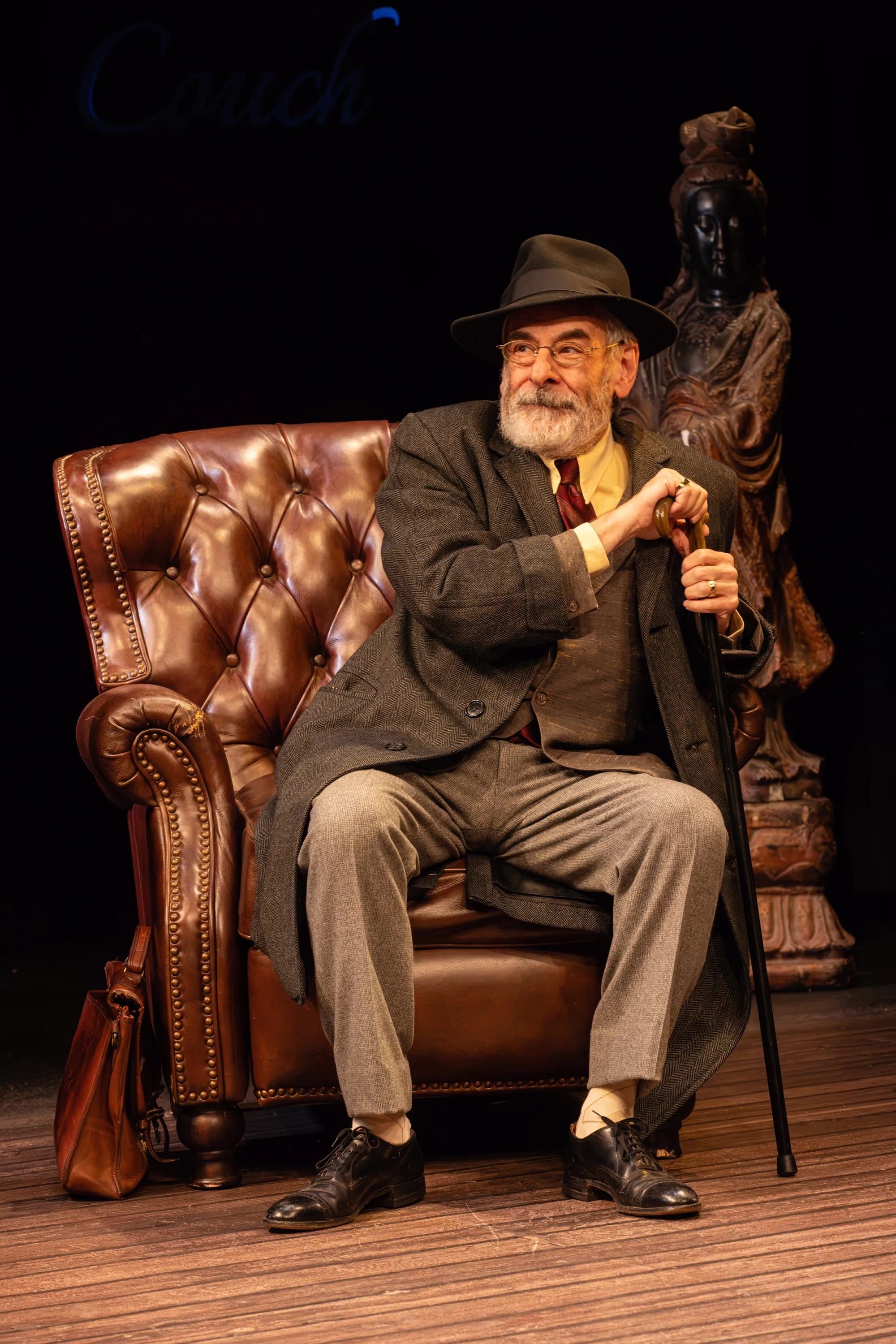
Long Wharf Theatre Presents Arthur Miller’s “The Price”
Legacy Theatre
Branford, CT
Through Nov. 22, 2026
Leaving The Price on opening night, I thought only of Gregory Solomon, as portrayed by Mark Nelson.
Nelson’s lively performance was a tuning fork in a pitchless production of Arthur Miller’s 1967 play about the choices we make — and sometimes regret — for family.
I found myself sitting up straighter when Nelson’s character Solomon was on the stage and missing him when he was gone.
“Water I don’t need; a little blood I could use,” he told the Franzs when he first hobbled onto the stage, garnering his first of many laughs from the audience.
The play — put on by Long Wharf Theatre at Branford’s Legacy Theatre — tells the story of a New York City police sergeant named Victor Franz who sacrificed his own education to support his father in the wake of the Great Depression. More than a decade later, Franz comes home to sell his parents’ estate. The play is set in the attic of his parents’ soon-to-be-demolished brownstone.
With his thick Russian-Yiddish accent, Solomon — an antique dealer — felt like the most fully realized character on stage. I believed him when he said he had been in the appraisal business for 62 years.
In contrast, the rest of the cast was rather wooden, giving the production a mechanical feel. Their performances notably livened up when Solomon was in the scenes.
The Price started off promising, with Alexis Camins cutting an imposing figure as Victor Franz; he stood proudly at the very front of the stage. You got the sense that this was a man with purpose; I wanted to know his story.
As the play went on, we learned that Victor seems to live without conviction. His life plans to work in science were derailed when his father lost his wealth, and he felt compelled to take care of him. Now, he’s a cop. He’s resentful of his brother Walter (Carman Lacivita), who became a successful doctor and seems to live without the familial guilt that trapped Victor. His wife Esther (Jennifer Lim) complains that he always settles for less and what is temporary in life.
When Esther entered the scene in her fancy blue suit, I noticed an air of falseness around her. Perhaps, that was the nature of her character who was stuck in a life she didn’t want – to portray herself as something she’s not. As the scenes progressed, I struggled to find her emotional authenticity.
Esther felt most authentic when she exclaimed, “Vic, I want it. I want money.” There, I felt her despair over living an unfulfilled life.
I also felt no chemistry between Victor and Esther. Esther had way more chemistry with Solomon who teased her about her suit. (“I like her,” Solomon told Victor. “She’s suspicious.”)
Camins also had more chemistry with Nelson. Earlier, when acting alongside Lim, he stumbled over a few of Victor’s lines. But there was none of that with Nelson.
Camins and Lacivita did a decent job of portraying estranged brothers, but I didn’t feel the stakes of their frayed relationship. Victor didn’t convey the deep darkness that results from the sorrow and resentment of a life ill spent. Walter was believable as the more successful brother; he carried himself with the plum demeanor of the wealthy. But I didn’t quite believe him as the man who lost his mind and had to be carted off to a mental hospital. His description of the incident almost made it sound like a lark in comparison to the disorientation he must have really experienced.
Scene designer Riw Rakkulchon did a great job of making the stage appropriately claustrophobic, with furniture lying here and there. Black placards hung from the ceiling with names of furniture written across them to represent the pieces of furniture, such as the carved bed and chest of drawers, that were not physically present. The objects seemed to occupy more space than the people who had inherited them, an apt visual metaphor for the weight of the past neither brother could escape. As cozy as Legacy Theatre is, the audience also felt crowded in with the Franzs’ property, which was an effective atmosphere for this play.
Apart from Nelson, the actors’ body language seemed all wrong. As they gesticulated on the stage, I thought, these are actors. That’s not what I want to think while watching something scripted. I want to feel like the characters are living, breathing humans and like I’m living their story alongside them. But I felt like I was watching The Price at a remove all the while.
The actors’ lack of chemistry wasn’t merely disappointing. It undermined the play’s foundation of reckoning with emotional debts accumulated over a lifetime.
Thank goodness for Nelson, who made Solomon feel so believable, no matter how outlandish his lines. Somehow, the ridiculousness of his character added an emotional weight to the play as he was the perfect foil to the Franzs’ heaviness.
As Solomon cajoled the Franzs, he dropped hilarious lines about loving every woman who would love him. He shared fantastical stories about his former time as an acrobat. One second, he was offended when he felt they were suggesting he would steal from them. The next, he was crying because they took a chance on him in seeking his services.
Even old adages were funny the way Solomon said them: “In a day, they didn’t build Rome.”
And his simple gestures were hilarious too. The crowd cackled when he pulled a sandwich out of his briefcase to eat in the middle of a discussion: “You give me such an argument, I’m hungry!” When he asked for salt, the audience lost it. One tired guest’s yawn turned into a full-throated laugh as he watched Solomon.
It was incredible to watch Nelson breathe life into Solomon. Though he couldn’t rescue The Price from its shortcomings, he reminded me of the magic of theater.


