
이유를 잊은 움직임들 (Movements That Forgot the Reason)
정덕용 (Deokyong Jeong)
Jeonil Building 245, first floor lobby
Through Aug. 10, 2026
(Jisu Sheen recently moved from New Haven to Gwangju, South Korea, where she’s covering local arts and culture for the New Haven Independent and Midbrow.)
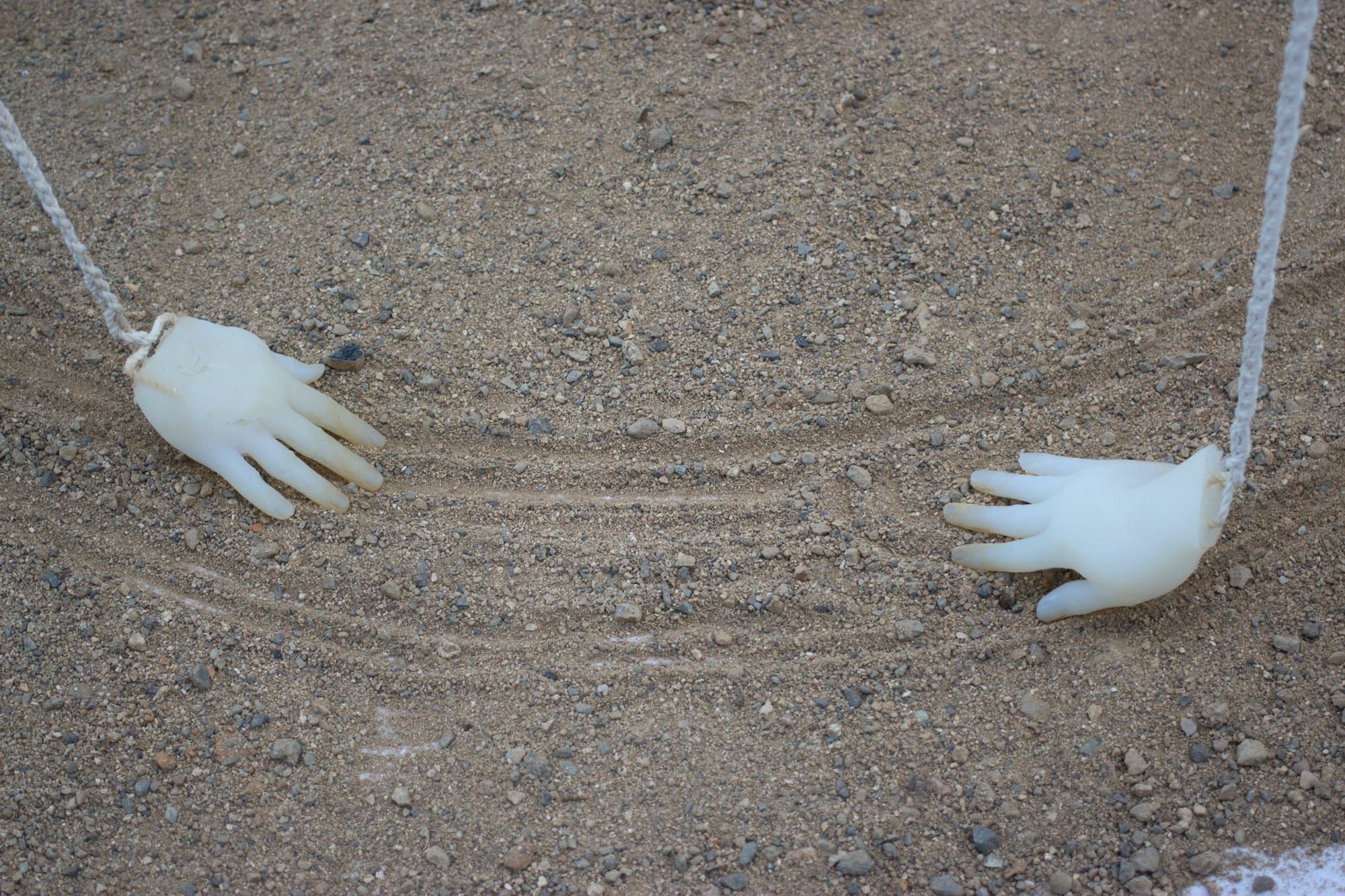
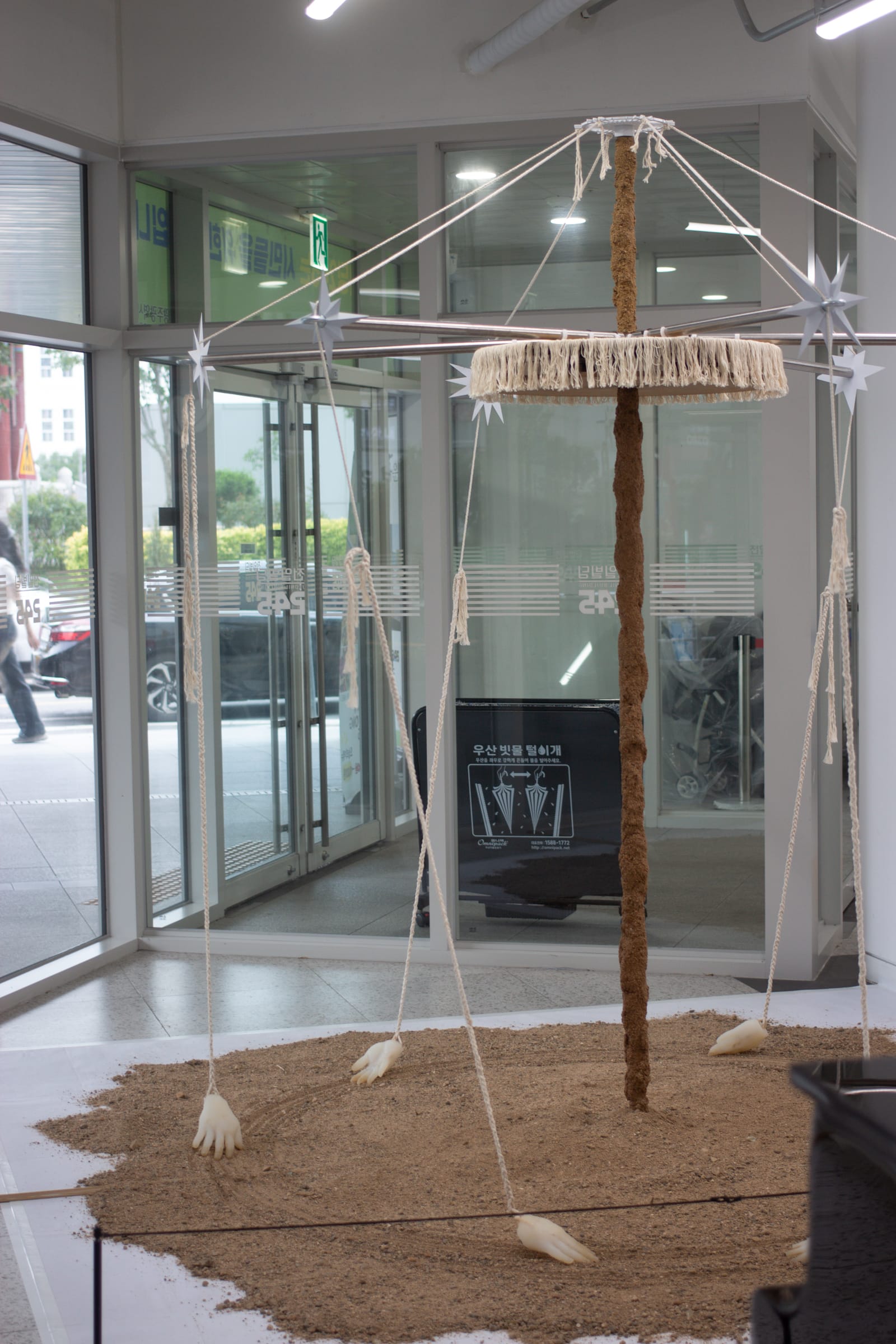
Six hands are frozen in time, mid-drag through a patch of sand. Some are palm-up, others palm-down; regardless of how they were oriented at the fictional start, they’re now compelled along the same round path around one ominous star-adorned pole. Time will move them no matter what.
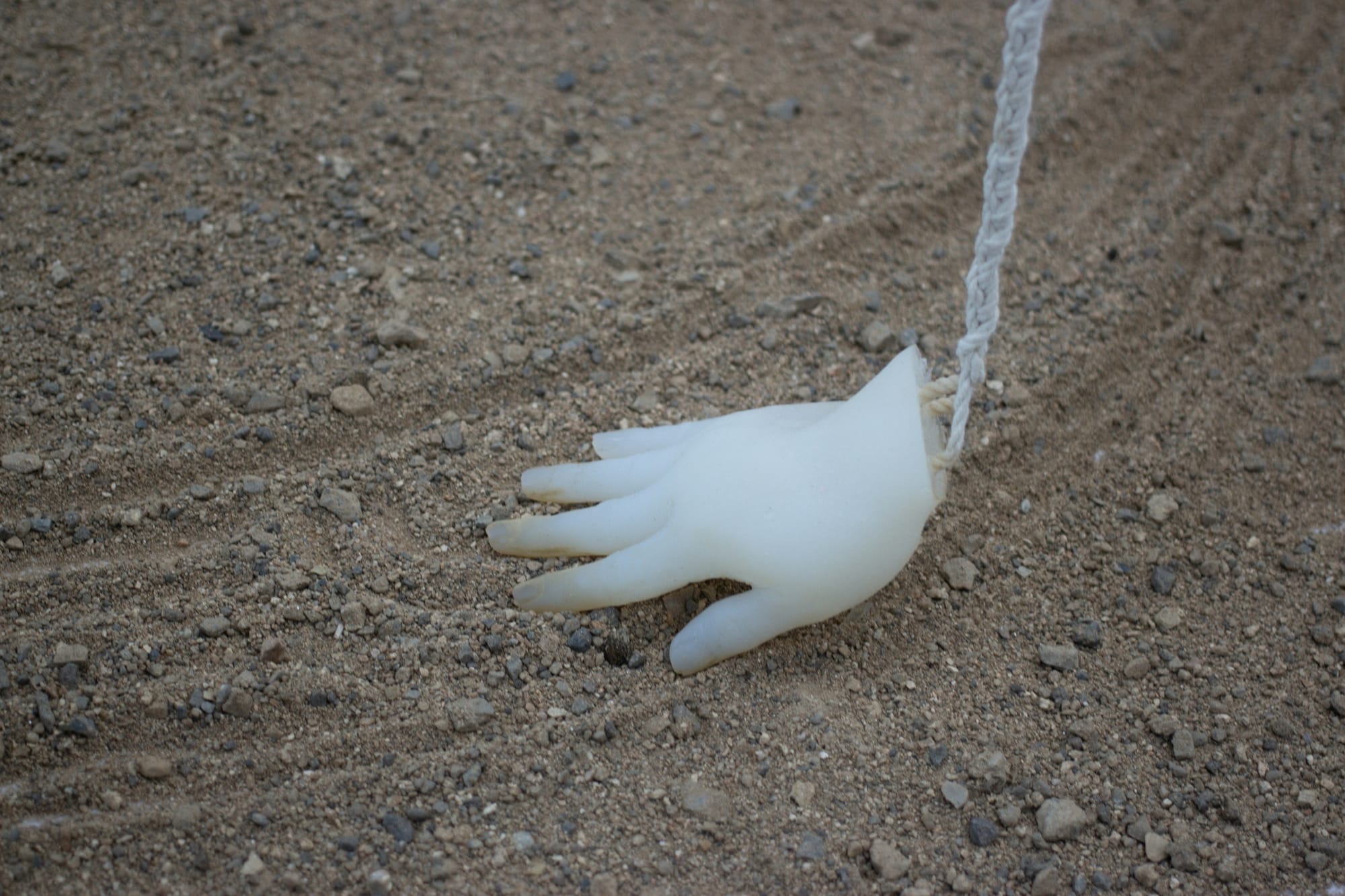
But wait—one of the hands is not like the others. It’s backwards, reaching its fingers toward the fingers of the hand next to it instead of going heel-to-fingertip like the rest.
The hands, along with the strings, the sand, and the pole, make up an installation called 이유를 잊은 움직임들 (Movements That Forgot the Reason) by artist 정덕용 (Deokyong Jeong). Starting this week, the piece is stationed in the lobby of Jeonil Building 245, a central community center, tourism hub, and museum in downtown Gwangju.
The museum aspect is a bit meta. Jeonil Building 245 is not just the shell hosting the museum’s pieces; the building itself is the main piece on display. But more on that later.
I visited Jeong’s installation on Thursday, one day after it opened for its month-long tenure in the building. Its circular nature reminded me of Sun Yuan and Peng Yu’s 2016 creation Can’t Help Myself, the robotic arm doomed to clean up the dark red liquid ever-leaking from its core. Like the robotic arm, the sculpted hands in the Jeonil Building 245 lobby appeared to move without respite or escape—with the exception, perhaps, of that one hand.
It took me several minutes with the art to realize that the six hands were not all being dragged in the same way. Before that, I saw the hands as powerless extensions of the direction given by the inner entity. When I noticed the odd hand out, I felt an unexpected empathy for it, or maybe for some hidden part of myself.
The hand spoke to me of the impossibility of reaching backwards in the forward trudge of time. And—was I imagining this?—it looked like it was having a tough time. There were marks in the sand where it might have turned around or met resistance.
I felt bad for it. If it was trying to go against the grain, it wouldn’t win. It was still attached, by a secure braided rope, to the same pole as every other hand.
Was the backwards hand being pulled in an opposite direction from its five sisters (while still somehow staying attached to the same pole)? Or was it pushing of its own volition?
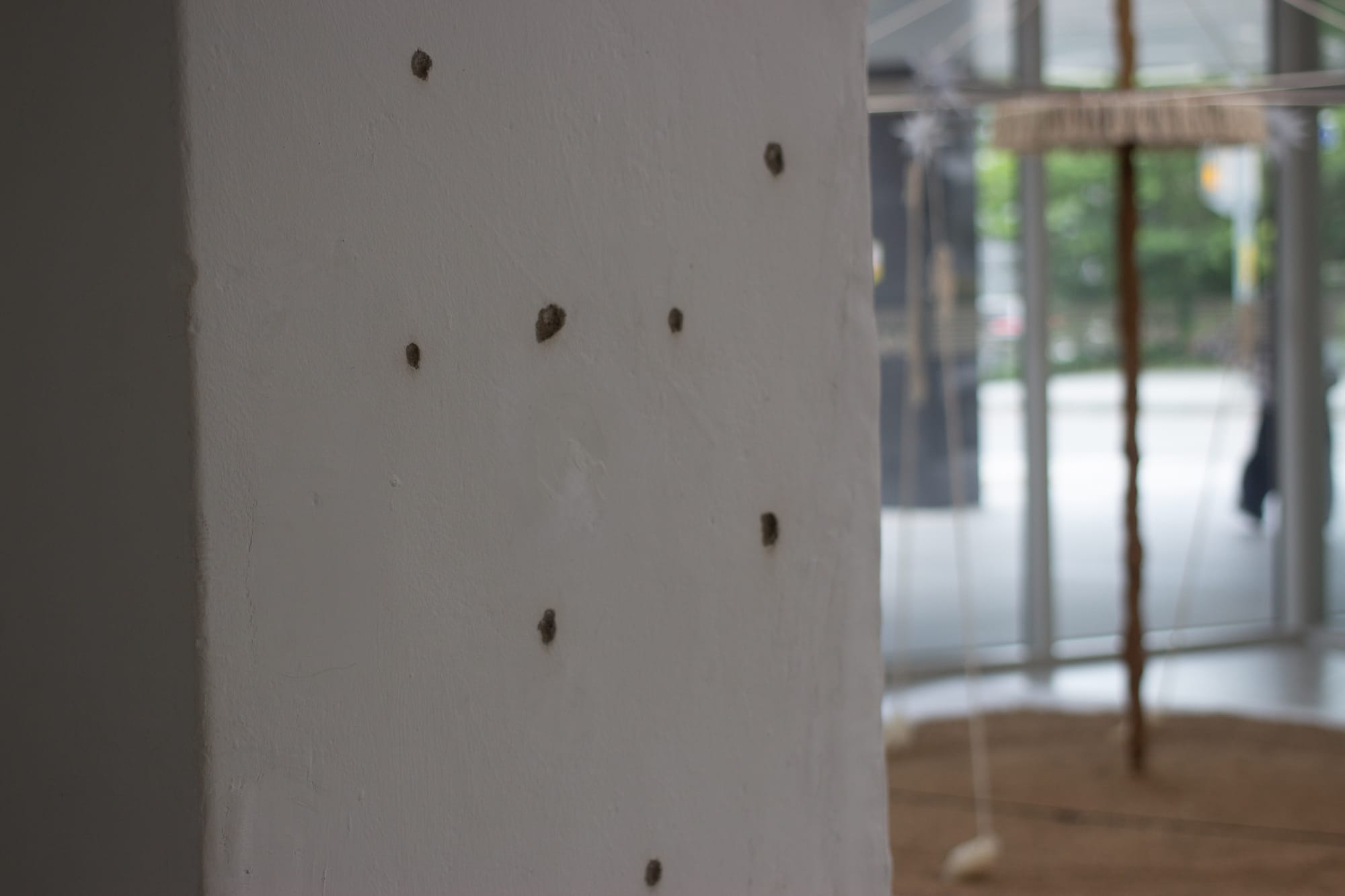
Facing the installation, a few paces away, is a replica of a pillar marred by bullet holes.
It’s not that the real pillar has been lost to the sands of time; it’s a doubling-down. The original is just an elevator ride away, along with a bullet-stricken floor, on the 10th floor of the building.
The 245 bullet holes found in the building are part of the reason for Jeonil Building 245’s name. After the 1980 massacre that caused it, the damage served as key legal evidence that the military police had used a helicopter to shoot civilians, amidst denials by the army. Based on the angle of the bullet holes and the lack of taller buildings nearby, it became clear the marks could only have been been made by a helicopter.
Every week, it seems, I get deeper into the weeds of another revolution, dictatorship, or echo of colonization in Korea’s history. Somehow, it’s making the world make more sense; I can’t understand it because it’s beyond understanding. Each inconceivable act changed the logic of possibility forever.
Acts like: when two U.S. generals used a straight line on a paper map to divide Korea (kind of King Solomon-y, if you think about it too hard), or when the new Korean dictatorship of 1980 gunned down students from a helicopter.
It’s like playing tic-tac-toe with someone who responds to a challenge by ripping up the paper itself. That wasn’t even supposed to be a move, you know? There’s no going back from that.
So the hand moving along its own route in Jeong’s installation drew me in. If it was being pulled by an unseen force, it was finding some divine signal in the noise. If it was pushing itself, it was defying its position at the end of the string.
In this moment, the future is still uncollapsed, undetermined. Movements That Forgot the Reason is a slice of time, one where history is etched in the ground and lines are destined to be retraced. The past can’t just be smoothed over—not when the wheel is still turning.
Sign up here to get Gwangju Midbrow email updates delivered straight to your inbox.


