History of the National Liberation Movement
By National Federation of the National and People’s Art Movement (Minjok Minjung Misul Undong Jeon-guk Yeonhap)
Documented by 최열 (Choi Yeol)
The Gap Within the Whole
Gwangju Media Art Platform (G.MAP)
Through July 15th, 2026
(Jisu Sheen recently moved from New Haven to Gwangju, South Korea, where she’s covering local arts and culture for the New Haven Independent and Midbrow.)
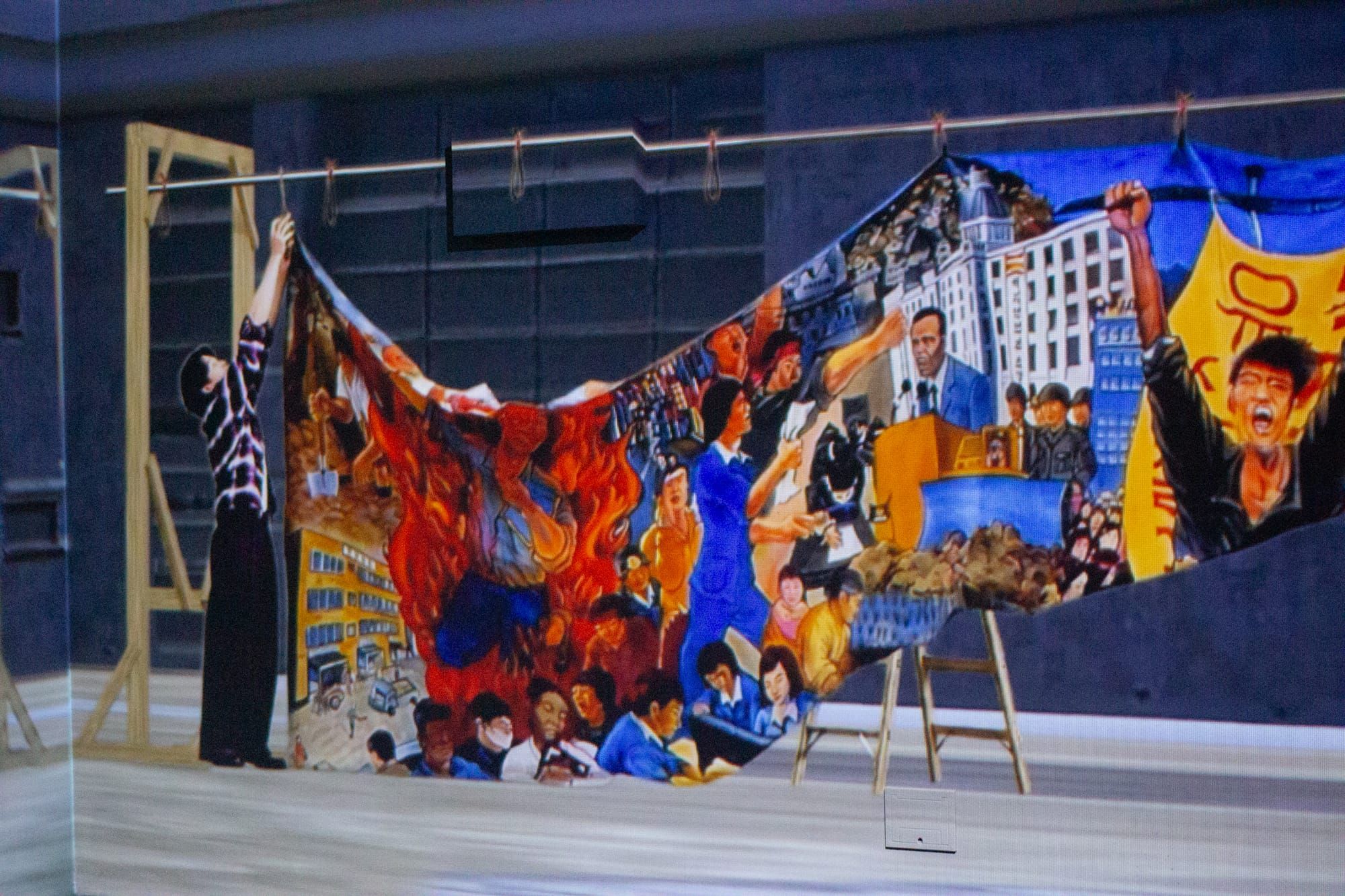
A mother holds a photograph of her dead son, who self-immolated in protest of inhumane working conditions. Above her, the fire is lit; her son is still in his final moments. Beside them, authoritarian Korean president-dictator Park Chung Hee makes a speech in front of a band of soldiers. Below, teen girls work long hours in a textile factory.
These are the scenes in just one of 11 panels making up a 77-meter scroll created by a nationwide Korean activist art collective in 1989. The work was destroyed that same year after touring 19 locations in the country. But a digital restoration surfaced this spring as part of an exhibition at Gwangju Media Art Platform called “The Gap Within the Whole.”
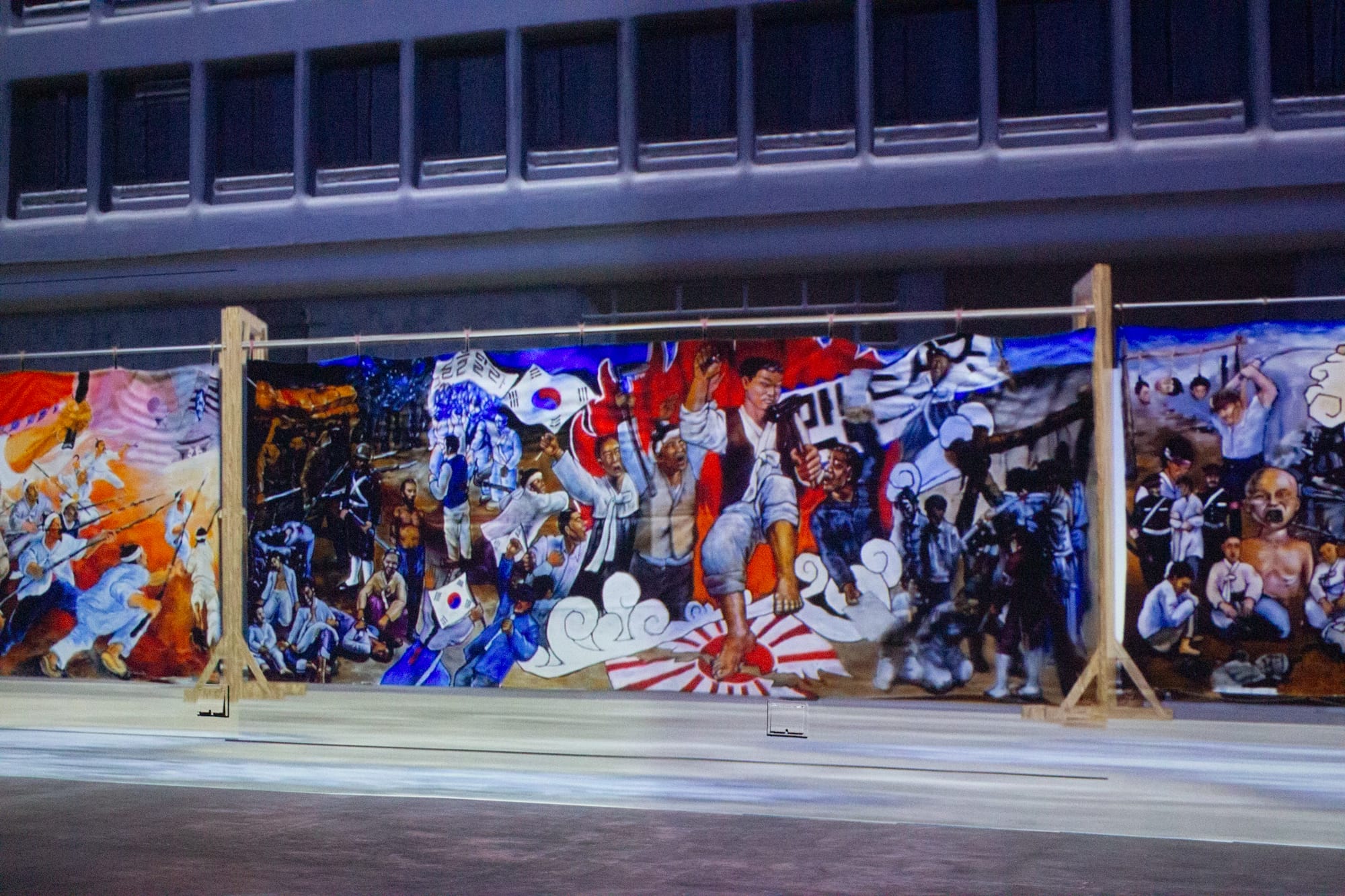
Walking around the exhibit Sunday, I kept thinking people were passing behind me. The projections aren’t limited to the art on the walls; shadows and ambient light move around the floor, plunging the scene into a living context. The panels depict 100 years of the struggle for democracy, from Japanese colonialism to U.S. imperialism to declarations of martial law. Striking scenes are collaged together in perfect placement, giving the subjects a sense of dignity: everything happened so the next thing might.
The physical scroll’s last stop was in June of 1989, at an outdoor theater at Hanyang University.
There, 8,000 riot police stormed the campus and threw the 11 panels into a pile, along with thousands of artworks the federation had created on site that week. They set fire to the pile, then destroyed the ashes that remained.
It was, as art historian Choi Yeol described in Korean in a video playing outside the exhibit, an “extremely violent act.”
At the time, Choi was a central committee member of the National Federation of the National and People’s Art Movement (Minjok Minjung Misul Undong Jeon-guk Yeonhap), a federation of grassroots movements of activists and artists in Korea. This was the group that organized the creation and traveling display of the banner.
The banner’s style, called geolgae, was an oft-used (and oft-suppressed) method of political art in the ’80s, using the shape of Buddhist hanging scrolls and elements from Korean folk art to record resistance against oppressive regimes.
On the first day of the tour, Choi took slide photographs of each of the panels. It’s the reason we have those images in full today.
The banner, Choi said, shows “a mode of making rooted in the people. It was the first of its kind in the twentieth century, and since there has been nothing like it since, it was also the last.”
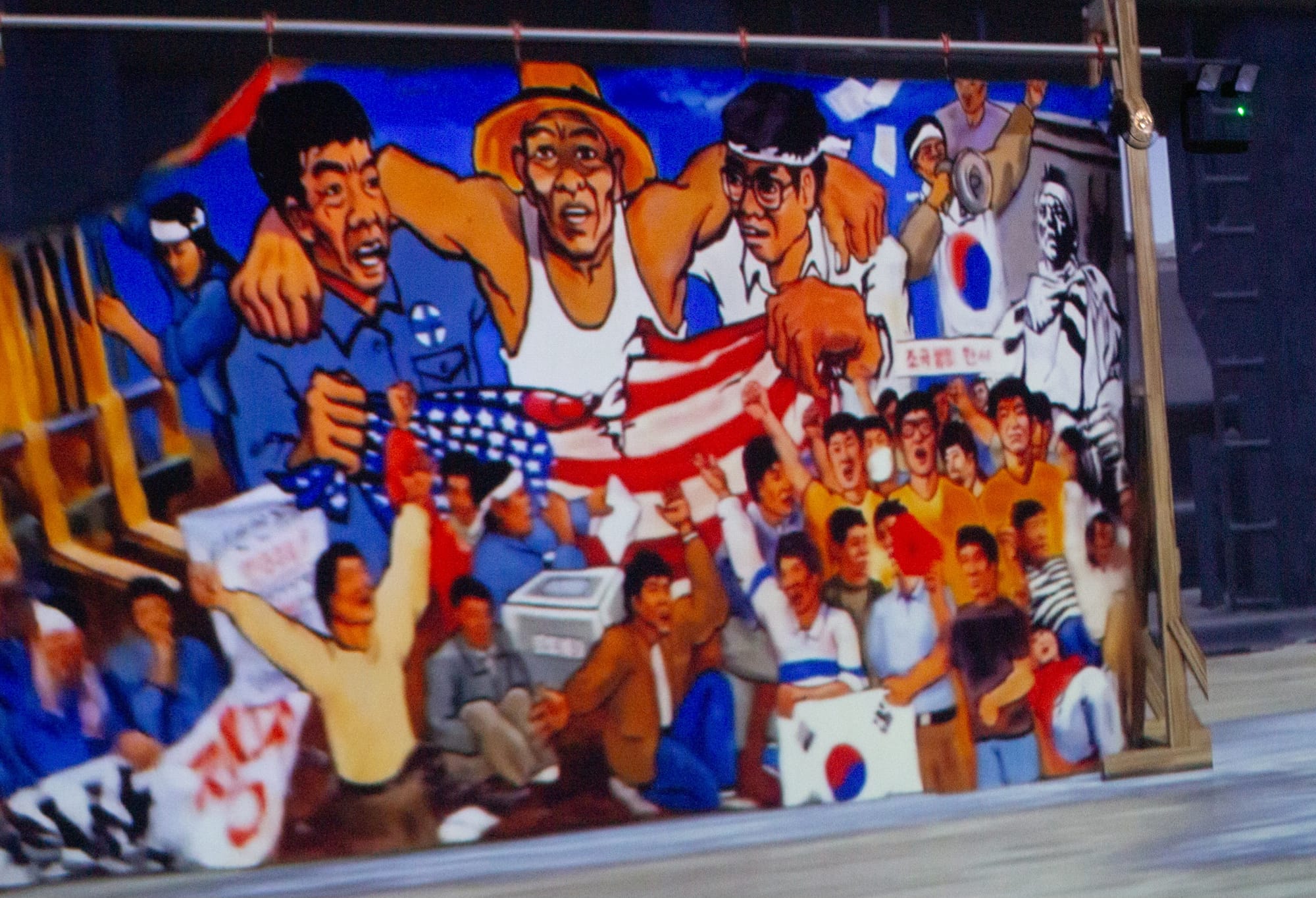
The panels depict solidarity among peasant farmers, workers, and students. Representatives from the three groups stand with their arms around each other, fighting together.
The panel with the self-immolation illustrates the movement against the Yushin Constitution of the 1970s. It was an oppressive government, granting the executive branch unfettered power and cracking down on any sign of social deviance. For workers, conditions were dire. In 1972, labor activist and textile worker Jeon Tae Il set himself on fire in protest. In shades of orange and red against bright blue, the banner shows not only Jeon’s final act but the movement that erupted as a result.
Another key theme in the banner is the reunification of North and South Korea, an ambition whose definition of “success” changes as the years go on. When my immediate family was last living in South Korea, the split was only a generation old. Now it’s too late for some (all four of my grandparents, who left North Korea, died without seeing the family they promised to come back for), and the hope for reunification is alive but different.
At the time of the touring banner, the federation had set their sights on traveling to Pyongyang, North Korea, for a special convening of the group’s World Festival of Youth and Students. Before they could, the South Korean police descended upon their movement and started the fire at Hanyang.
It was a devastating last stop. The fact that the piece was created, and that it could reach 19 locations, including universities and public plazas, before its bitter end, was remarkable for an artwork so clearly against the status quo.
“Looking back now, it seems almost impossible—something that shouldn’t have been feasible,” Choi said, “but as often happens, things that seem impossible do come to pass.”
I thought my dad might enjoy seeing the anti-Yushin panel; in his twenties, he used to run from police who had full authority to cut his long hair. So I sent him pictures of the banner. He sent them back with his own notes scribbled on the sides.
Even after going up in flames, the mural was still, somehow, serving as a storyteller from one generation to the next.
Sign up here to get Gwangju Midbrow email updates delivered straight to your inbox.


