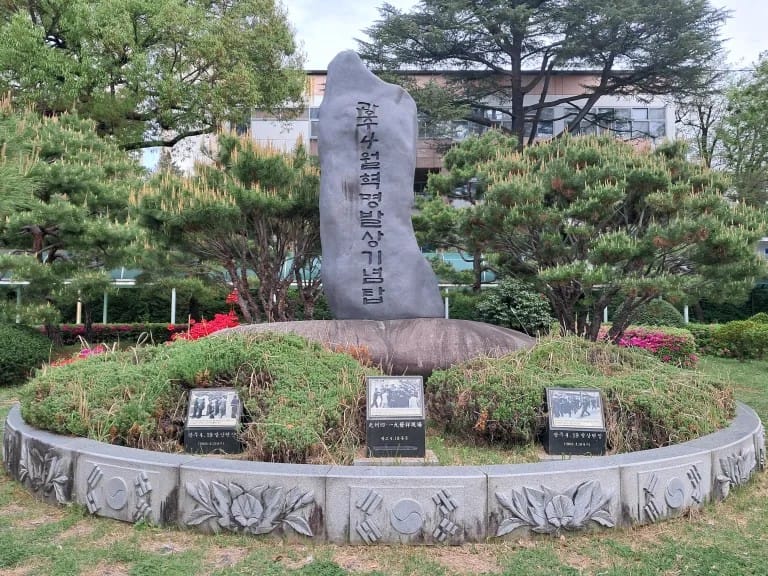
4.19 Monument
Gwangju High School
Gwangju, South Korea
April 19, 2026
(Jisu Sheen recently moved from New Haven to Gwangju, South Korea, where she’s covering local arts and culture for the New Haven Independent and Midbrow.)
I woke up Sunday to a text from my dad that began:
“It’s 4.19
“In1960, there was a revolution for democracy against dictatorship of corrupted government in Korea. I was 4, was scared watching college student marching on street. Police were shooting at innocent people and there were many casualties.”
OK, so:
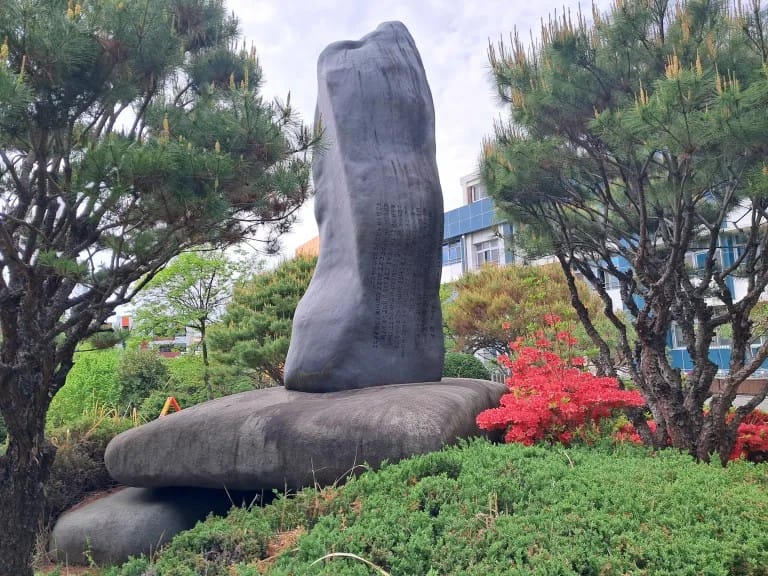
An hour later I was on a bus to Gwangju High School. There, a large stone commemorated the 4.19 Revolution as it happened in the city of Gwangju—in fact, right at the gates of the high school itself.
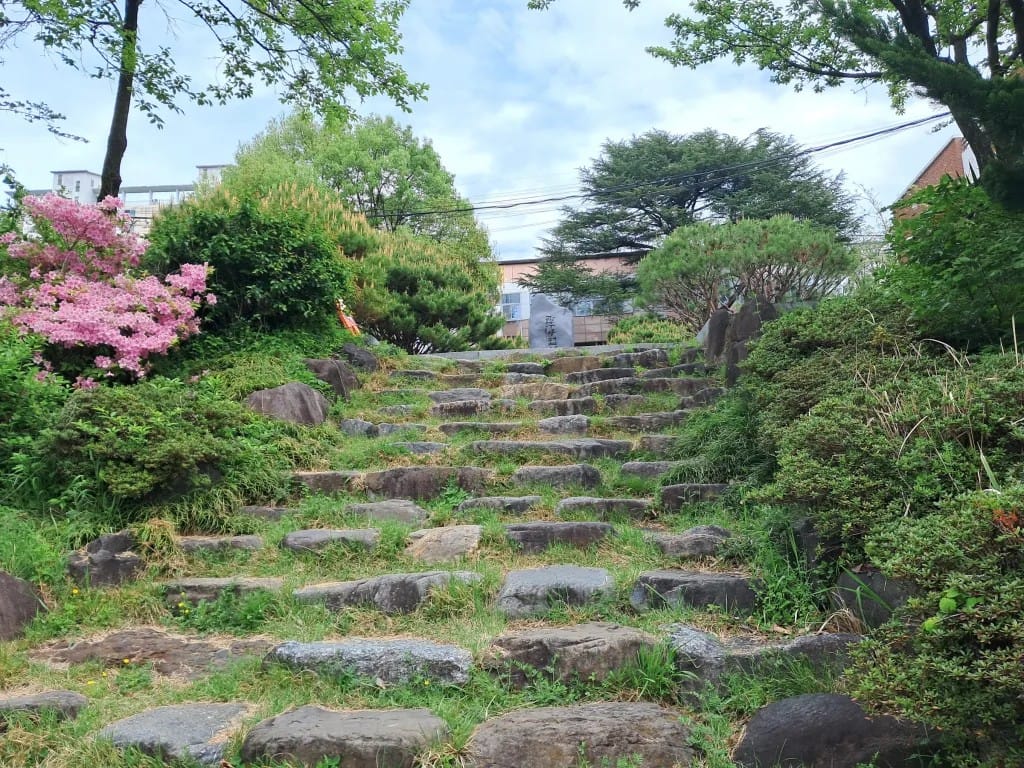
I passed through the school’s entrance and walked behind the sports field, to a set of grassy stone steps. In the distance, at the center of a clearing guarded by Korean pines, I saw the stone I had come here for. It was massive, bearing the words “Gwangju April Revolution Monument” in Korean.
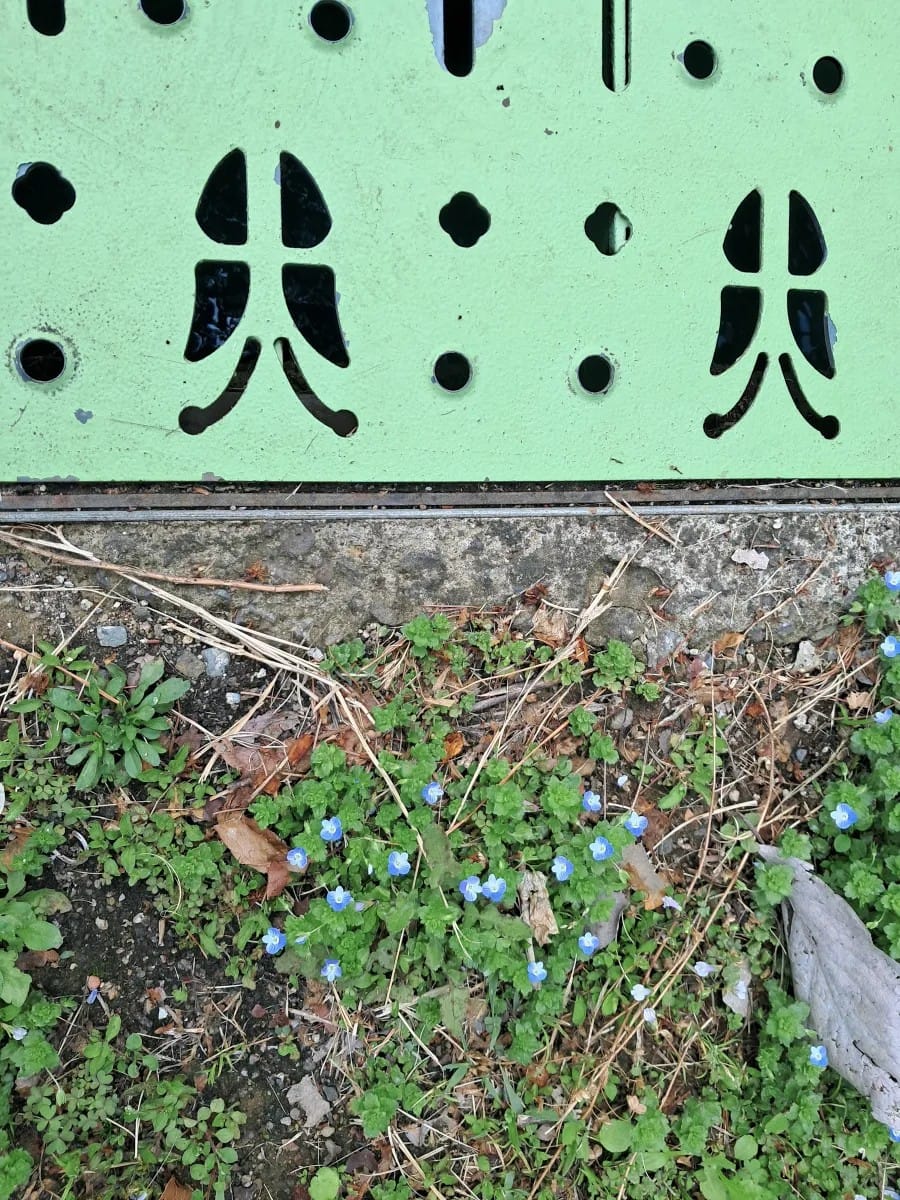
A burly pigeon cooed from a telephone wire. A lilac butterfly disappeared and appeared among the bushes, echoing the design of the school’s drainage gates.
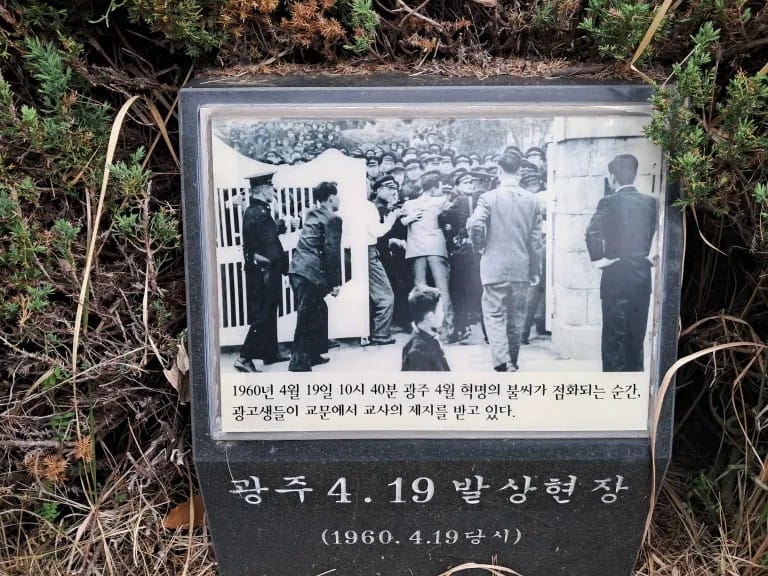
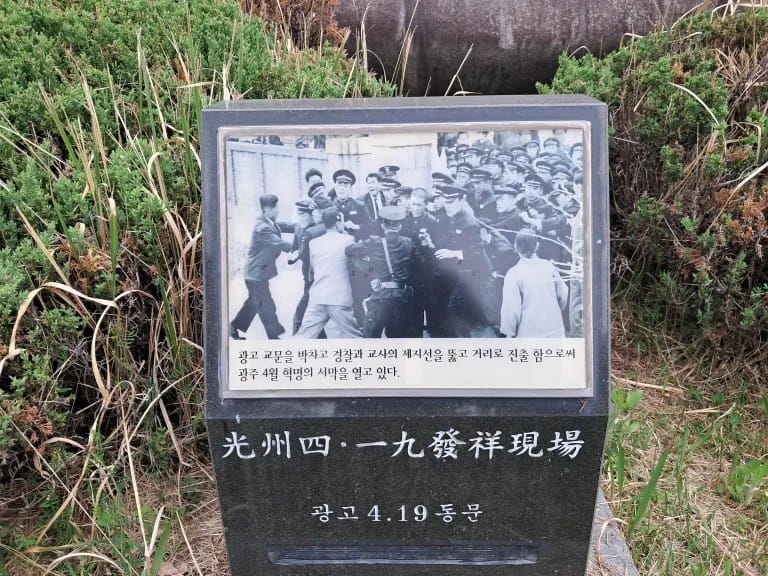
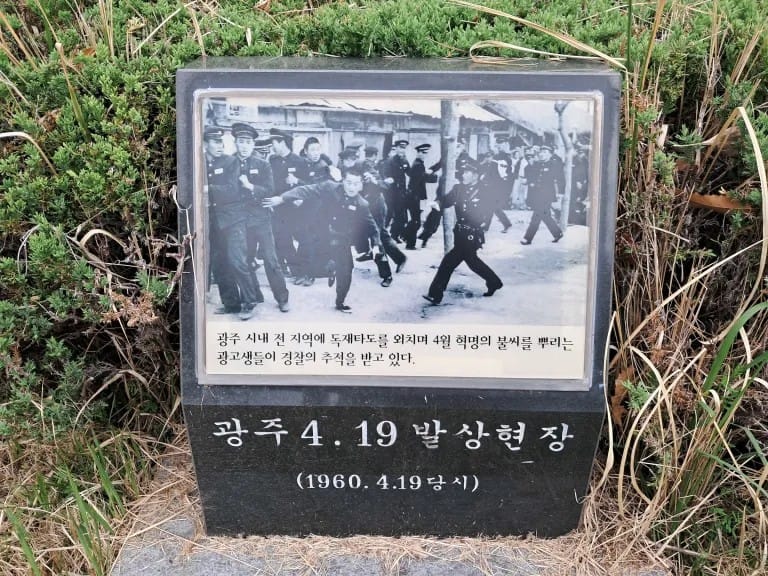
Coming from the outside in, I had made a reverse journey of the story the monument would tell. A trio of photographs on engraved markers set the scene.
1. It’s 10:40 a.m. on April 19, 1960. A teacher, flanked by police, is attempting to block a sea of students from exiting the school gates. At first glance, it looks like a commotion at the threshold. A closer look reveals the full situation. As far back as the photo’s field of view allows, rows and rows of students make it clear they are an unstoppable force.
Carved into the back of the stone monument were long vertical lines of script describing the series of events leading up to this snapshot.
One month prior, during the March 15th elections, the party of dictator Syngman Rhee, South Korea’s first president, committed election fraud. The people of Masan took to the streets.
On April 18th, students from schools in Gwangju planned a demonstration, which they announced at 9:40 a.m. on April 19th. When they faced off with teachers and police an hour later, the plans were already in motion.
2. The dam has broken. The students, most wearing school uniform caps—one missing his cap, likely fallen in the struggle—push past the authorities, backing each other up as they begin to flood the streets of Gwangju.
I wonder if it crossed their mind at the time that they would one day be celebrated by their own school for this act of resistance. I wonder what the teachers thought as they allied themselves with the cops.
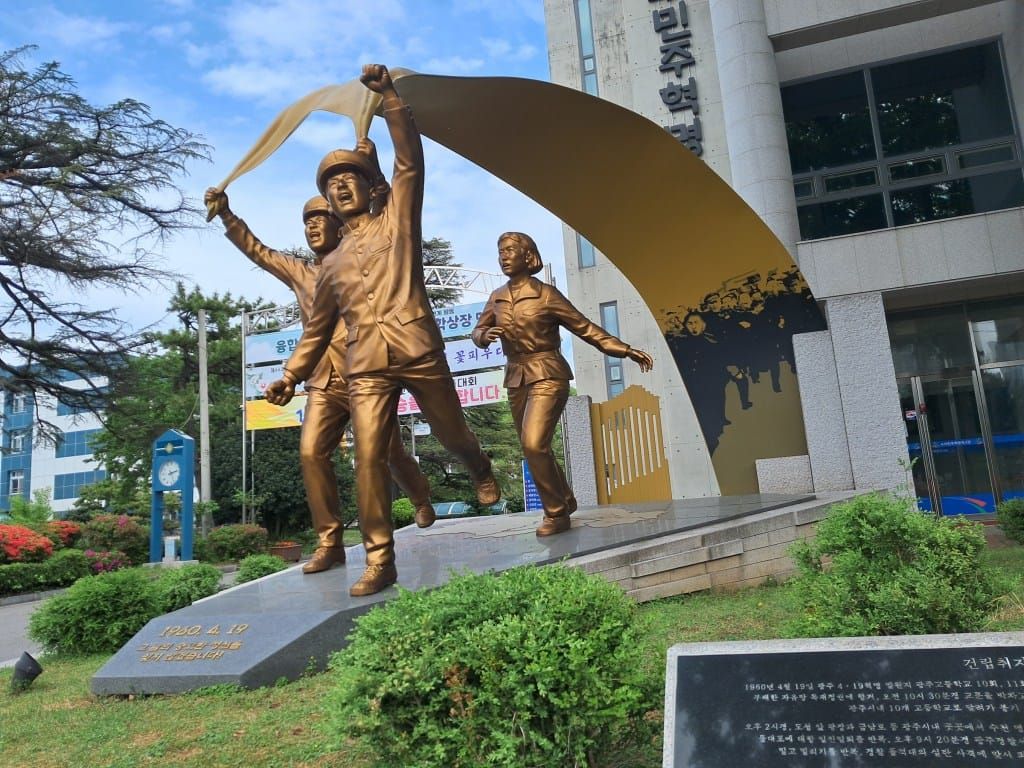
In addition to the stone monument, Gwangju High School has a sign at the school’s front gates reading “Cradle of the Gwangju Democratic Revolution” in Korean. A few paces back, larger-than-life statues of student protesters rush toward a new era for the country. On weekdays, visitors can enter a museum dedicated to the history of the 4.19 Revolution.
None of this feels inevitable. It feels like an ongoing story, one I am learning out of order.
For example, Syngman Rhee may have ended his career in shame as a result of the 4.19 Revolution. But how did he start?
This was a man who got his B.A. in D.C., M.A. in Massachusetts, and PhD in New Jersey. According to a now-declassified C.I.A. document titled “Prospects for Survival of the Republic of Korea,” Rhee gunned for a “strong executive system modeled after that of the U.S.”—the kind of system, I’m noticing, that would allow the declaration of martial law, which Rhee first invoked just two months into the new government.
How much of Korea’s modern history has been shaped by the imaginations of the culture I am supposed to be familiar with, the one I’ve lived in for 28 years? Why did my dad never tell me about his memory of the 4.19 Revolution? How did I never do the simple math to know he was alive for it? Sometimes I fear the human lifespan is not long enough for me to understand it all before I croak. I’m going as fast as I can.
3. The students run through downtown Gwangju, calling to overthrow the dictatorship. They are being chased by police. These are, as the photo caption describes, the sparks of the April Revolution.
The stone is tall and silent, casting its shadow on the path students once took to rewrite the script for South Korea. It’s irregular enough to be natural, aligned enough to evoke a sense of rightness. Part of its beauty is the approach from below, the way the piece emerges from the center of the space. Then there is the journey around the stone, through the pines and flowers, to read the story on its back.
Maybe it wasn’t a surprise to the 4.19 student protesters that their rebellious acts would come to be honored like this. Maybe, even then, they could guess.
Sign up here to get Gwangju Midbrow email updates delivered straight to your inbox.


