
The Murmuring 2: Habitual Sadness
Dir. Byun Young-Joo
Jeonju Film Festival
Jeonju, South Korea
Apr. 29—May 8, 2026
(Jisu Sheen recently moved from New Haven to Gwangju, South Korea, where she’s covering local arts and culture for the New Haven Independent and Midbrow.)
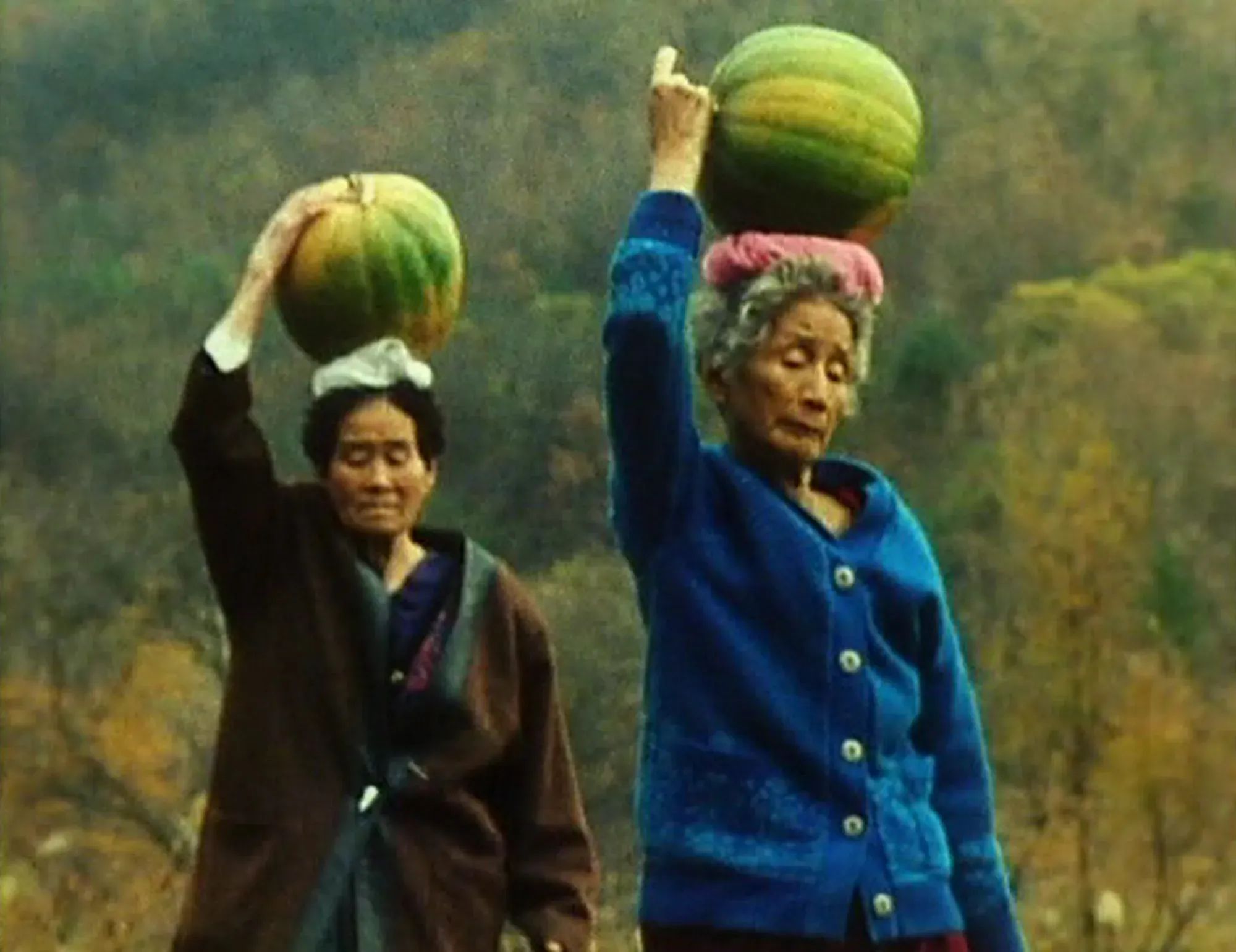
Against a backdrop of lush greenery, a woman in the distance drops a pumpkin.
A young woman appears in frame, coming to the rescue. She’s not just running; she’s frolicking, taking tall leaps through the grass.
So begins just one of the pivotal moments in director Byun Young-Joo’s The Murmuring documentary trilogy that almost didn’t happen.
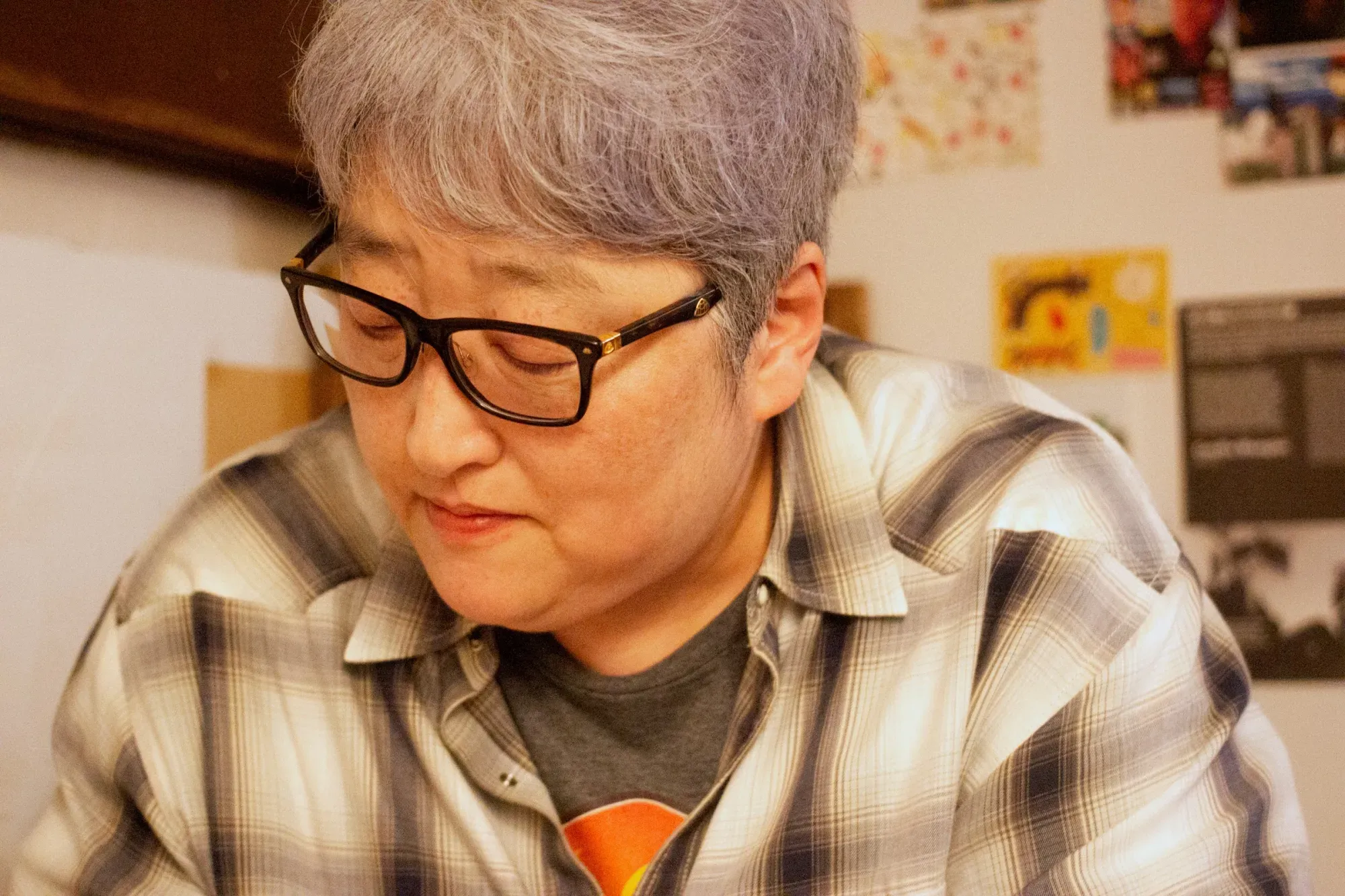
The second of the series, Habitual Sadness, is currently playing at the annual Jeonju International Film Festival, where Byun has been recognized as the 2026 Programmer of the Year. I got the chance to chat with her in between talks and screenings with the help of interpreter Taeksoo Jang.
The trilogy, released in the later half of the ’90s, tells a truth so impossible to tell, thousands of women were ready to let it die with them. Eighty thousand young women and girls were forced into sexual slavery during Japanese colonization, 60,000 of them Korean. After Korea’s “freedom,” the survivors made it home, only for their families to ask why they returned alive.
The camera meets them in their 70s and 80s, after one woman has told her story and others have come forward with their own, finding community after decades of silence. The women extend life-giving affection. They also curse, drink, and make fun of each other.
“If there’s anything good in me,” Byun said in Korean at a coffeeshop off Jeonju’s Film Street, “it’s because of these women.”
Thirty years later, Director Byun has made feature films like Ardor and Helpless. As Programmer of the Year at the Jeonju International Film Festival, she’s been invited to screen some of her favorite films and her own works for the bustling crowds.
The festival, in Byun’ words, is a place to discover independent, alternative, and arthouse films. When I asked how this came to be, she said it was partially the need to find a niche that hadn’t been taken yet—but it might not have worked if it wasn’t Jeonju.
The city has the image of traditional Korean art, Byun noted, which is something outside the mainstream. This existing personality blended well with a festival that rejects commercial tastes.
It was the kind of festival that, in deciding a Programmer of the Year, would look to a director unafraid to see the bigger picture.
Before coming together as grown women in the ’90s, Byun said, each of the subjects of The Murmuring thought she was the only one left. Scattered and isolated, the women sat at home watching news reports that attempted to erase the horrors of colonization.
The women hid the truth even from their husbands—often strangers their parents had married them off to and with whom they later parted ways. Because of the brutality of the rape they had been through, most were not able to have children. They were excluded from the kinds of family structures they dreamed of.
After their disclosures, a group of Buddhists opened the House of Sharing, inviting the now-elderly women to live together, share meals, and paint. Every Wednesday, without fail, the women would go to demonstrations demanding the recognition of what had happened to them as a war crime.
Byun lived among the women for over a year before they let her start filming the first The Murmuring documentary.
I asked what those months were like. What if after all that time, they had said no?
No big deal.
If she didn’t earn the women’s trust, Byun said, she would just give up. In life, things come and go.
As fate would have it, the women did warm up to Byun and her team. They moved to a different house after a year and a half, and everyone could sense this might be the moment to start filming. The crew prepared.
Then the moving company dumped the women’s luggage outside the new house without bringing it in. There was no electricity. It was snowing, in the middle of April.
The crew didn’t film at all that day. Instead, they helped the women move in. Byun’s assistant director knew electrical. Finally, the women felt that Byun’s crew was on their side.
Without the “foundation for good” that formed inside her at the House of Sharing, Byun said Ardor, Helpless, and the rest of her films would have come out differently. In her eight years filming the Murmuring series, she learned how to think—how to face the world and her emotions.
In Habitual Sadness, the women have moved once again, to a town in the countryside called Toechon. There, they grapple with the impending death of one of their house members, Kang Duk-Kyung, a prolific painter Byun has gotten particularly close with.
Death takes on a special meaning for these women. Time is ticking, and they don’t want to die before seeing their true history in textbooks. Sometimes it seems they are living long to spite the governments who want them gone. (As recently as 2019, I remember a statue commemorating these women that was placed in front of Yale’s Asian American Cultural Center and removed within two weeks, for what I would say is a bullshit reason.)
For days leading up the pumpkin scene, the women would ask Byun and her crew when they were going to film the pumpkins they farmed.
Byun didn’t get it. Where would a scene like this even fit? Film was expensive.
But the women wouldn’t stop asking, so one day the crew asked each other: Should we just go along and pretend to film?
It’s a rare wide shot in a documentary full of close-ups. From that distance, the crew figured, the women wouldn’t be able to hear whether the camera was rolling or not.
Then Byun felt bad, so she thought: Let’s just film for five seconds.
The scene opens quietly. Two women hold their pumpkins.
Then it happens.
Kim Soon-Duk’s pumpkin rolls away, and a young Director Byun runs after it, crossing into frame.
Remembering it later, she said she didn’t care about how she showed up on screen; this footage wouldn’t end up in the film anyway.
Or would it?
Running through the field, racing to get to the gourd before the women put themselves in danger trying to pick it up, Byun felt a sudden happiness.
She considered the whole situation. Why am I running? And why are they putting so much effort into carrying these huge vegetables?
Later, slightly out of breath, she would ask Kim directly, “Why did you ask us to film you carrying these pumpkins?” And Kim would reply, “Because we grew them ourselves.”
That was after, when the decision had already been made. In the moment, Byun didn’t need a reason to keep the scene. It was something she knew inside, that she didn’t know before she started running.
On screen, Byun, now also in the distance, bends down to find the pumpkin and places it on Kim’s head. She lets the women play out the rest of the scene as they wanted, walking across their farm with the fruits of their labor.
Byun ended our conversation with one last note for young directors: please don’t forget to watch films by your peers. People think there’s nothing to learn from each other, but that’s not true.
“This is your generation for several decades,” she said. They will be making movies together for a long time. She thought of her own cohort. Park Chan-wook, Hong Sang-soo, Bong Joon Ho—”it’s been like twenty years” the directors have spent alongside each other.
She wasn’t just saying this as an accomplished filmmaker. She was saying it as someone forever changed, right at the start of her career, by a group of women determined to live a good life.
Sign up here to get Gwangju Midbrow email updates delivered straight to your inbox.


