
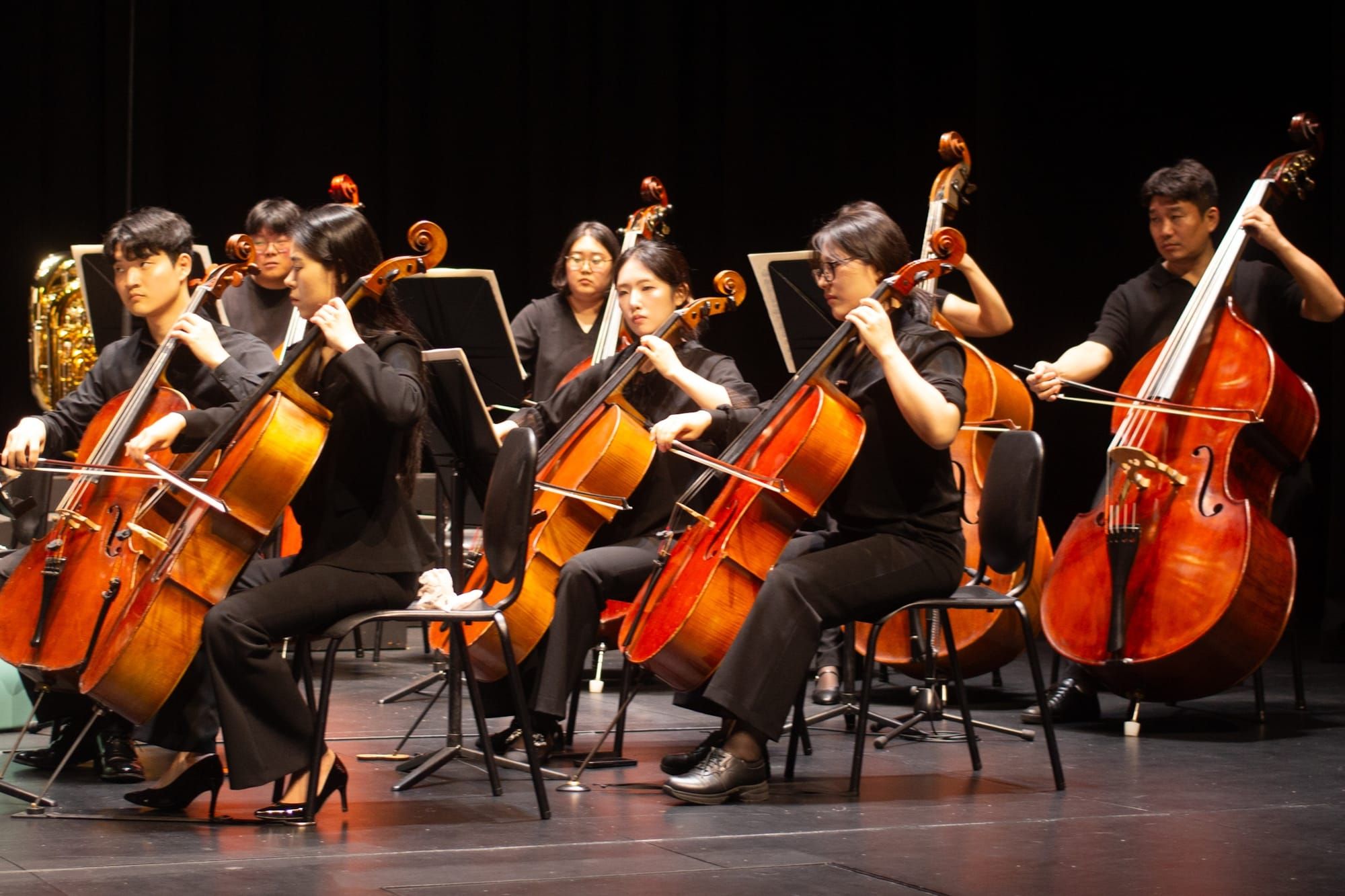
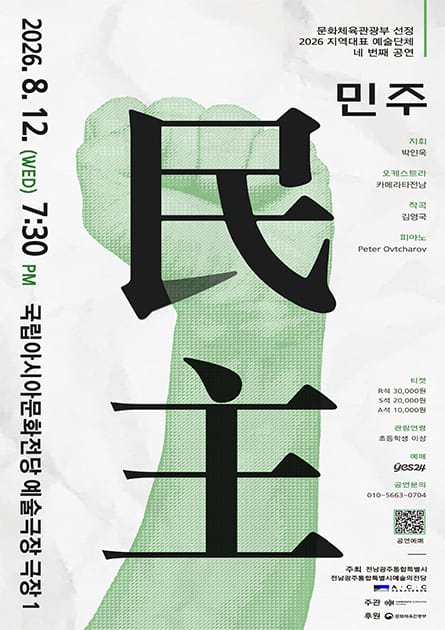
Camerata Jeonnam Orchestra
민주 (Democracy)
National Asian Culture Center Theater 1
Partners: Jeonnam-Gwangju Special Integrated City and the Ministry of Culture, Sports, and Tourism
Aug. 12, 2026
(Jisu Sheen recently moved from New Haven to Gwangju, South Korea, where she’s covering local arts and culture for the New Haven Independent and Midbrow.)
What feels impossible about nature, I realized from my seat in row E at Camerata Jeonnam Orchestra’s “Democracy” performance Wednesday, is the lack of a linear relationship between strain and result.
It takes as much time for the wind to move a blade of grass as it does to draw sweeping patterns across a field. On the stage in front of me, the orchestra’s melodies flowed from pensive single notes to intricate blooms with the same readiness.
In day-to-day life, I love visible effort. I love being an individual person. Opposites attract, and maybe that’s why puny humans are drawn to the magic of large-scale phenomena.
Resilio, the first piece of the night, was like a film score, fueled by a strong narrative. It’s the creation of 김영국 (Kim Young Guk), a Korean composer and professor at Sunchon National University in the east of Jeollanam province. The Camerata Jeonnam Orchestra, a blend of students and professionals, has a special focus on uniting the Jeonnam (A.K.A. Jeollanam) region.
The piece started with an eerie tremolo on strings, followed by a warning blare of brass. Woodwinds added the sound of objects falling in graceful succession. Percussion twinkled over the orchestrated scene.
At intermission, I saw my aunt had texted me, a new kind of occurrence since my move to Korea. She said she was reading Han Kang’s Human Acts, which opens with the Gwangju youth facing death in their fight for democracy in 1980, known as 5.18.
고모는 광주 사랑해, she had written. 5.18에 너무 마음 아파.
(I love Gwangju. 5.18 breaks my heart so much.)
Up close, the musicians were giving their all to the “Democracy” concert. The artistry, storytelling, and physical movements added up. I could see how much they poured into the music.
Together, the orchestra showed no signs of fatigue. It was an experience of humans approximating nature, playing without hesitation toward whatever might come next.
I thought of the coordinated movements of a political uprising. From the food to the songsto the local pride Gwangju carries to this day, the nature of the 5.18 protests feels personal.
In Human Acts, each character had their own self-driven reasons behind the fight, no less important than their goals as a whole. Their movement was something separate from event production, project management, working at a company, or any other social structure bound by the issue of “scaling.”
After the show ended, I checked my phone again. My aunt had texted about her visit to the bullet-marked Jeonil Building 245 in Gwangju last year and told me more about her feelings on 5.18.
광주 사람들에게 미안한 마음이야.
(I feel apologetic toward the people of Gwangju.)
한국이 이만큼 자유롭게 사는것은 광주 5.18 덕분이야.
(It’s because of 5.18 in Gwangju that Korea can live so free.)
Resilio set the context for the pieces that followed, by composers Edvard Grieg from Norway and Jean Sibelius from Finland. The night’s selections found throughlines between national pride, natural wonders, and respect for the spirit of independence.
As Resilio was entering its full shape, the orchestra built up a feeling of creeping danger. A motif of four tones dropped in a decisive slope, alternating with the tension of the high notes.
Danger gave way to sounds of tragedy, then horror. Dissonant, complex single chords chrystallized attention in whole-orchestra moments. A drum rattled.
The piece’s macabre atmosphere held for a while, then broke into a sense of awe. There was a reverent silence, empty except for a ring carried over from the percussion. Little by little, low strings came in with a melody, repeating as the sound blossomed into a noble, grand ending.
Sign up here to get Gwangju Midbrow email updates delivered straight to your inbox.


