Brelyn Wooten-Harvin, 13, wasn’t a big talker. She liked to keep to herself. Then something changed.
Because there she was, at Yale’s Strathcona Hall on Friday night, swearing in witness after witness as the bailiff during a mock trial. There she was, in late July, puzzling out drills on critical thinking skills led by University of New Haven math professor Yevgeniya Rivers and, later that day, identifying the logical fallacies in each of the candidates’ arguments after a political debate at Edgewood Park’s Coogan Pavilion.
“Every one of these students is coming alive, but Brelyn is taking our breath away,” RE-CEE Academy founder Marcus Harvin told a crowded courtroom at the beginning of Friday’s mock trial, “In the Matter of the Estate of Hip Hop.”
RE-CEE Academy, which is short for “reconsidering your roles and rights in the system,” is a free summer program that’s designed to have the participants literally re-seeing themselves and what they can do. Nine students from the New Haven area are taking part.
Yale Law Professor Elizabeth Hinton has provided space at the university to host the program, which is open to anyone from the ages of 13 to 18 and meets at Strathcona Hall three times weekly from 9:30 a.m. to 1 p.m.
“This is about placing these young people in positions to succeed,” said Harvin, the head of the nonprofit Newhallville Fresh Starts and a second-year student at Western New England School of Law; a half-dozen of his classmates serve as coaches in the program. “The world gives these young people negative reinforcements every day. We are here to change that.”
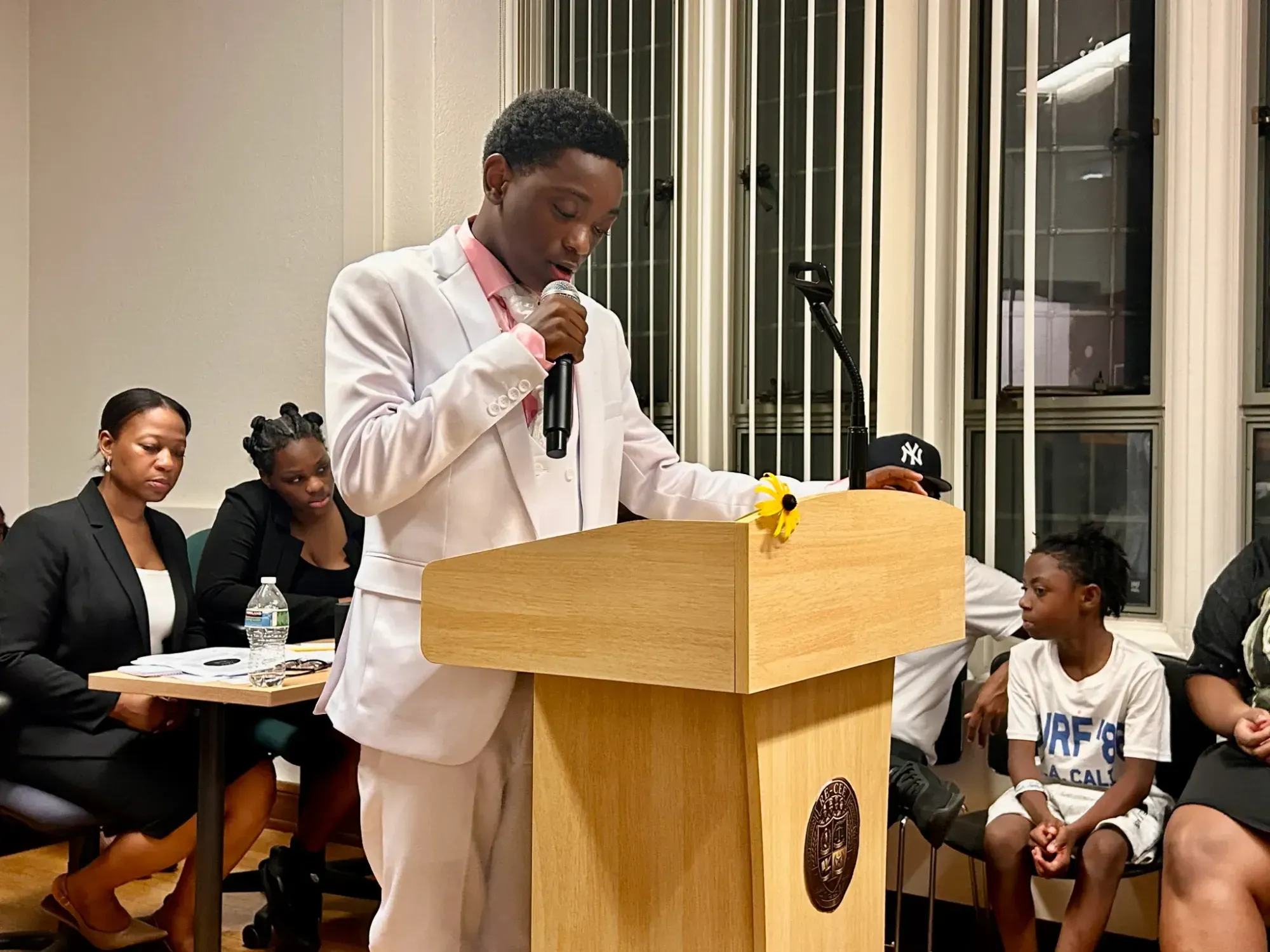
With that, Harvin signaled Telihl Streater, 14, an incoming freshman at Achievement First Amistad High School, to lead the court in a recitation of the RE-CEE decree.
“I shall be the best version of myself, every day for the rest of my life, because I have too much inside of me which the world needs and deserves,” Streater, stylishly attired in a white suit, read.
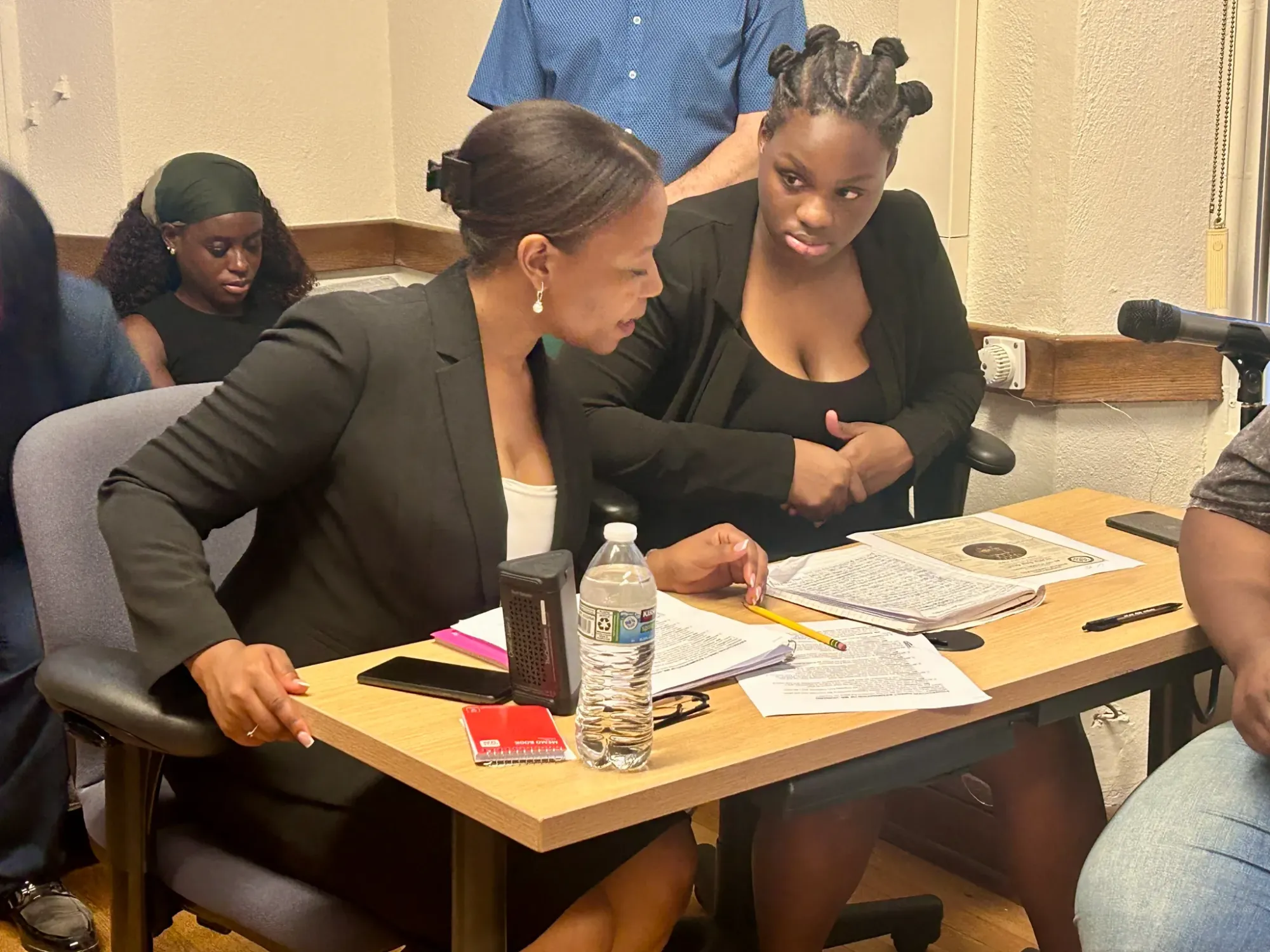
Brandese Wooten-Harvin, Brelyn’s older sister, delivered the opening statement for the people, arguing that hip hop was dead. “Hip hop was never just about rapping,” she began, as mother Jamese Harvin looked on with pride. “It was a whole culture, and today that culture has been occupied and consumed by big record companies that care more about money than art and that create fast and simple tunes just to go viral instead of making music with real meaning.”
“Relieved it’s over,” she said later. She said she had spent the last three days preparing, including a Zoom call the night before with co-counsel Catherine Robinson, among Harvin’s second-year law school classmates. “My big thing was to keep my voice strong and steady.”
Following Telihl Streater’s opening statement, a parade of witnesses took the stand. Under questioning by Robinson, law student Rickey Howard played Public Enemy’s 1989 “Fight the Power” protest anthem to establish that current hip hop, with its lack of substance, was “pure trash,” as he put it, and consequently dead.
Marcus Carpenter, who’s been spinning tunes as DJ Marc Mecca for the last four decades, characterized 1986 as the beginning of the end for hip hop when Run DMC formed a collaboration with Aerosmith on “Walk This Way” “It brought the two cultures together but then it started being plagiarized and diluted,” he said.
Jose Candelario, formerly a deejay with WYBC, countered that the changes to hip hop’s sound and nature are a result of the natural cycle of any musical genre, including jazz, classical, and pop. “Hip hop is alive and well as an essential form of expression to tell our stories and to heal ourselves,” he said.
As the evening deepened, thunder rattled the windows. The rain picked up. A few drops landed near the gavel of Song Kim, who was serving as judge for the evening. Kim, a civil rights lawyer who’s currently with the CT Bar Association, facilitated the acceptance of RE-CEE Academy as the first ever community mock trial team in its mock trial program, Harvin said.
After a recess where jurors, attorneys, court officials, parents, and siblings enjoyed pizza donated by da Legna at Nolo, as well as cupcakes, deliberations followed. They were brief. Jury forewoman Lindy Lee Gold announced the verdict. Hip hop was alive and well.
“I was hoping for a hung jury,” Harvin told the courtroom with a wry smile, referring to an outcome that has the jury unable to reach a final verdict. “But I think on this night everybody won.”