오월의 꽃, 다시 오늘의 빛 (Flowers of May, Light of Today)
5.18 Democracy Square
Gwangju
May 15-17, 2026
(Jisu Sheen recently moved from New Haven to Gwangju, South Korea, where she’s covering local arts and culture for the New Haven Independent and Midbrow.)
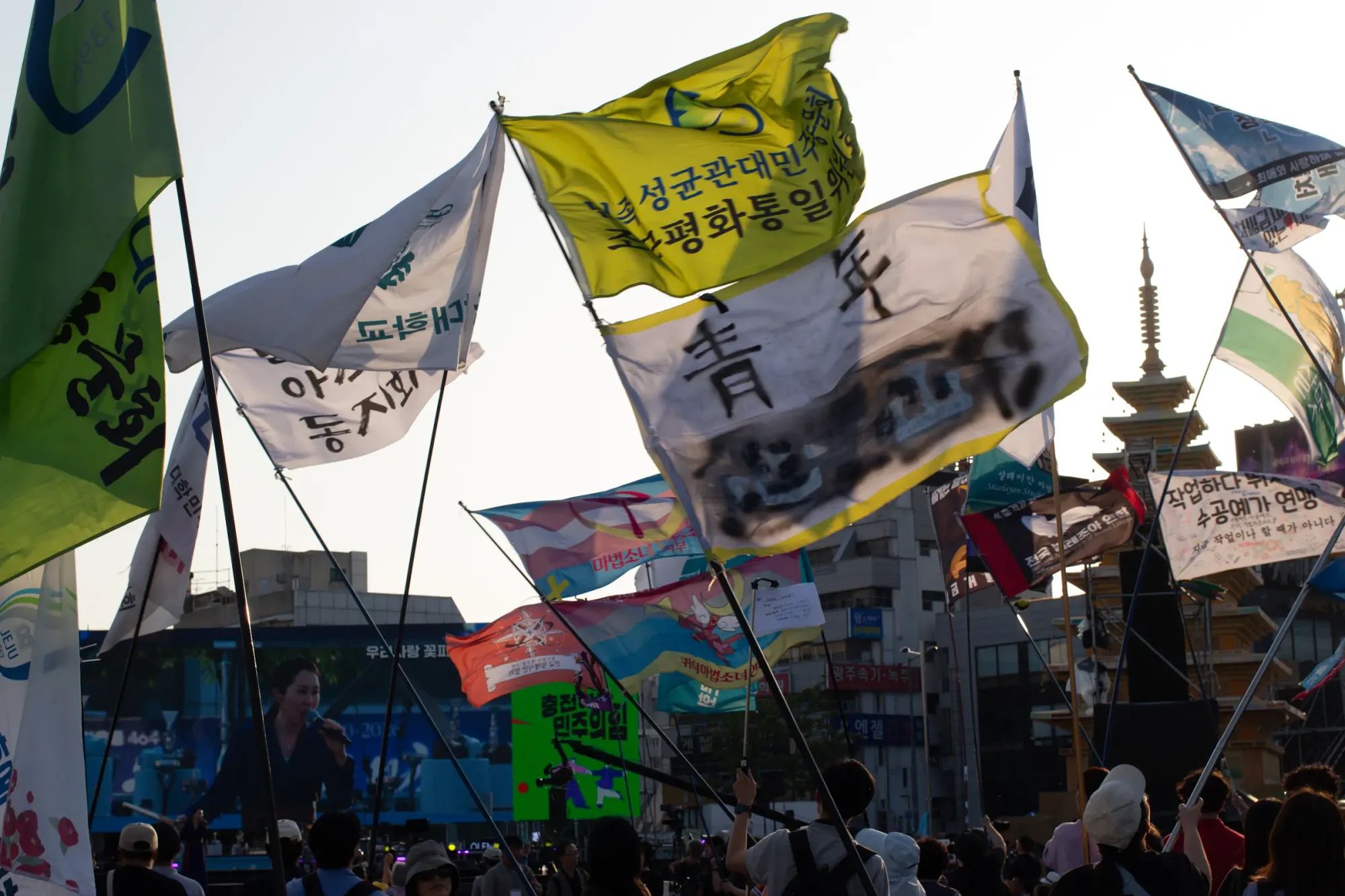
At 5.18 Democracy Square in downtown Gwangju Saturday afternoon, horns blared a single note. A massive crowd had gathered for a multi-day program called “Flowers of May, Light of Today,” honoring the memory of the Gwangju Democratic Uprising in 1980. The horns kept going as people lowered their heads and closed their eyes.
Then the horns stopped. Chimes in the distance began playing a familiar melody, a march song called “임을 위한 행진곡,” Marching for Our Beloved.
Somehow, the song had been in my consciousness for a while, but my first clear memory of it was from a year and a half ago.
In 2024, I had been trying to visit Korea for at least two years. I opened Al Jazeera’s Asia section late one night to see a headline about Korea with the words “martial law.” A few weeks later, I landed in Seoul.
In the large-scale protests calling for the impeachment of the president, the impeachment of the prime minister, and the disbanding of their right-wing political party, I had the feeling I might be able to meet members of an older generation in the crowd—people who remembered the declaration of martial law in Korea in 1980 and the tragedy that followed. I had always wanted to talk to these elders to better understand my mom, who was active in protests in Seoul in 1980. But a variety of factors (language, geography, feeling like: Who am I to dig up people’s trauma?) prevented me from getting more info.
On the street, to the background sound of Christmas songs turned into protest songs, I met a man who told me he had been in the streets in 1980, watching police attack young demonstrators and getting beaten himself. To him, democracy was not a given. It was a right his peers had died for. He told me his story with an urgency, making sure I understood past the language barrier. Then he started singing.
The first lines of the song, the same “Marching for Our Beloved” song I would hear again the next day at an emergency demonstration after the prime minister’s impeachment and again more than a year later in Gwangju, are about endless love and commitment toward the people who were killed in 1980.
The man was just on the sidewalk, no speaker, no mic, but his song cut through the winter air with a sharp clarity. People stopped to listen.
Back in the 5.18 Democracy Square Saturday, the chimes finished their wordless melody, and the voices of the people joined for Round Two. The crowd knew the lyrics. They raised their fists to the beat of the song; it was not just a tune, or chant, or elegy. It was a march.
Its driving rhythm fit the message. The last lines of the song are a call to keep going. It is not enough to grieve. We have to get it together, to get in lockstep, to march.
Speakers on stage emphasized the age of the people who were killed in 1980—kids, really. Many were students. It felt like time had moved in two directions at once. The adults on stage, speaking passionately in honor of the young people who fought against corrupt authorities, seemed protective. They had a platform those demonstrators didn’t, and they would use it.
In reality, the students killed in 1980 were born before many in attendance Saturday. They were youth, forever. They were also elders.
When the man at the protest in Seoul sang “Marching for Our Beloved” on the sidewalk, he marched in place with his sign, determined to finish once he had started. He had a strong voice, cracking slightly from emotion, range or exhaustion; I wasn’t sure which. He told me to send his gratitude to my mom. I think we were both glad to have crossed paths.
In the crowd at Gwangju’s public square, people waved tall flags in unison to the rhythm of the music. Energy was high, and people seemed proud of the city’s role in the history of Korean democracy.
Forty-six years ago, this was one of the last nights before the military opened fire on the people of Gwangju.
In efforts to remember violent crackdowns like these, I am interested in where people’s focus lies. Does zooming in on “hope” elide the gruesomeness of the massacre that followed? Or does it respect the protestors’ long-term vision, ensuring it is not recorded in history as some kind of failure?
I am thinking of what scholars like Orisanmi Burton call the Long Revolt or Long Attica Revolt, the effort (led by survivors) to remember the Attica Prison Uprising not just as a mass killing of inmates protesting their conditions but as a successful four days of freedom and a continued fight for the future.
I wondered where the fountain was, the one surrounded by thousands of citizens in the most circulated pictures from the uprising. The one I read about in Han Kang’s book “Human Acts,” where citizens gathered to face their almost-certain death, and at the same time, the part of their spirit that could never be killed.
As I was thinking about this, water flew in an arc behind the stage. We had been at the fountain the whole time.
Sign up here to get Gwangju Midbrow email updates delivered straight to your inbox.


