말하는 시선 (Speaking Gaze)
김성재 (Kim Seong Jae)
Jeonil Building 245
Gwangju
Through Nov. 30, 2026
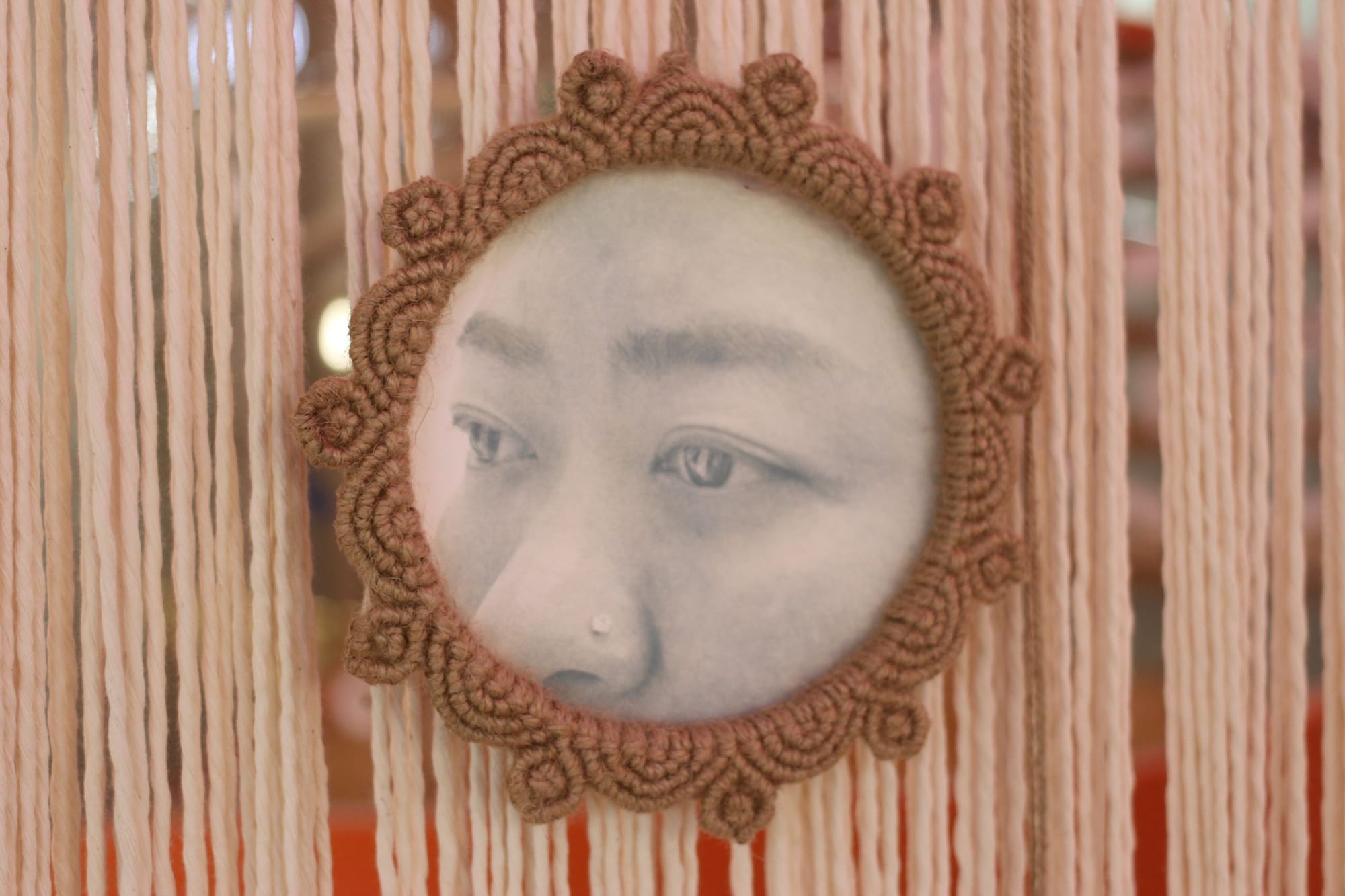
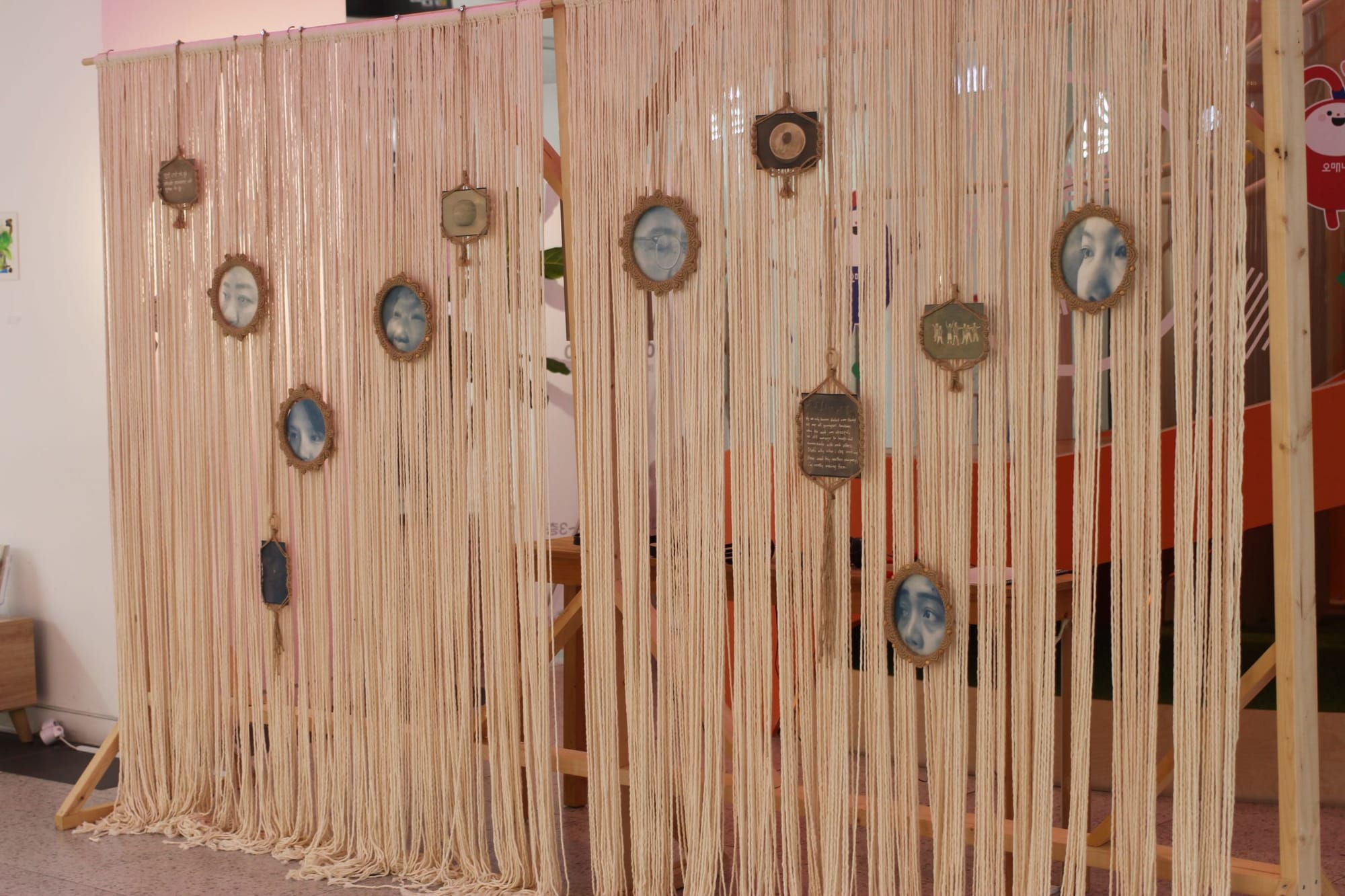
I was walking through the lobby of Jeonil Building 245 in downtown Gwangju when a pair of eyes stopped me. The eyes weren’t looking at me; they were staring somewhere in the distance. They rested against a panel of strings, part of a photography exhibit by 김성재 (Kim Seong Jae), featuring the faces and stories of migrant women.
I went back Tuesday for a closer look.
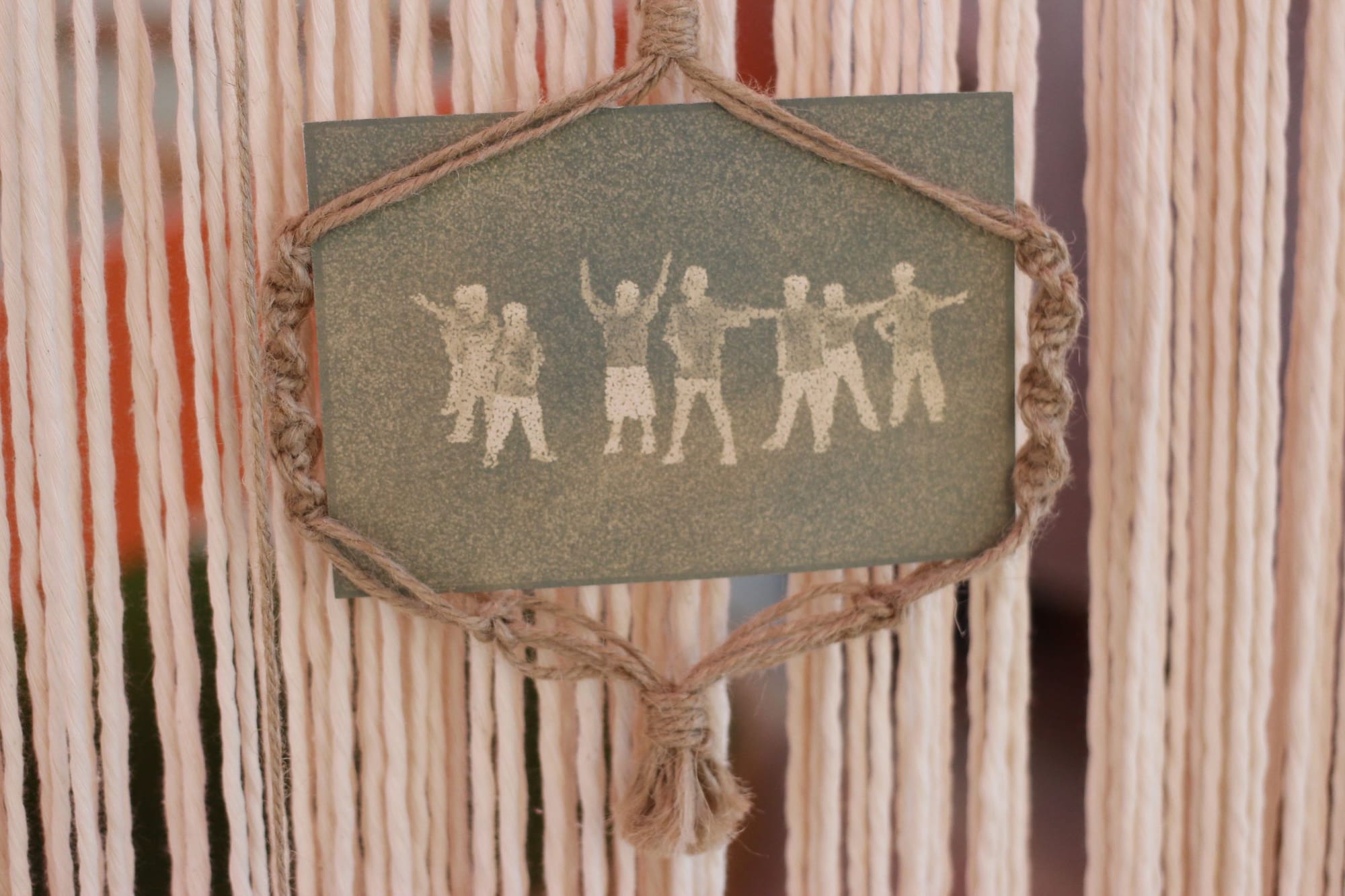
Kim’s exhibit, "말하는 시선" ("Speaking Gaze"), is a collection of photos of migrant women in Gwangju and other cities in Korea. Floating alongside the portraits are words and images of objects, like a striped melon. Explanations are found in the exhibit's accompanying notes, which include quotes from the photographic subjects as well as Kim's own thoughts while talking to them.
Behind the wall of rope and framed photographs are headphones playing dialogue from a play by one of the photographed subjects, 김봄희 (Kim Bong Hee), who came from North Korea. The script starts with a story recounted to a reporter about the night of a red crescent moon, when two friends with the same name fall asleep on a coal cart in North Korea and wake up in China.
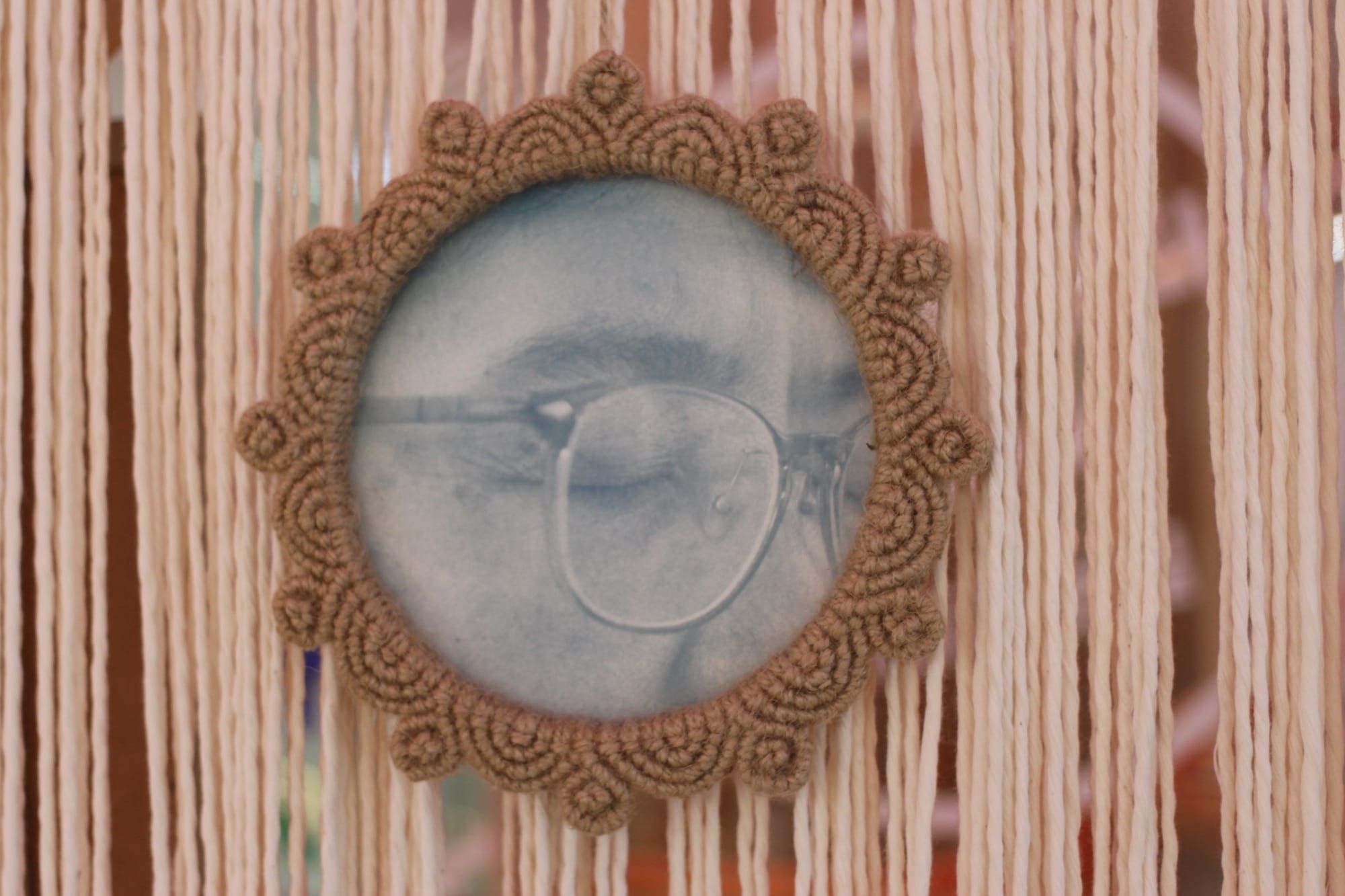
The women in "Speaking Gaze" get detailed in their stories of legal hurdles, in-law power dynamics and aging. To protect their identity in the photographs, Kim doesn’t obscure or blur them using typical methods. Instead, he goes closer, taking pictures only of their eyes.
In doing so, he turns the focus onto the wider world beyond his subjects. The eyes are gazing at something beyond what the close-up frame reveals.
The photos are printed in cyanotype, lending their subjects a dusty blue fuzz that fits well with the exhibition's intimate approach. Spaces between the innumerable tiny dots are filled in by the mind of the viewer to form edges; reality is completed through witness. It resists being determined outside the bounds of a personal experience.
In the context of the subjects' stories, this approach is a relief.
A panic crept under my skin as I read in the exhibit's notes that a child of one photo subject from Nepal, 마야 (Maya), was stateless for a while, belonging legally to neither Nepal nor Korea. When categories of people are treated as cut-and-dry, like the output of some set of all-knowing rules and laws, the barriers can seem unsurmountable.
Now, Maya's child has a visa. According to Kim's description, from the kid's point of view, nothing much has changed.
Many of the migrant women interviewed talk about their children; what style of food do they like, what languages do they speak? So far, Maya's child doesn't speak Nepali and loves Nepalese chicken curry.
Sometimes, these tastes cross generations more than once. 이스텔라 (Estella), who came to Korea from Uzbekistan, recounts a Korean melon (chamoe) she used to eat as a child.
"The pulp was so soft I would eat it seeds and all, and the peel was thin, so I would eat it with the skin on," she says in Korean in the exhibit's accompanying text.
She is Koryoin, a term referring to ethnic Koreans with cultural roots in the former Soviet Union. Kim explains in the exhibit's accompanying text that the Koryoin elders in Estella's community must have brought an old Korean variety of chamoe with them to grow and eat in Uzbekistan.
Chamoe is popular in Korea today, but like many agricultural crops, the native variety is now hard or perhaps impossible to find. Estella remembers the melon of her youth being green (compared to the modern-day yellow), fragrant and sweeter than any chamoe that exists in Korea or Uzbekistan today.
Kim frames the photographs in this exhibit with intricate knots, suspended at different heights along the strings' straight lines. The strings reach the floor, transforming in those last few inches from a wall to a soft fabric.
The photographs elevate quiet decisions and memories. In Kim's exhibit, an experience doesn't have to extend beyond a single individual to be important. Like a distinct taste or a shared gaze, its fullness lies in the moment of contact.
Sign up here to get Gwangju Midbrow email updates delivered straight to your inbox.