
Elizabeth Laprelle & Erik Ruin, World Assembly Body Opera
Studio 34
4522 Baltimore Ave.
Philadelphia
April 18, 2026
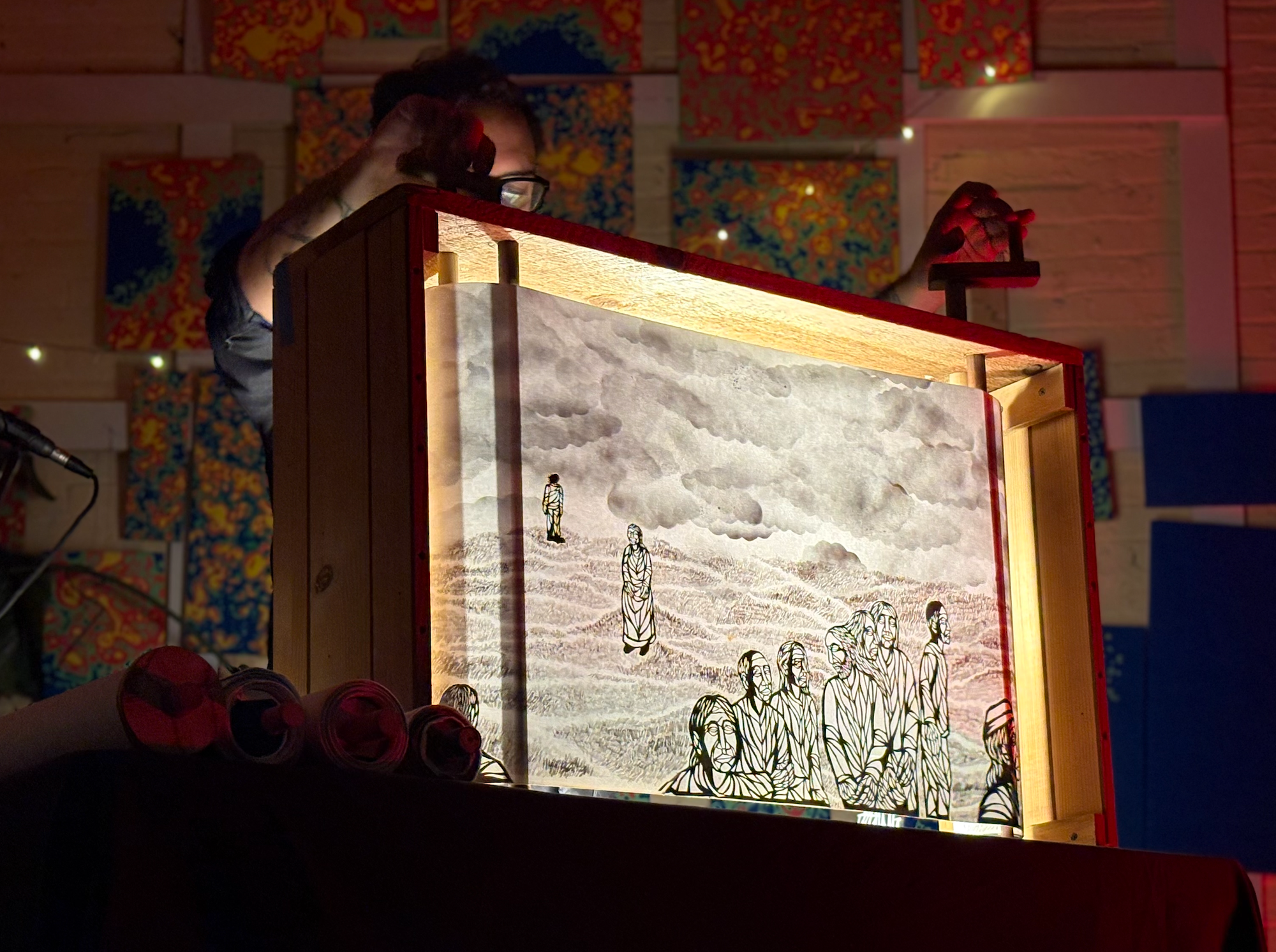
Have you ever seen a crankie show? Waaay back in the day (like centuries ago) they were called “moving panoramas” and it seems they’re experiencing something of a renaissance; I managed to witness a few different crankie performances last summer while traveling in the Carolina’s. There’s something movingly deliberate, patient and gradual about the way they function, not to mention the obvious points about handmade and analog-versus-digital, and the mechanism of the scrolls themselves in these doomscrolling times. Local artists Elizabeth LaPrelle and Erik Ruin – LaPrelle’s a folksinger and banjo player, but makes crankie scrolls too; Ruin is primarily a visual artist specializing in printmaking, among other forms – collaborated on a performance of spellbinding, meditative resolve.
With the main room’s lights strategically dimmed and Studio 34 as packed as I’ve ever seen it, the rapt audience watched and listened as LaPrelle sung and frailed a sawmill-tuning open-back banjo and Ruin hand-cranked the spools, backlit to display the consistently-dazzling scrolls. Storytelling is the beating heart of this kind of work, and the duo drew on a variety of sources: the centuries-old Child ballads (like the set-opening Scottish ballad “Jock of Hazeldean," Child Ballad 293), William Blake poems, banjo-showcase pieces like “The Cuckoo," children’s songs like “Who Killed Cock Robin?" but also works of vital contemporary import, like a spoken-not-sung piece about the harrowing conditions of solitary confinement, as described firsthand by prisoners. Ruin's visual style was unbelievably rich, and I loved his abundant enthusiasm for pairing his work with LaPrelle's wonderful singing and playing. I was especially struck by the empathetic spirit and wellspring of colorful and formal energy in his scrolls; one piece had an incredible scene with the figure of a person, surrounded by blue streams of countless intertwined wailing bodies, which gradually, with the turning of the crankie, slowly transformed into waves.
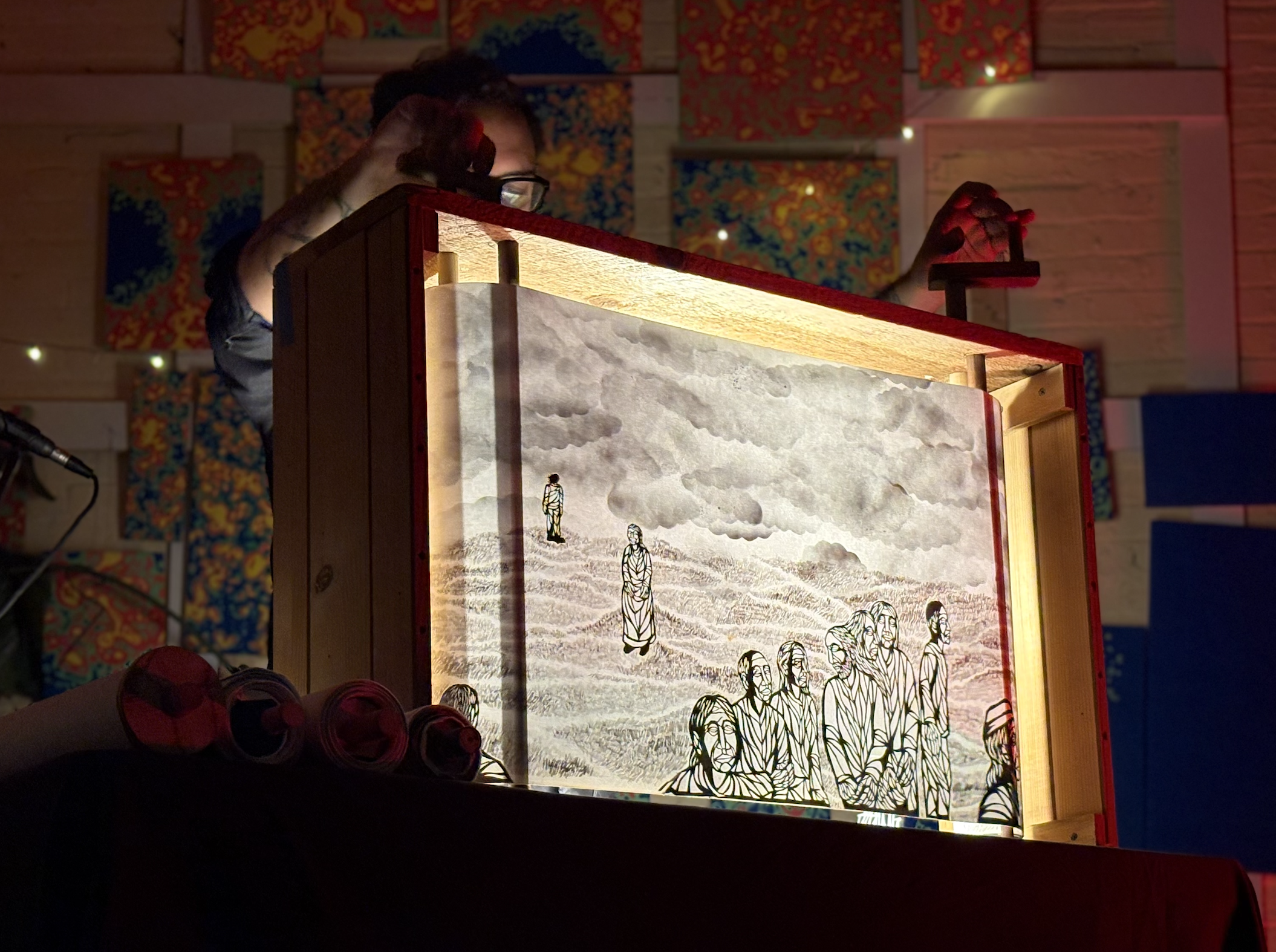
The pair had delightful chemistry, and the necessities of removing and switching out scrolls and re-tuning banjo strings – including dealing with one breaking and not having a replacement handy – had them expertly bantering and joking to stretch time. Joey Scarbury’s “Believe it Or Not” – the theme song to the 80’s TV show The Greatest American Hero, which you probably don’t remember but you’d know the song if you heard it – was a recurring bit throughout the show. Opening band World Assembly Body Opera’s Mason McAvoy interpolated the tune into her band’s last song as a winking shoutout to Ruin, who just celebrated a birthday; later, when the crowd decided impromptu to turn an extended banjo tuning break into an opportunity for a “happy birthday” singalong, the house sound engineer blessedly cut us off by queuing up and blasting the “Believe it Or Not” over the PA. Happy birthday don’t even slap, but “Believe It Or Not” is still stuck in my head.


