
Min Xiao-Fen & Julian Kytasty
Solar Myth
1131 S Broad St
Philadelphia
April 19, 2026
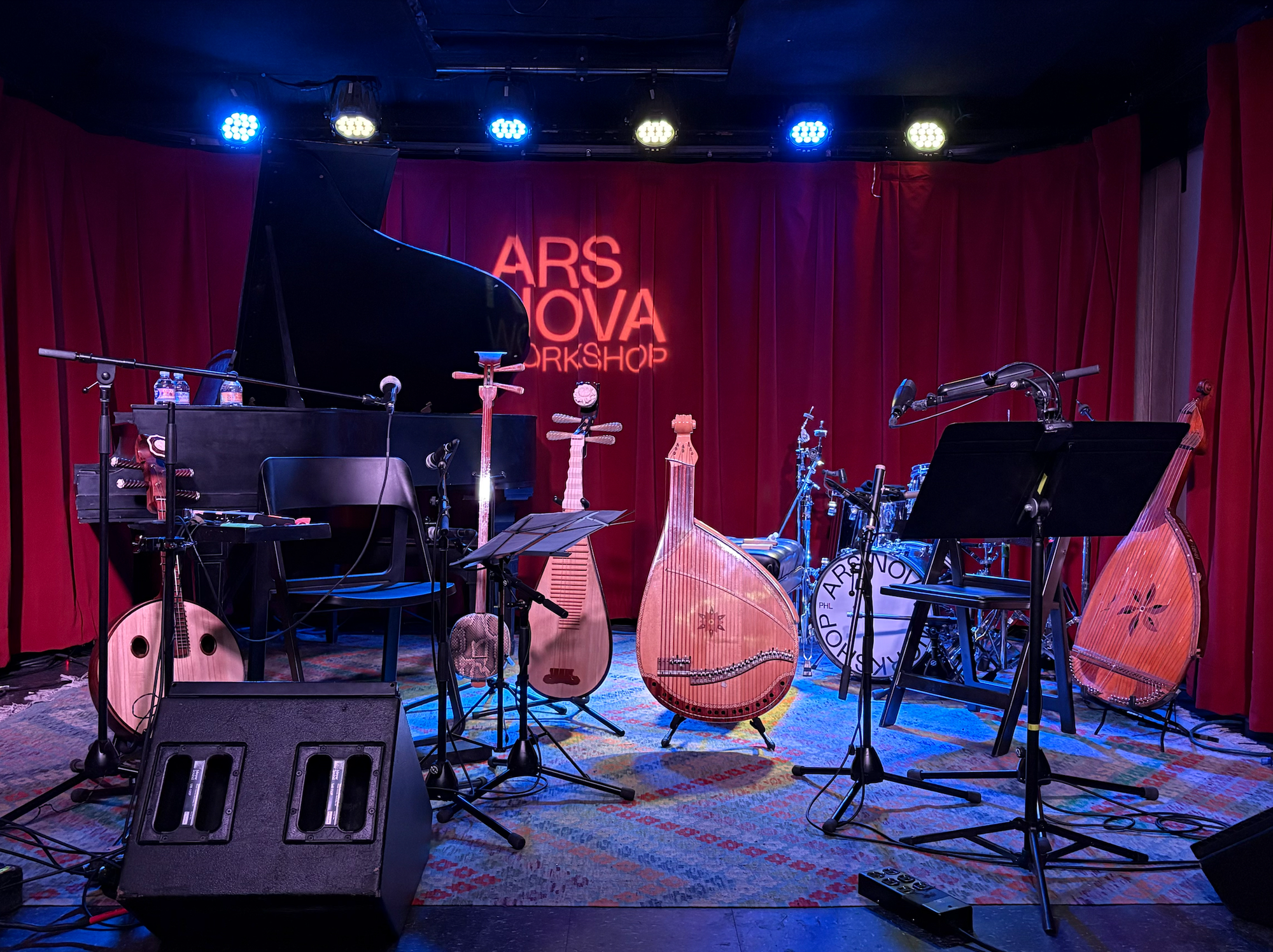
I’ve got a great book called The Practically Complete Guide To Almost Real Musical Instruments For Nearly Everyone by Harvey Rudoff, an illustrated collection of only the unreal-est and most impractical of music-making devices. We’re talking instruments like the lurk (“The Lurk fits inside your piano, / It doesn’t make noise; / It just enjoys / The inside of the piano”), the blomp, the groanette, and, of course, the six-wheeled furble (“There are seven tires / On the Six-Wheeled Furble, / But there’s a reason for that. / The extra one’s there / For use as a spare, / Just in case of Ab”) and my personal favorite, the bofflebone. (It only plays Hide-and-Seek, apparently.) Now, of course, who needs fake instruments when there’s still new ones to discover and enjoy? There’s a scene in Richard Linklater’s Boyhood – I don’t remember anything else about that movie – where the kid is asking his dad about elves and magic being made up, and the dad says, “What makes you think that elves are any more magical than something like a whale? You know what I mean? What if I told you a story about how, underneath the ocean, there was this giant sea mammal that used sonar and sang songs and it was so big that its heart was the size of a car and you could crawl through the arteries? I mean, you’d think that was pretty magical, right?” The performance I watched last night from Min Xiao-Fen and Julian Kytasty, two masters of various heretofore-unknown-to-me stringed instruments, from China and Ukraine respectively, had me feeling like I was hearing the world with fresh ears.
About the instruments: Xiao-Fen played the pipa, ruan and sanxian; Kytasty played two different banduras; both sang. The pipa is a fretted instrument, with raised frets that can produce dramatic pitch-bending effects akin to sitar; the ruan, and sanxian especially, almost resemble banjos, with the sanxian being like an incredibly long-necked fretless banjo with only three strings. Kytasty’s ornately-decorated banduras had qualities of zithers, dulcimers and lutes, with an amazing number of strings, producing more harp-like tones in its near-total absence of vibrato, glissando or portamento (all qualities Xiao-Fen’s instruments excel at). It needs to be said: both musicians were absolutely shredding, with fierce, fiery, freaky playing throughout their set. Generally pitched in uptempo minor keys, with blazing tempos and rapid tremolo-picked passages, the music was extremely colorful, with both musicians exploring the outer reaches of their timbral possibilities. They drummed on the bodies; Xiao-Fen slid a wooden coffee stirrer under the pipa’s strings near the bridge at one point, producing ring-modulator-esque overtones; in a piece that spun my head around, she sang into a pitch-shifting vocal effects pedal, to cartoonishly colorful effect. There was a real lightness and sense of humor throughout, despite the fact that some of the music was gravely beautiful and complex. One piece, “Sonic Tonic," is dedicated to the late, great guitarist Derek Bailey, and fittingly is fully improvised and more or less devoid of musical cliché: for the duration, the masters played in a trust-falling manner, excitedly unsure of what would happen next.
This was only the pair’s second performance together – the first was recently, at Lincoln Center in New York – and they took obvious delight in each other’s musical company. Near the middle of the set, Xiao-Fen performed a piece by herself, while Kytasty sat, eyes closed, listening almost with his whole body, excitedly strumming his knee during intense sections, not even pretending to hide his appreciation, upper lip curling into a smile under his mustache. There were times when I couldn’t take my eyes off the pipa, that magical thing, but when she dug into a loud triplet-ish ostinato and Kytasty wheeled his neck around in circles, eyes closed and carried away, he was the one I couldn’t stop watching.


