
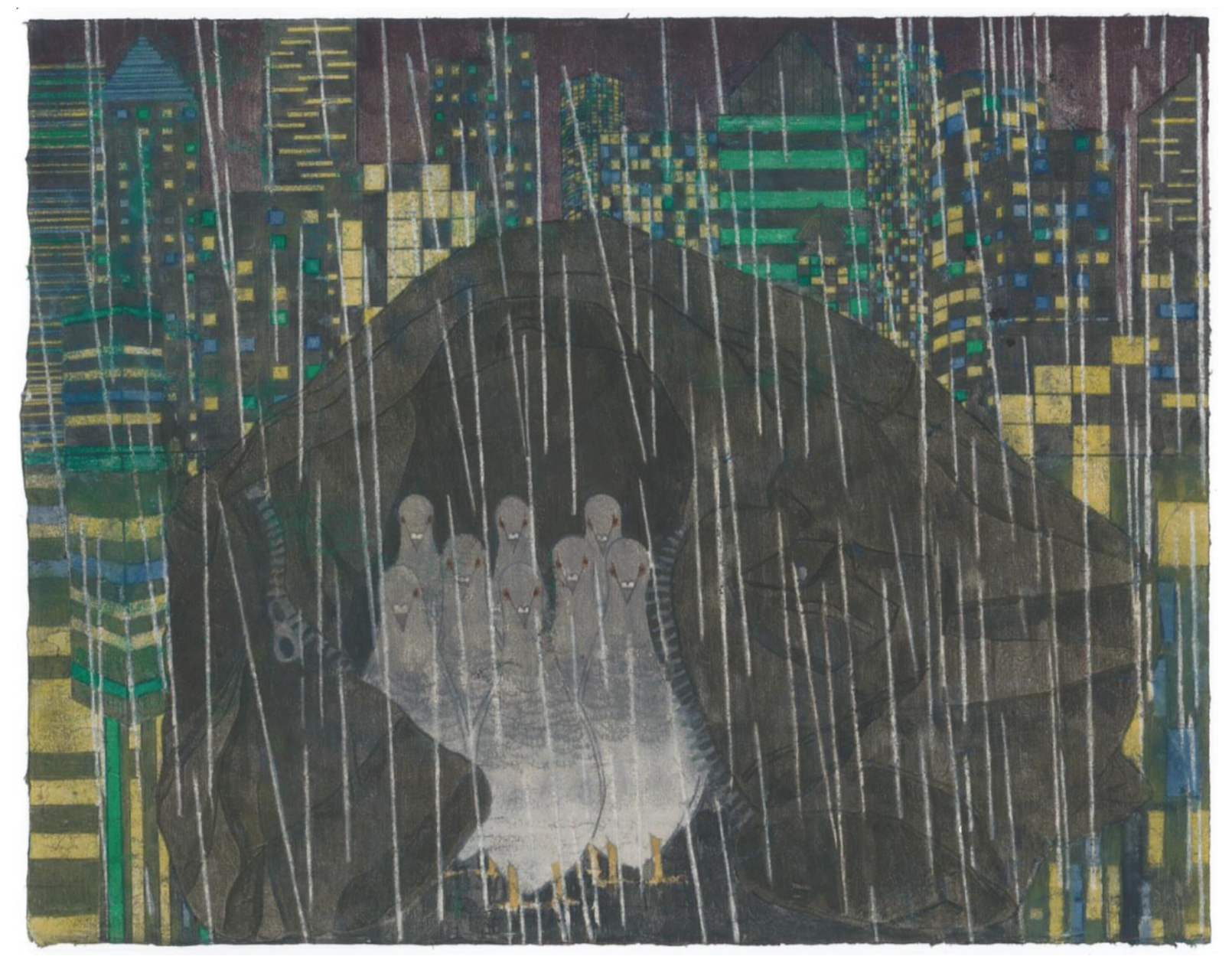
Treasure Sanctuary
Procession Gallery
30 S 2nd St.
Philadelphia
Showing through June 7, 2026
A whip of wind glares at me. A jester, mid-jig, contorts into a horse. Two solemn figures take a ride on a scorpion to places unknown.
I was introduced to those characters at Procession Gallery while visiting their latest exhibit, “Treasure Sanctuary.” It’s a series of fantastical print works by artist Otoño Andino-Gaskins exploring creativity as a means of bursting through the confines of circumstance.
The characters that make up this collection are mythical and self-referential, pulling from a personal folklore crafted over years of dedicated and consistent creative practice that stretches across drawing, printmaking, tattooing and woodworking. Many from this particular series came to fruition during the height of Otoño's grappling with a chronic illness; the artist dreamed of "leaving a situation you weren't necessarily the happiest in and going to a better thing or finding refuge in some way.”
The works evoke a sense of desire to escape the boundaries of the human condition. Otoño's skill of working with, despite and beyond these constraints are evident in the work and what is required to make them.
Every piece featured is a monotype, the product of a printing method in which the maker paints an image with ink onto glass or gel and transfers it to paper via printing press, creating an edition of only one. Otoño employs trace monotyping specifically, an approach where the reference image is traced on top of the inked glass by hand.
Originally chosen out of necessity as an immediate and accessible means of printmaking, the trace monotype also allows for a complex range of textures to shine through. The language of each tool used to reproduce the reference image makes its way into the final print. "The press is literally my pencil," Otoño told me.
This process can take upwards of thirty hours, laying down two to three colors at once, giving time for the work to dry before adding more layers of color. The direct intimacy of utilizing the pressure of the pencil as a press allows for abundant expression and detail.
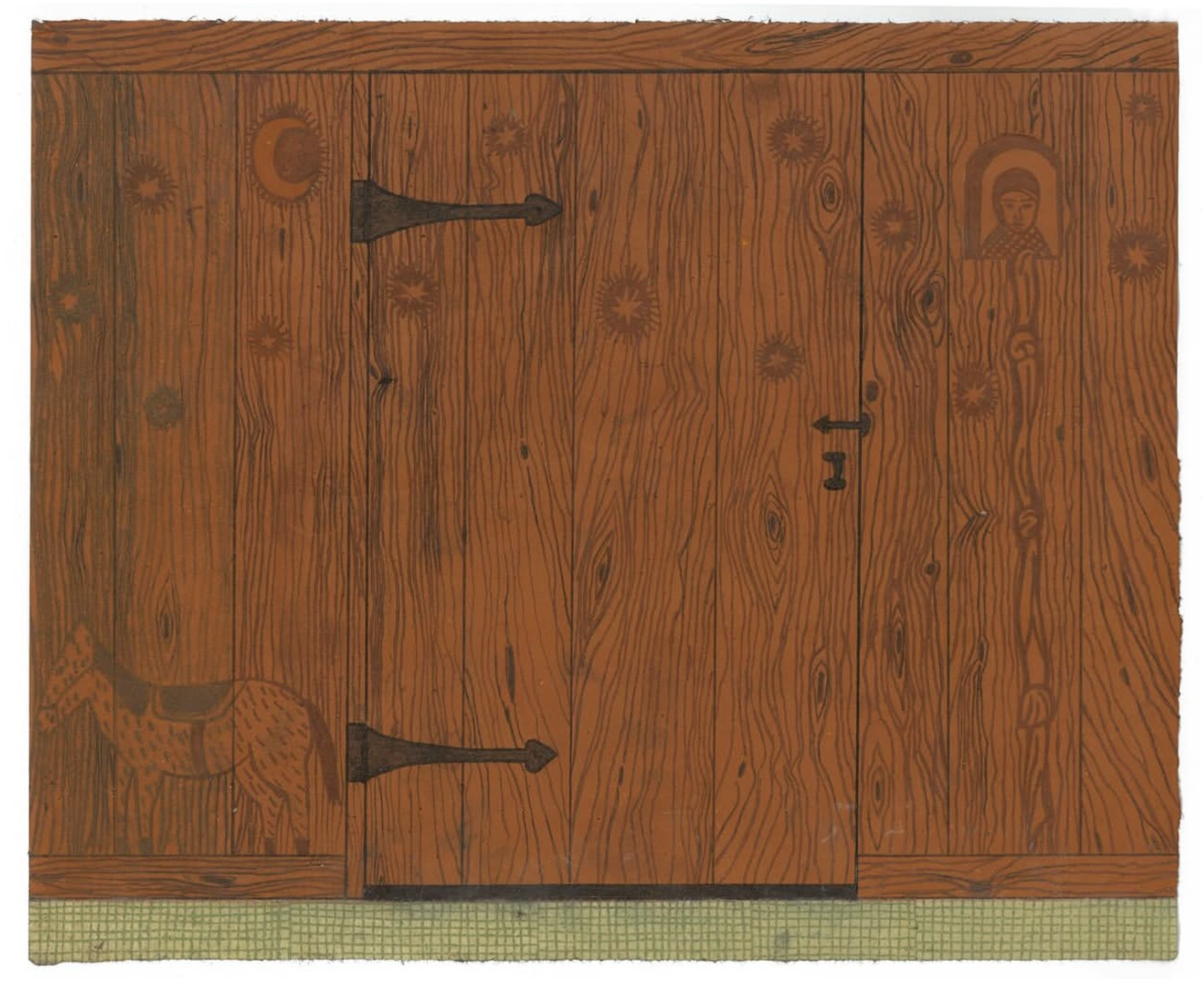
The intricate line work in the piece “Escaping in wood grain” brings us to a scene set in the knots and lines of a cupboard or exterior wall. A waxing moon implies it’s nighttime, and a figure looks out of a small window with apparent determination. From this window, a tied rope hangs and a horse stands nearby in waiting. If all aspects of this get away plan go as envisioned, where could they end up? The ride away from the figure’s enclosure offers a feeling of possibility, but will the subjects ever find a way beyond the grain?
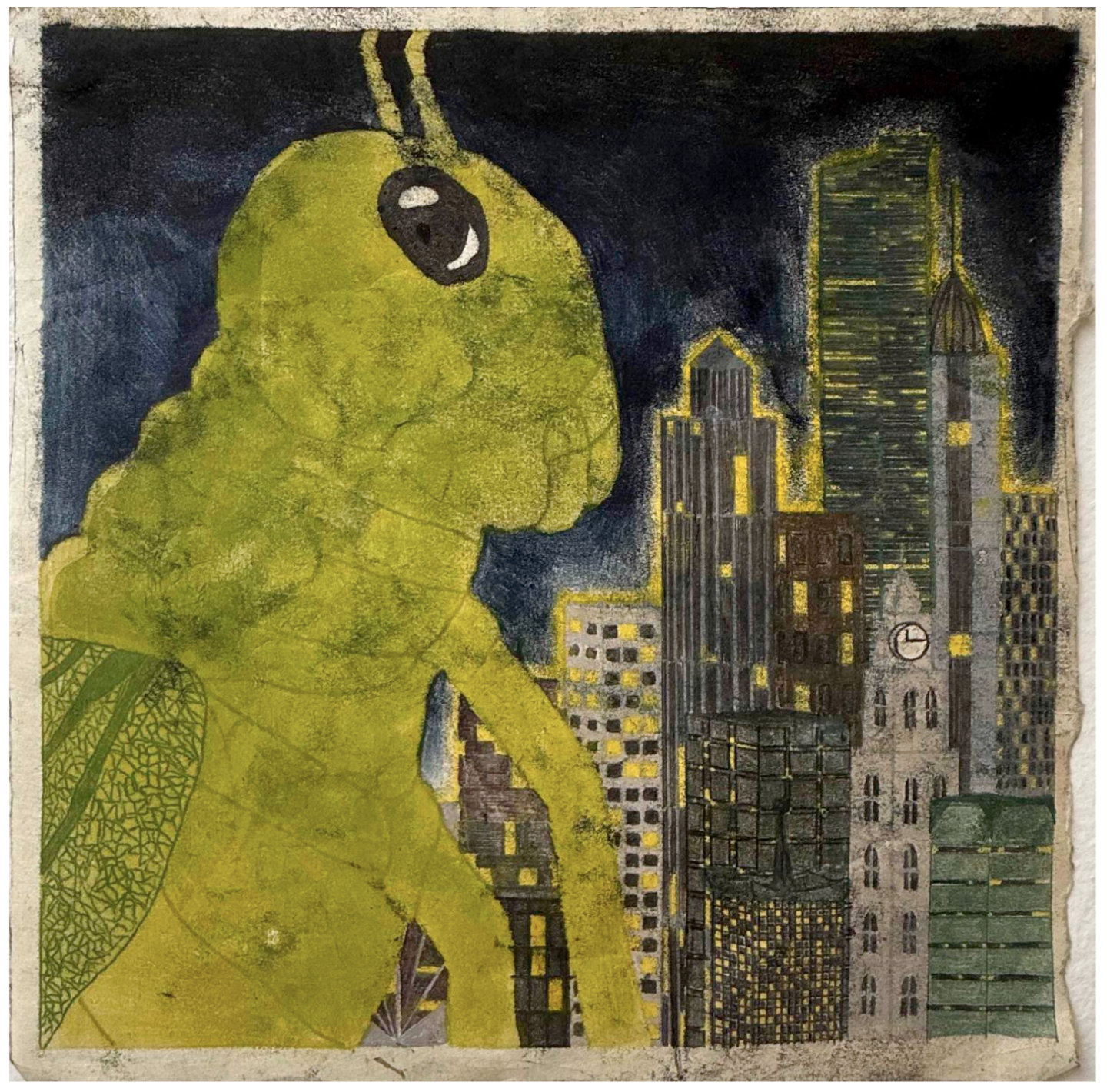
In “Hopper Watching Over The City,” the macro and micro exist synchronistically. The featured grasshopper looks over a non-descript city but also, with a push of the imagination, is maybe looking back at the viewer, too. Its exoskeleton is almost jewel-like, dominating the page. It’s one of many creatures in this exhibition blown up to a disproportionately or absurdly large scale. When I asked Otoño about their use of bugs throughout the exhibition, they said: “I don’t feel like they get a lot of respect and to put them in situations where they’re bigger than they’re often times perceived makes me feel really good. I love the bugs! It’s such a good feeling to spotlight something that usually isn’t spotlighted.”
Otoño also finds inspiration in Southern folk art, naming Howard Finster as a primary muse for their work. Finster’s pieces similarly feature dense city scapes and larger than life creatures exploring the world, all created in service of capturing something sacred.
The artist maintains a practice of seeking out the abnormal or unexpected, pulling from an unconventional source as a personal creative challenge — “looking at things I don’t like and trying to figure out the things I do like in that. It’s challenging but fun. Looking at art or even just, like, life objects I don’t think are really pretty or beautiful but forcing myself [to think] ‘What do I like about it?’ makes it a novel feeling for me and I draw on that a lot.”
Otoño’s ability to transfigure something abhorrent into something useful or relevant is inspiring. It’s much easier to be bogged down by unpleasant obstacles.
Ultimately, Treasure Sanctuary is not so much a place you may find shiny wares to covet, as the title might suggest. It’s a personal mantra and a call to action: to "treasure sanctuary" is to find and embrace the moments that allow us to feel free even as we writhe beneath the heavy boot we’ve been given; to look at what else might be within reach in the present and what we may grasp in the future as solace.
As Otoño put it: "It's such a treasured thing to feel [...] that 'Oh, I'm in a good place or I'm going to be in a good place soon.”


