
Contemporary Art
Susan Morse Hilles Gallery
Wadsworth Atheneum
Hartford
June 10, 2026
It’s a question I’ve been avoiding for the better part of three years. Yet as I stood there, staring at a stack of stools in the middle of the Wadsworth, I finally let myself ask:
What is a piece of art?
I’ve written about the impact and inspirations of art, its meaning and its intent. But to really write about what makes an object art? I heard a gentleman at the bus stop say that to define something is to limit it; defining art might lead to stacks of stools being excluded, which seems like a loss with no purpose. But sometimes limits are necessary. If a stack of stools is really just a stack of stools, then what does it matter if it’s excluded?
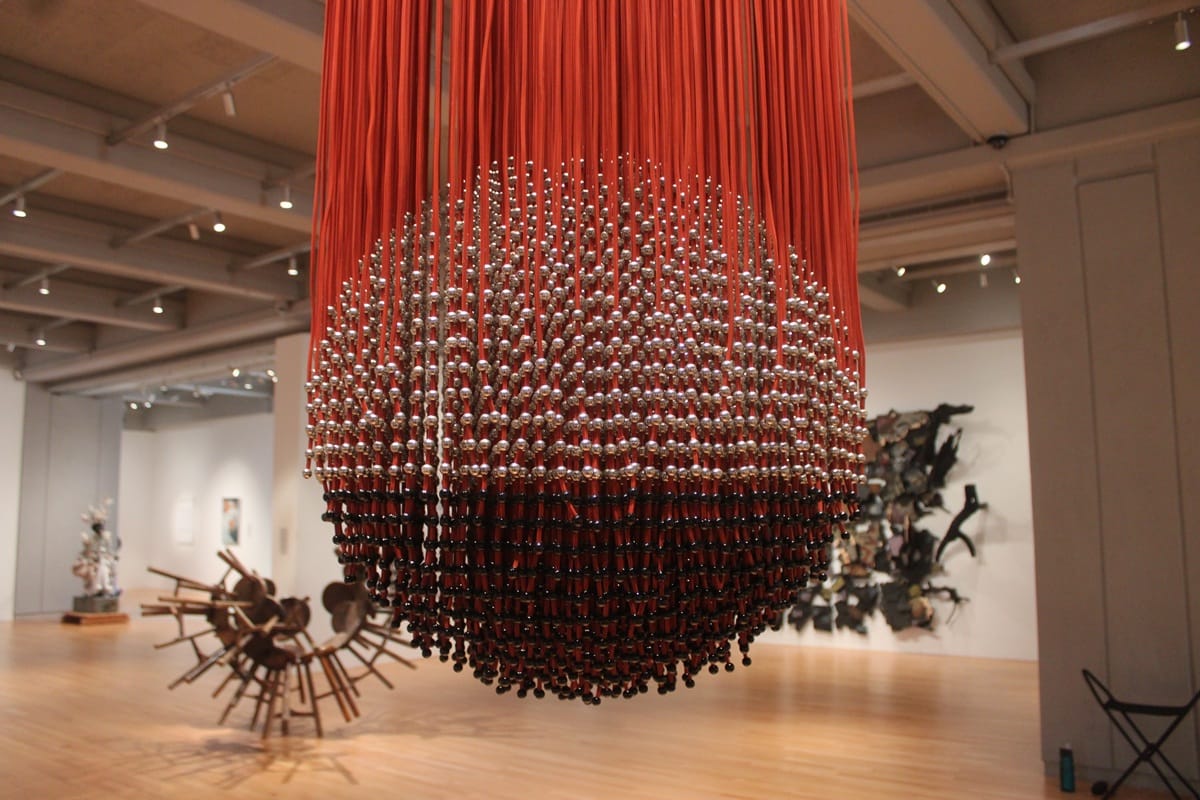
The Contemporary Art exhibition in the Susan Morse Hilles Gallery at the Wadsworth had several interesting and provocative pieces on display. Their only connection is that they’ve been created since 1960, and represent a wide range of cultures and perspectives. Some of them had me asking a similar question, but none transfixed me like the collection of stools though.

Take a look for yourself. I am not being derisive or attempting to diminish Ai Weiwei’s piece Grapes. It is literally a stack of stools. Impressively, a docent told me the stools were assembled using no glue or nails, instead fusing the stools. People stack stools all the time though, admittedly in not as creative a fashion.
Does its artistic value come from its cultural connections? Weiwei collects and reassembles furniture from the Qing dynasty in China, which ended in 1911. According to his artists’ statement, the three-legged stool was a staple of Chinese homes for centuries until being replaced by aluminum and plastic models. Capturing and preserving history is one of the quintessential aspects of how we define art, and if that’s his goal, then he seems to qualify.
Yet further down in the statement is another wrinkle: “...a craftsman joined the 26 stools in Grapes, named for its resemblance to a cluster of grapes.” As I recalled the docent’s words, he never said Weiwei assembled the piece himself, just that it was done without certain items.
Well now we’re getting into something more concrete than intent and expression. Does a piece still move beyond a mere object to a work of art if the artist didn’t make it himself?
Skill is another foundational element of what art is, maybe more so than the preservation of culture and knowledge. Art is about what the artist can do, the interaction between the materials and their abilities. An artist doesn't necessarily need the skill to be talented. They do need the skill to do a project themselves. And I’m not suggesting at all that designing and envisioning aren’t forms of “doing”; we differentiate and acknowledge both architects and construction workers, after all.
Yet art is about more than the finished product, not in the same way a house is. If the power of art is about expression, creativity and intent, musn’t those things flow from the hands of the artist themselves? I don’t think that being weird, avant garde or opaque has anything to do with the artistic merit of any individual piece.
But yes, I do think a piece attributed to one person, constructed by another, falls into a no-man’s land of artistry. That doesn’t say anything about skill, talent or vision, as all those things can exist independent of art. Still, the most important thing in art is the artist, and since Weiwei didn’t stack those stools himself, I feel like I’m just looking at a cool stack of stools, but not a cool piece of art.
NEXT
Jamil goes to check out some jazz.


