
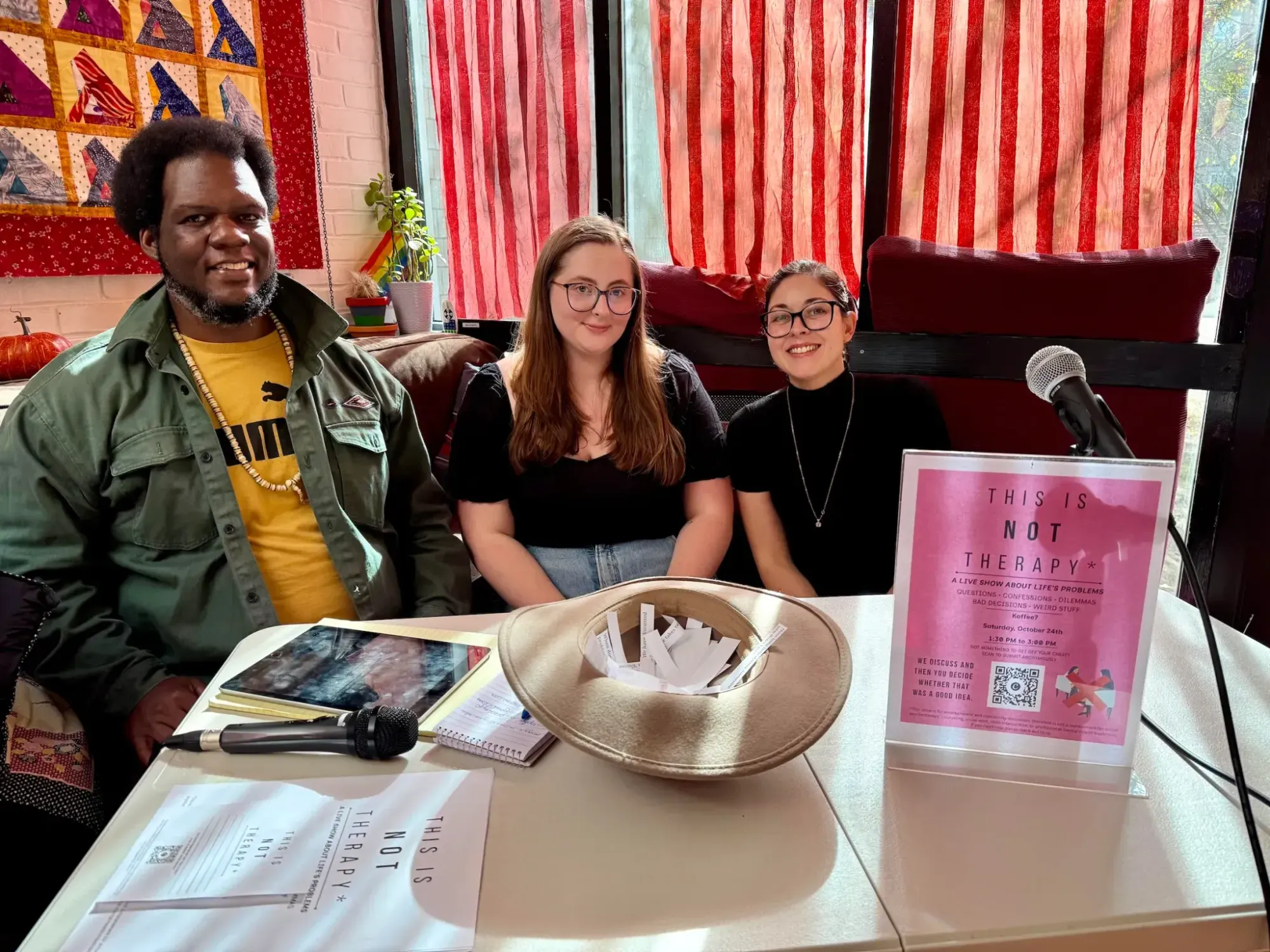
This is NOT Therapy
Koffee?
New Haven
Oct. 24, 2026
“I’ve been followed by a fetus on Instagram,” comedian Taylor Doyle announced to the crowd at Koffee?. “This is a Gen Z scenario.”
“There’s posting your baby online, and then there’s pretending to be your baby online,” said comedian Brittany Robarge with a laugh.
Actual tears pooled in the corners of my eyes as I watched these and other moments of This is NOT Therapy, an evolving show staged at Koffee?.
Relationships were the topic of the day for the live show. A question of whether weddings are performative inspired a larger discussion about performativeness in other areas of life.
The outrageous lengths people go to on social media was a reliable lightning rod. Doyle once knew a girl who created an Instagram for her baby while the baby was still in utero.
Imagine.
Doyle’s anecdote raised a question that threaded through the evening’s conversation: At what point does sharing our lives with others, whether through relationships or online, become a performance? Is performance always problematic?
Apparently, when a social worker and two comedians walk into a coffee shop, things get deep.
This is NOT Therapy was conceived by social worker Christopher Pressley who had long been fascinated by the intersection of comedy and his profession. To bring his vision to life, he reached out to Robarge and Doyle, Connecticut-based comedians whose work he enjoys. He deliberately sought female co-hosts, hoping their perspectives would provide a counterbalance to his own.
Saturday marked the trio’s debut. They plan to put on This is NOT Therapy monthly at Koffee?, with the next show scheduled for November, sometime before Thanksgiving. Its theme will be “family” — the source of 80 percent of people’s issues in life, calculates Pressley.
As advertised, the show is not therapy. The hosts aren’t quite sure where it will live, so it’s also not a podcast or a YouTube series. For now, they relish its ephemeral nature: You must be there in the moment to witness it.
The format on Saturday resembled a live podcast. Each host had a mic and took turns addressing anonymous audience questions. They pulled questions out of a hat. They also had blank forms there for people to submit questions live.
(When I confessed to having a tragic dating life and stories for days, Pressley solemnly handed me a form.)
The performative wedding being the first question immediately satisfied my appetite for mess. The show was coming in hot!
Robarge agreed that weddings are performative but wondered whether that’s necessarily a bad thing. “I think it kind of depends on what your motivation for performing is.”
Doyle declared that the most performative thing at her wedding would be a groom.
Pressley added, “There’s nothing wrong with Broadway. There’s nothing wrong with a movie set. So, if the movie set or the Broadway stage happens to be your wedding, I say, God bless them.”
Robarge said she knew a couple who are “triple performative”: 1) The couple met at karaoke. 2) They fell in love. 3) They hired the karaoke DJ to be their wedding DJ.
As the conversation continued, they answered a question from a smug happily married person whose entire friend group is divorced. “What’s wrong with me and my friend selection?” they wanted to know.
Robarge pushed back against the suggestion that divorce is a failure.
“I don’t think there’s anything wrong with divorce, to be honest. I think divorce is an essential option for marriage. If marriage is going to be available, divorce should be easily accessible,” said Robarge.
Doyle wisely said that she’d rather her friends leave a marriage than remain unhappy. “To perform a wedding is one thing, but to perform a marriage …” she added.
Pressley introduced the concept of sunk cost fallacy – when you continue investing time, energy and resources in something simply because you’ve already invested so much into it He suggested it could be a reason that some people perform in their relationships.
“It’s like, no, man, you gotta cut your losses,” he said. “When you realize you’re on the wrong train, it’s better to get off.”
When the conversation turned to couples performing happiness on social media, Pressley suggested that performativeness extends far beyond Instagram.
“Largely in society, we’re all performative to a degree. We’re performative at work. Performing with our friends and family. Performative online. That’s like the social mask we wear. So, it’s about just finding where you want to be performative or where you want to consume performances.”
In other words, perhaps the question isn’t whether we’re performing, but how much of ourselves we’re willing to sacrifice to maintain the act.
The hosts struck the balance between humor and sincerity. Outrageous punchlines one minute, insightful reflections on complicated human behavior the next.
This is NOT Therapy had taken over a corner of Koffee? during a pretty busy afternoon; I suspect more than a few patrons had no idea what they’d wandered into. As Pressley introduced the show, he accused the Koffee? patrons of pretending to work and refused to apologize for disturbing their day.
Some patrons felt no choice but to get involved. Throughout the show, Erica was watching curiously from her table. Eventually, she joined the “hot seat” to share her story of a quasi-relationship with a grieving man struggling with emotional detachment.
My first instinct was to tell her to run. Rather than writing him off, the This is NOT Therapyhosts provided a nuanced take on how grief and apathy complicate intimacy. They commended Erica’s paramour’s attempts at vulnerability.
Then Doyle reminded Erica that even if the guy is a great person, there’s no reason too small for her to end their situation. “If a butterfly flaps its wings in China, you can leave. If you don’t want to be there, that’s enough.”
I came to This is NOT Therapy’s show expecting to laugh at the messiness of relationships. I left impressed by the hosts’ genuine thoughtfulness and compassion.
Erica left the hot seat looking resolute. Judging by her expression, their advice had landed.
“Y’all are honorary social workers after today,” Pressley told Robarge and Doyle.
It was ironic that a show that emphatically insisted it wasn’t therapy had managed to offer something unexpectedly therapeutic.
And made me laugh until I cried.
For information on the next show, follow ‘This is NOT Therapy’ hosts on Instagram at:partialoblivionstudiosnhv, brobarge_comedy and taylor.m.doyle.


