
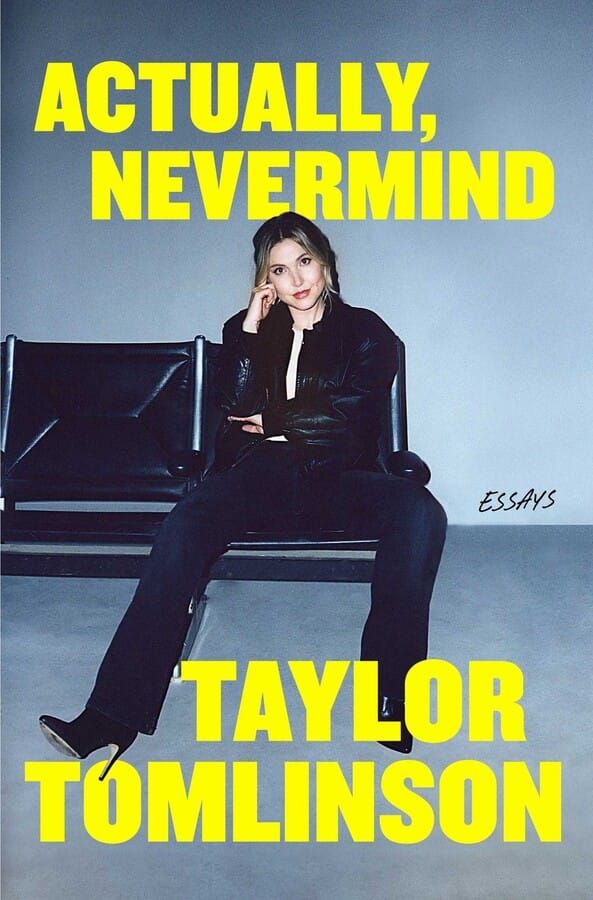
“Actually, Nevermind”
By Taylor Tomlinson
Gallery Books
I have a compulsion about reading books by stand-up comics whose work I admire.
I’m not exactly sure why. Many of them are strikingly similar in tone and structure and feel like a merely satisfying (rather than great) read. Yet when I connect with a comic, I inevitably get curious about their background: Where did they grow up? What kind of kid were they? How did they get started on this unconventional path? What have they learned along the way? What does a life in comedy demand (by way of sacrifices) and what does it provide?
If this mirrors your own criteria for stand-up comic memoirs, Taylor Tomlinson’s new collection of essays, “Actually, Nevermind,” not only checks these boxes but also offers up some bracing insights about grief (her mother died of cancer when she was just 8), mental health, and family.
Early in the book, we learn that Tomlinson was the oldest of four kids in a strict Christian household; and because she lost her mother so young, Tomlinson is like an oldest child on steroids — anxiously trying to be perfect, feeling responsible for her beloved siblings, avoiding conflict, and straining to be the observant Christian her father (and soon her stepmother) want her to be.
But if you’ve watched Tomlinson’s most recent Netflix special, you know she has since come out as queer, and this is likely one reason she hasn’t spoken to her father in five years (as she notes in her book). In a quietly heartbreaking essay titled “Estranged,” she articulates the rift like this: “The universe sets you up on an eighteen-year-long blind date, and sometimes it just isn’t a match. In Hollywood, a decade of marriage is considered a success. Twenty-seven years with your parents is one hell of a run. … Try not to think of it as a rejection but as a lack of chemistry. Becoming yourself feels impossible when you know it will alienate your parents. But if you don’t, you’ll always resent them for only loving this inauthentic version of you. It won’t feel like love. It will feel like performing.” This hits like both a gut punch and a mic drop.
And although there are, predictably, a number of lines and observations in “Nevermind” that cracked me up, these moments of vulnerability will be what stays with me.
There are several of them, actually. When Tomlinson unpacks her ambivalence about having a child one day, she does so as a traumatized daughter of a mother who died at 34; as an ambitious, feminist artist who wonders if the necessary sacrifices would make her resentful; and as an anxious person who grew up with a father who ruled by inspiring fear. (Tomlinson worries about becoming like him.) But there’s deep sadness surrounding this question, too, and that inspires some of Tomlinson’s most affecting prose.
Tomlinson writes, “I mourn the parts of me that would open up if I had kids. If I remain childless, those doors stay locked. It’s difficult, knowing that there’s a dark room inside me with a crib collecting dust. … When I think about having kids now, I think about all of it. Reading them my favorite books. Trying to calm them during a meltdown in public. The sensation of their little feet pushing against my insides. Tearing me open as they exit. … My body evolving into something more powerful. Me not recognizing it anymore. Losing myself in mothering. Finding myself in parenthood. … Do I have it in me?”
Tomlinson also writes about her strange, almost random point of entry into stand-up comedy (a woman at the family’s church urged her dad to sign up for a stand-up comedy class, and he talked Tomlinson into joining him); how she initially worked the church stand-up circuit, until a joke she tweeted out got her fired (the joke: “In bed, I am a wild animal — way more afraid of you than you are of me”); how her bipolar diagnosis led her to reach for, then call off, an engagement; what a rootless life of constant travel and late nights actually feels like; how she approaches joke-writing and tries to jump-start her creativity; and how fraught her time hosting “After Midnight” was, due to health issues.
Frankly, the more conventional, jokey essays in “Nevermind” — about advice, alternatives to a committed relationship, red flags and dealbreakers, etc. — were of less interest to me because Tomlinson’s autobiographical material was so compelling.
And one central question driving the whole essay collection is: how can an artist be fully present in both their work and their life? For as Tomlinson writes, “The problem with this business is that your fears about missing your window, being forgotten, and never getting another chance are all valid concerns. There’s no way to self-soothe. You just have to accept that fear as a part of your daily life. … In this industry, good luck, hard work, and perfect timing is a tough jackpot to hit. If you’re not careful, you’ll miss your shot. Every year I told myself I’d ‘take some real time off once I ___.’ But every time I filled in the blank, some other glittering opportunity would slink seductively down the staircase, and I would have no choice but to take a big gulp, straighten my tie, and offer my arm.”
Follow Midbrow Detroit on social media:
Bluesky, Facebook, Instagram, Threads, TikTok, X.


