
Gallery Talk
Curatorial fellow Danielle Drees
Matrix 199/Sorry I Love You Wadsworth
Wadsworth Atheneum
Hartford
Oct. 24, 2026
Growing up in Hartford, I learned that if you let her, if you didn’t fight her, Hartford would swallow you whole. There was beauty in making it out of Hartford. However, as I stood in the Wadsworth, in front of a group of family photos taken in a nail salon as part of Ocean Vuong's "Matrix 199/Sorry I Love You" exhibition, I realized I had never considered the beauty in staying in Hartford, nor in the cultivation of Hartford itself.
Ocean Vuong’s exhibition serves as a love letter to the salon workers, migrant farmers, daydreamers, and lovers of Hartford. There is a surge of excitement when your existence is declared for the whole world to see, when who you are cannot be denied. Through its photography, Vuong states that we are here. We are here and we are human; we are ordinary yet extraordinary, and we will not go unrecognized.
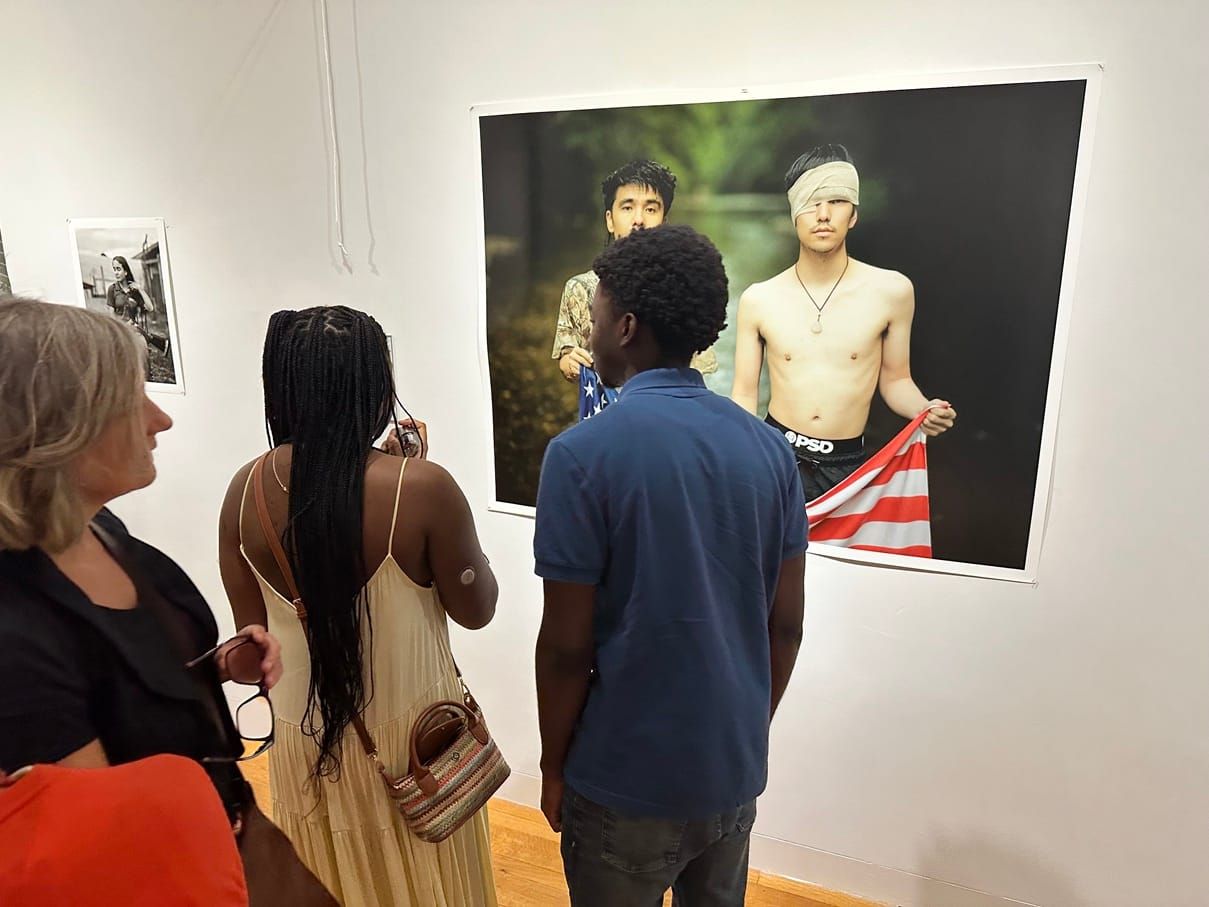
As curator Danielle Dress moved us through the exhibition Saturday, I was reminded of Vuong’s talk back in August, where he discussed the radicalness of the Asian body at rest, when one becomes recognizable outside of the labor one produces. This idea shaped how I experienced the exhibition, particularly its tension between labor and rest, life and death, nature and industry. During the artist talk, Danielle guided us clockwise through the exhibition, beginning with a collection of photographs featuring Ocean’s mom, Rose. One photograph, Phuong Feeding Sara, immediately caught my attention. A folksong in another language played in the background. In the photograph, a woman sits holding Sara, her head turned as she gazes outward, seemingly lost in thought. Ocean’s mom stands to open the door, and I imagine a customer has entered the salon. The moment captures the coexistence of care and labor, while the woman’s gaze suggests a world of thought beyond her physical presence in the salon. Here, the ordinary life of Hartford became the center of attention, and the act of existing became its own quiet resistance.
Throughout the artist talk, we were invited to interpret these images and ask questions, opening paths of inquiry beyond those explored on opening night. I was surprised when the curator didn’t discuss the photograph of a person proudly displaying their neck tattoo, titled All I Know of War. The pride radiated through the image onto me. Like the other photographs, it seemed to affirm the person's right to define themselves, to live alternatively and authentically as themself.
However, the photograph also made me consider the institution in which this declaration of self was being presented. I wonder what does it means to affirm one’s identity, community, and work within a museum, an institution that has historically held the authority to determine what deserves recognition?
During his artist talk, Vuong argued that museums should serve as spaces for visibility rather than legitimizing forces. While I understand the distinction he is trying to make, I find it somewhat idealistic. Museums offer visibility in part because of their institutional authority and legitimizing nature. How might this exhibition have been different if it was presented at the Boys and Girls Club or 224 EcoSpace on Farmington Avenue? Would the photographs carry a different meaning in spaces more directly connected to the communities they represent? Perhaps this is the strongest point of the exhibition: its significance lies in presenting Hartford’s beauty as something that has always and while also existed, even in the absence of traditional recognition.


