
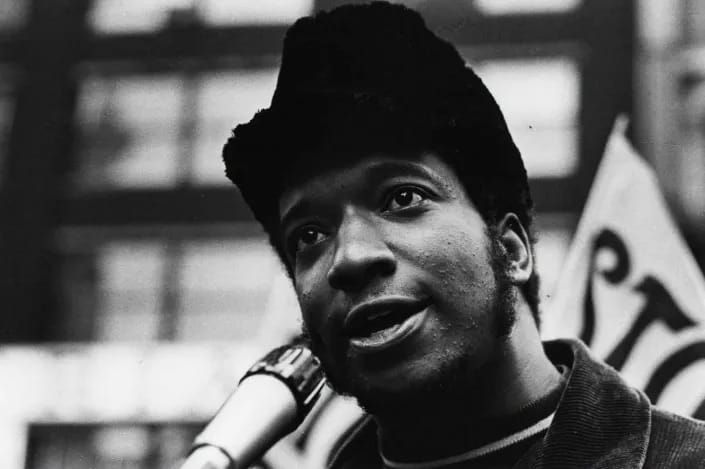
The Murder of Fred Hampton and May Day x 4
Yale Film Archive
Nov. 5, 2026
“Power to the people.” The seemingly simple phrase with a not-so-simple history rang through two films screened Thursday night at Yale Film Archive, not only as it is spoken or chanted, but in the actions of those being filmed and those who filmed them.
A 35mm print of Howard Alk’s 1971 seminal documentary The Murder of Fred Hampton was screened along with the premiere of Brian Meacham’s short film May Day x 4, which took archival footage from four different sources and combined them to give multiple perspectives of the same event: The 1970 May Day protest rally that occurred in New Haven following the arrests of nine members of the Black Panther Party, including Bobby Seale and Ericka Huggins.
According to Meacham, who is also a film archivist at Yale, May Day x 4 is the first work that pulls directly from materials in the Yale Film Archive. The materials it draws from include the 1970 student-made film May Day, Bright College Years by Peter Rosen; footage shot by Paul Sills, Mike Gray, and Jones Alk; and footage shot by Paul Williams and John Avildsen. The fact that each crew was filming the same events in such close proximity of each other without each other’s knowledge gives each crew a unique perspective that, once brought together, offers a whole new view.
Before the film began Meacham also said to take note of familiar surroundings and faces. Any New Haven native — or frequent visitor for that matter — will have no problem recognizing the Green and some of the buildings surrounding it, though much has changed since then. Thousands of people are seen peacefully protesting. Famous figures like Abbie Hoffman, Jerry Rubin, and Allen Ginsberg appear, some giving speeches, some simply participating. The events are seen in both color and black and white film, adding to the shifting perspective. One thing remains constant throughout: The recording and recognizing of an important event in both local and national history, one that needs to be preserved and passed along to others.
Meacham does a fantastic job of offering the viewer a multitude of memorable scenes: alternate views of the same speech, the juxtaposition of a singular man sitting up on a flagpole overlooking the masses, and children laughing and skipping past armed guards. The work of those recordings boldly and brilliantly weave together to create a tapestry that begs to be viewed repeatedly to remind all of us of a history we need not forget.
“Wow,” said professor and author Sampada Aranke in response to Meacham’s film as she came up to introduce Alk’s The Murder of Fred Hampton. Her book Death’s Futility includes a chapter devoted to the film, which she noted had a “dual focus” that “encouraged a complex mode of looking.” Complex indeed, as the first half of the film focuses on Fred Hampton, chairman of the Illinois chapter of the Black Panther Party, and the work he did to bring that power to the people, while the second half shifts focus to his murder at age 21, its subsequent cover up, and the fight to reveal the brutal truth.
In its less-than-90-minute run time, this film presents a wealth of information about Hampton and the Black Panthers in a riveting and rousing cinema verité style. We see and hear Hampton speak about his cause, and we also see that cause in play, like with the free breakfasts the Black Panthers offer children. We watch as he explains to others that people need to be “educated about everything before they can enact anything.” We also watch him defend himself during a trial where he was charged with robbing an ice cream truck. There are many moments that make you smile and laugh, but also make you think and nod your head along with what is being said. An audience member spoke along with Hampton as he said, “You can jail a revolutionary, but you can’t jail a revolution.”
The film becomes more solemn and bracing in its second half after Hampton’s death in 1969 at an early morning raid on his apartment by Chicago police. In total there were two deaths and four injured with officers firing 99 shots. Reenactments of the raid are shown as well as the apartment itself, the bullet holes left behind, the bloody mattress, the missing door, all as they worked to prove that he was in fact murdered. While the entire film is riveting from beginning to end, it is this second half that really keeps the viewer on the edge of their seat. Watching Debra Johnson — who was also shot during that raid while pregnant with Fred Hampton, Jr., seen as an infant — speak about the attack, getting shot, and how she was treated by the police is both infuriating and heartbreaking.
There are a wealth of topics to consider throughout this film that are beyond the scope of this article, but in the end, we hear and see the exemplification of that simple phrase, “power to the people.” It was not lost on this reporter that both films are as relevant today as they were when they were filmed almost 60 years ago. A sobering thought, yes, but also a call to filmmakers and film viewers alike. These are the stories that need to be told, to be shared, to be cheered on. It is in the sharing of these stories where we also gain a significant piece of that power.
Yale Film Archive screenings are free and open to the public. For further information about the remainder of their fall schedule please visit their website.


