
Tendered Ground/Coded Truths
Ely Center of Contemporary Art
New Haven, CT
Through Dec. 6/Nov. 30.
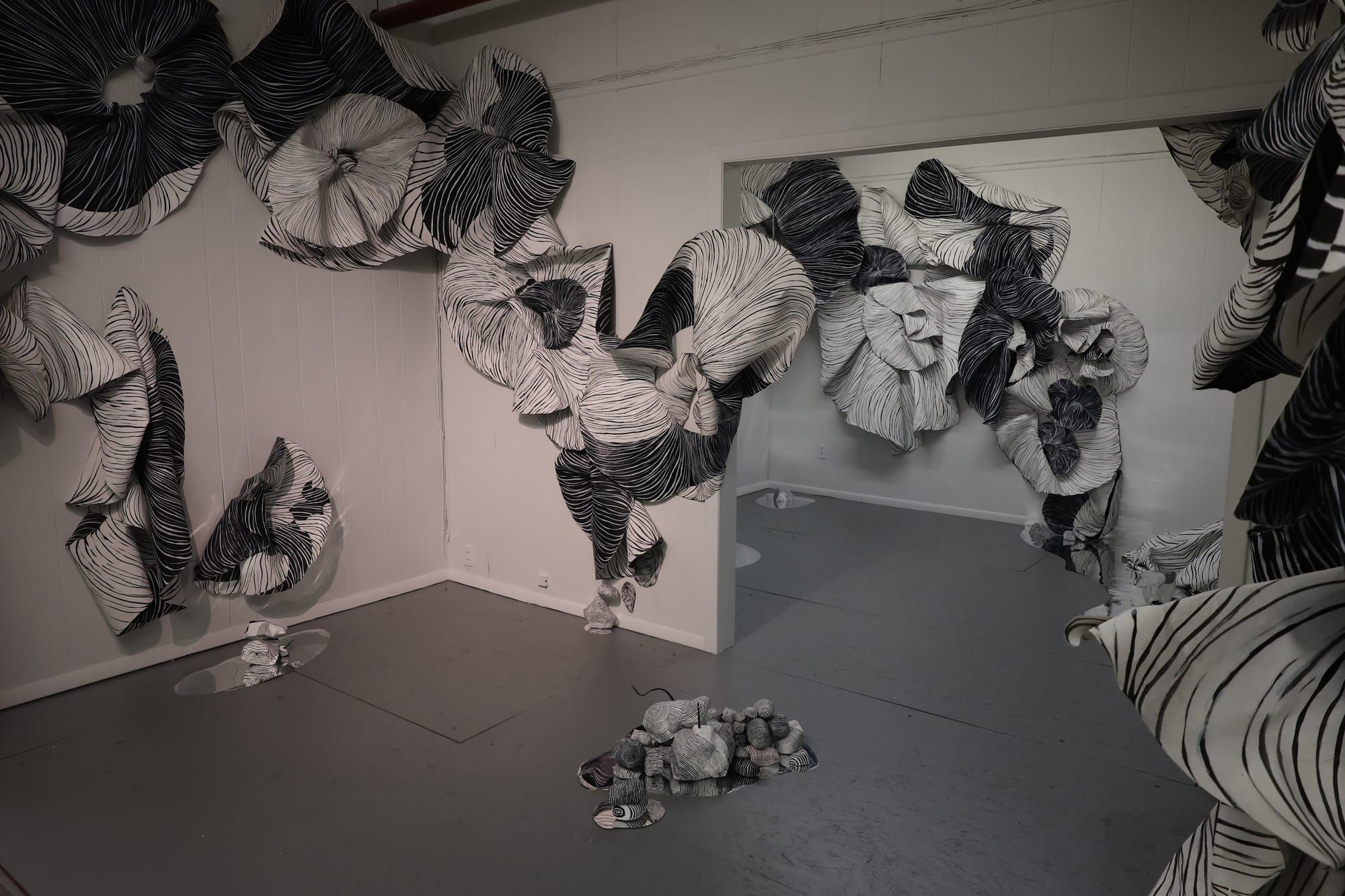
Two of the gallery rooms at the Ely Center of Contemporary Art are transformed in such a vivacious way that — having seen them in person — your reporter wonders if the verb tense of transformed in this sentence is right. The rooms have been transformed? Are being transformed? Tendered Ground, an installation by artist Maggie Nowinski curated by the SomethingProjects crew of Suzan Shutan and Howard El-Yasin, is an immersive experience in which the art reads as though it's making itself, taking over the space. It also feels like perhaps it was there all along, lying in wait for a crack in the wall to set it all free.
ECOCA's embrace of a large-scale piece of art that depends on the viewer showing up and entering it is an interesting pairing with another of its exhibitions, Coded Truths, which features the work of 14 artists and is completely virtual. As curator Judith Kruger explains, Coded Truths "is represented in an AI-generated fictitious gallery with multiple rooms while showing the artists’ actual works." The two shows together have something to say about how art can work with AI, and about the strengths and limits of the virtual and the real.
"The artists in Coded Truths make work in which meaning resides beneath the visible surface," Kruger writes. "At first encounter, we see color, pattern, repetition, gesture, material and form. Yet embedded within these works are experiences that may not be readily legible: grief and mortality, ancestry and diaspora, identity and belonging, memory and loss, spirituality, cultural inheritance, and the search for connection."
Displaying the works virtually only carries some friction because many of the pieces are partially about what they're made from. As the accompanying notes state, "materials are not passive; they carry associations and histories of their own.... Maps and repeated marks become measures of time, memory or human experience. Textiles carry histories of culture, community and care. Found objects, clay, biological materials, pigment, thread and accumulated fragments become vessels for ideas and lived experience. The act of making is integral to this translation. Counting, stitching, weaving, layering, carving, assembling, repeating and repairing become ways of thinking through experiences that resist direct representation."
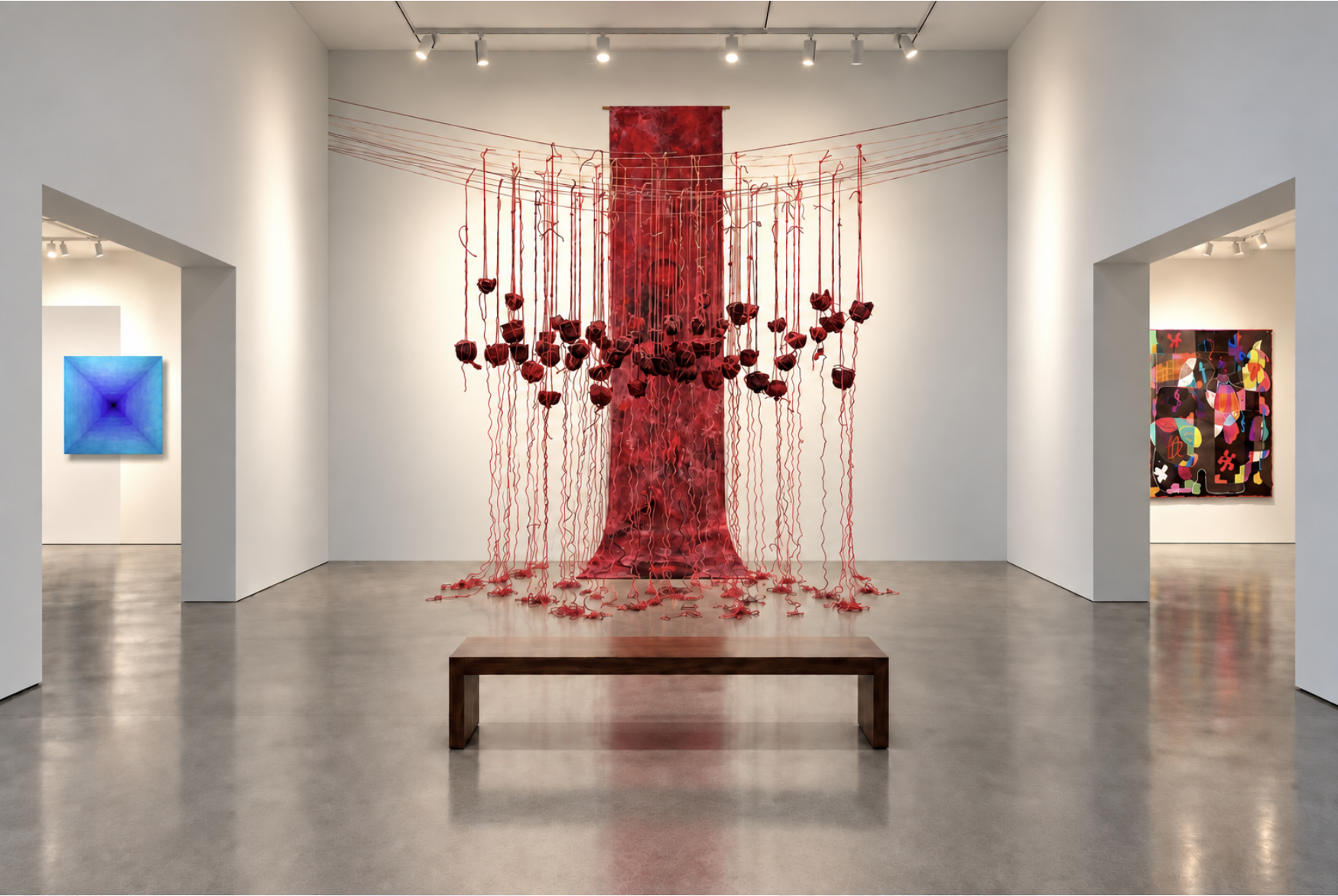
"What is visible offers one point of entry, while the histories, experiences and knowledge carried within offer another," Kruger writes. Displaying the works virtually forces one point of entry onto the viewer. That's most acute in the rendering of Edwine Poku's The Fire Talisman (ogya) & Soul Vessels (Nyameama). We know from the description that "the work contains motifs designed with twine spun in a spiral shape which symbolizes the Adinkrahene/the Ether, the King of 'Adinkra' traditional Ghanaian symbols that stands for authority, leadership, and gateways." We also learn that "the twine in the work is hung towards the ground to symbolize human connections to otherworldly environments and worlds beyond the physical realm."
The emphasis on materials makes Poku's the kind of work that, in person, a viewer might want to get close to and walk around, seeing it from different angles, to appreciate the importance of the material. The exhibition doesn't allow it; we can't even sit on the bench in the picture to get a little closer. But maybe if the materials carry meaning, then the viewer's distance from them does too. We can appreciate the way Poku's piece offers connection to another culture, but can't delude ourselves about how deep an understanding it allows.
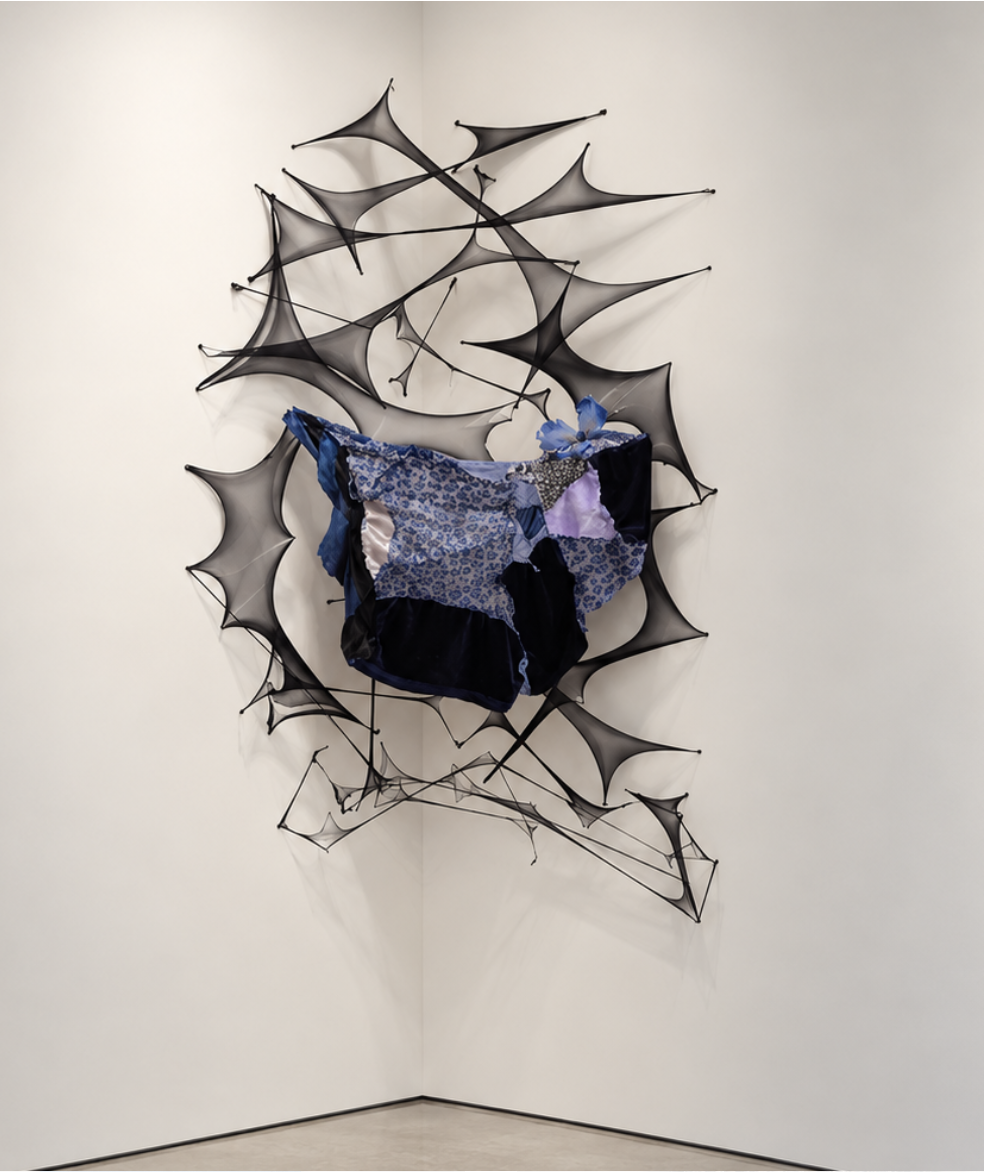
Yet the pieces still translate. In an artist's statement, Yasmeen Abdallah relates that "through the embrace of embodied connections to memories, legacies, and their ghosts, I explore the empty spaces and subsequent longing that linger as a result of living in diaspora through the distance of land, the silence of ancestors, and the fragmentation of language." The sense of that comes through in the piece. Its spider-web structure evokes a dual sense of neglect and menace, while the object caught in the web — or perhaps supported by it — is an invitation to be curious. And, of course, the strength of a virtual gallery, which ECOCA first played with during the COVID-era shutdown when seeing something in person was impossible, is the ability to mount a show that everyone with an internet connection can see. The options for viewing narrow. The scope of who can see it widens.
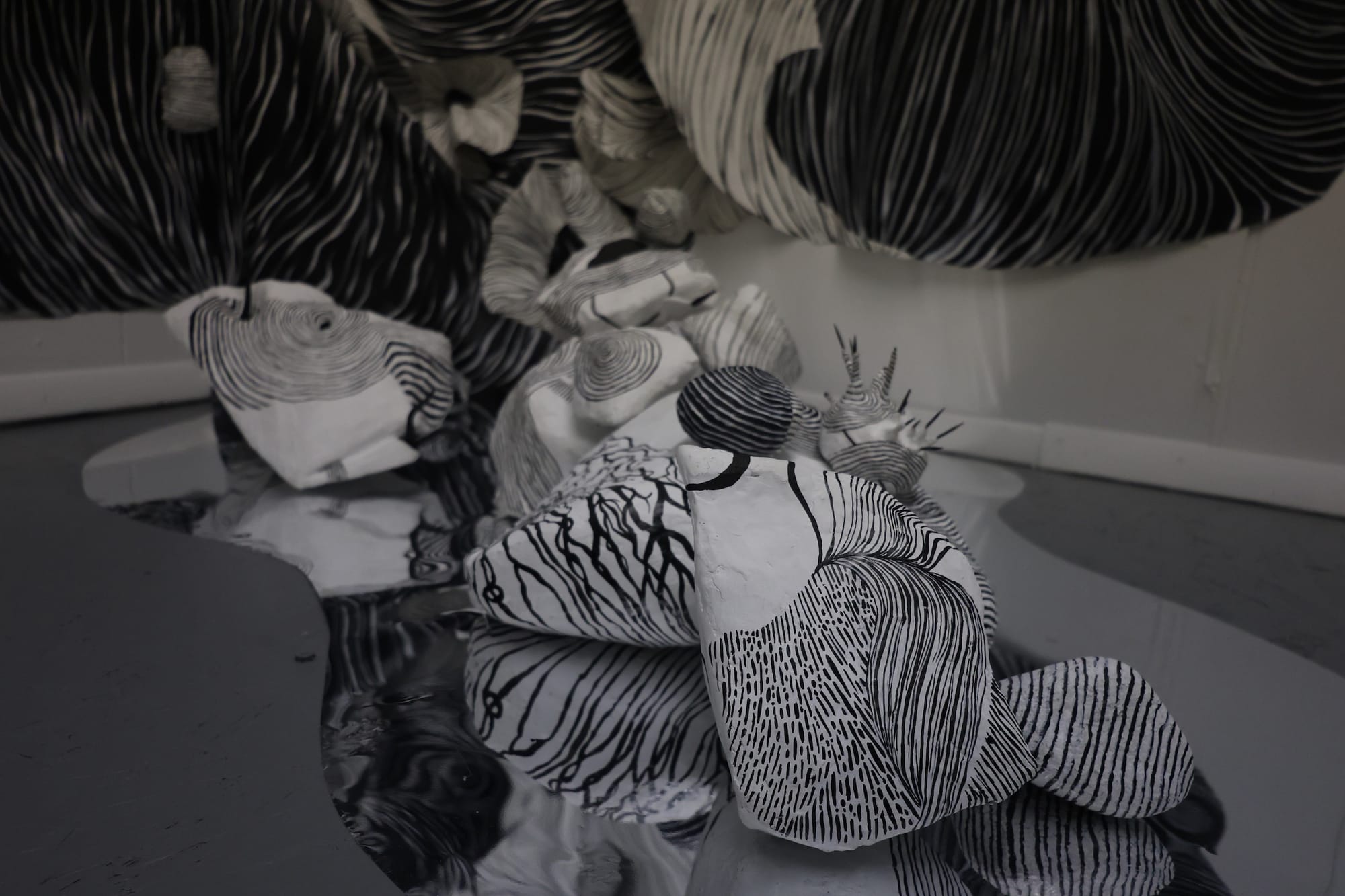
Some art, however, only really works in person, as Tendered Ground demonstrates. "Her work treats drawing as a way of imagining space into being," the curators write. "Black and white lines leave the page and are mapped onto cairns and other forms, gathering into intricate, organic structures that seem to grow, tangle, and inhabit the rooms. Viewers enter the drawing itself, discovering shifting relationships between their bodies and forms that suggest both internal anatomies and unfamiliar landscapes. Drawing becomes an environment and spatial encounter — an imagined world experienced through movement, proximity, and curiosity."
The forms "hover between cellular and geological, bodily and botanical," evoking "wounds, leaves, organs, and passages. Below and among them, somaliths (body-stones) that appear both ancient and newly formed — gather into cairns marking passage, remembrance, and uncertain direction. Nowinski’s installation is a form of wayfinding — where grief becomes transformative through traces of presence and absence."
Nowinski has an uncanny knack for creating work that partakes of fractals — the math that governs the shapes of objects from microscopic organisms to tree branches to coastlines to the arms of galaxies. Being in Tendered Ground, surrounded by it, is transforming in part because it plays with our sense of scale and distance. How big is the room, the piece? How big are we? Nowinski's art carries a sense of bursting through and flowing out of the walls. If it's about grief, it's an apt metaphor for it, the way it can feel like it grows and grows, like it's too much to contain. But when we release it, it can lead to the creation of wondrous things. Afterward, we and the world around us are changed.


