Watch Me Walk
Yale Repertory Theatre
New Haven
Through Dec. 5, 2026
“God did this to me.”
That is how artist and dramaturg Anne Gridley responds to the “God bless you”s that strangers bestow on her when they see her halting gait.
Gridley is fucking (she seemed to like that word) fed up. That much was clear from the content of her one-woman show, Watch Me Walk, currently showing at the Yale Repertory Theatre.
Watch Me Walk is Gridley’s expansive, eclectic exploration of her own physical disability placed within a larger historical and cultural context.
Gridley lives with the progressive neurological disease Hereditary Spastic Paraplegia (HSP), which has no cure. It causes muscle stiffness, weakness, and difficulty walking. Some people who have the disorder live with a lot of pain. (Thankfully, she does not.) Some end up in wheelchairs. She inherited the disorder from her mother Teresa, who inherited it from her mother Mary.
Gridley wryly shared other dumb, unsolicited comments she has gotten:
“You walk better when you smile.” That brilliant observation came from a physical therapist. A professional! He also told her to try marching.
“Have you tried turmeric?” That must have come from one of the many people who she said somehow think her physical disability means that her intellect is compromised.
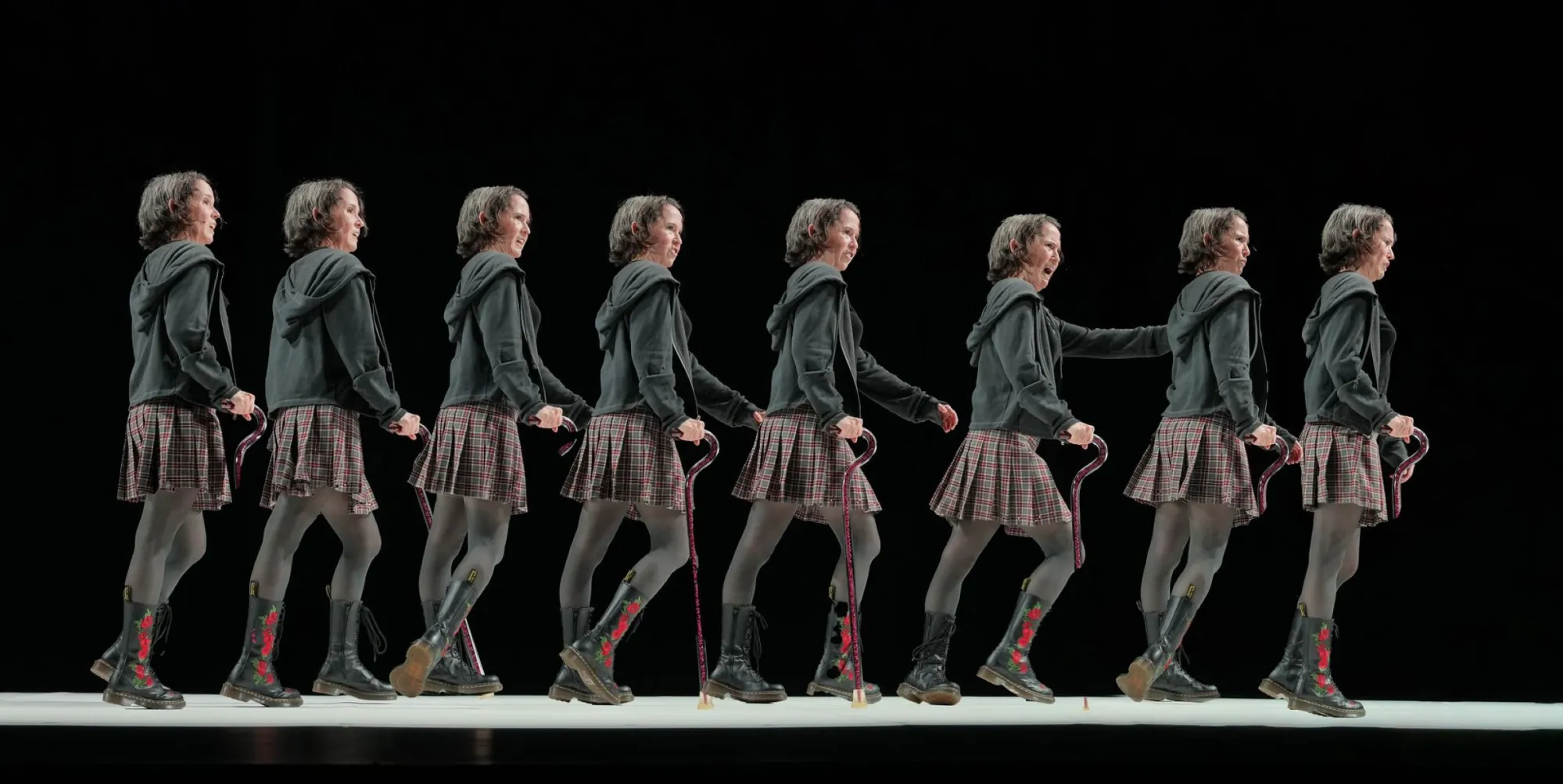
“Watch this,” Gridley told the audience as she got up from her chair at the start of the show. She began to walk around the stage with her stick (she doesn’t like to call it a cane). The audience watched in deep silence as she took lap after unsteady lap, falling once.
She used to be a runner.
You could hear the longing in Gridley’s voice as she reminisced on running trails back in the day, before she developed the debilitating disease at age 29.
The show had an intriguing format: part variety show, Q&A, Ted Talk, and history/science lesson. The visuals were captivating. In an inventive moment, curtains pulled back to reveal that images from a collage of family pictures on the screen above her had transformed into a larger-than-life diorama on stage.
Gridley’s reveries over simple conveniences that the average person takes for granted, like having two free hands or walking sans mental exhaustion, were twined with hard facts about HSP and the history of people with disabilities. Dark humor and vulnerability, with a dose of whimsy, balanced one another out throughout the show.
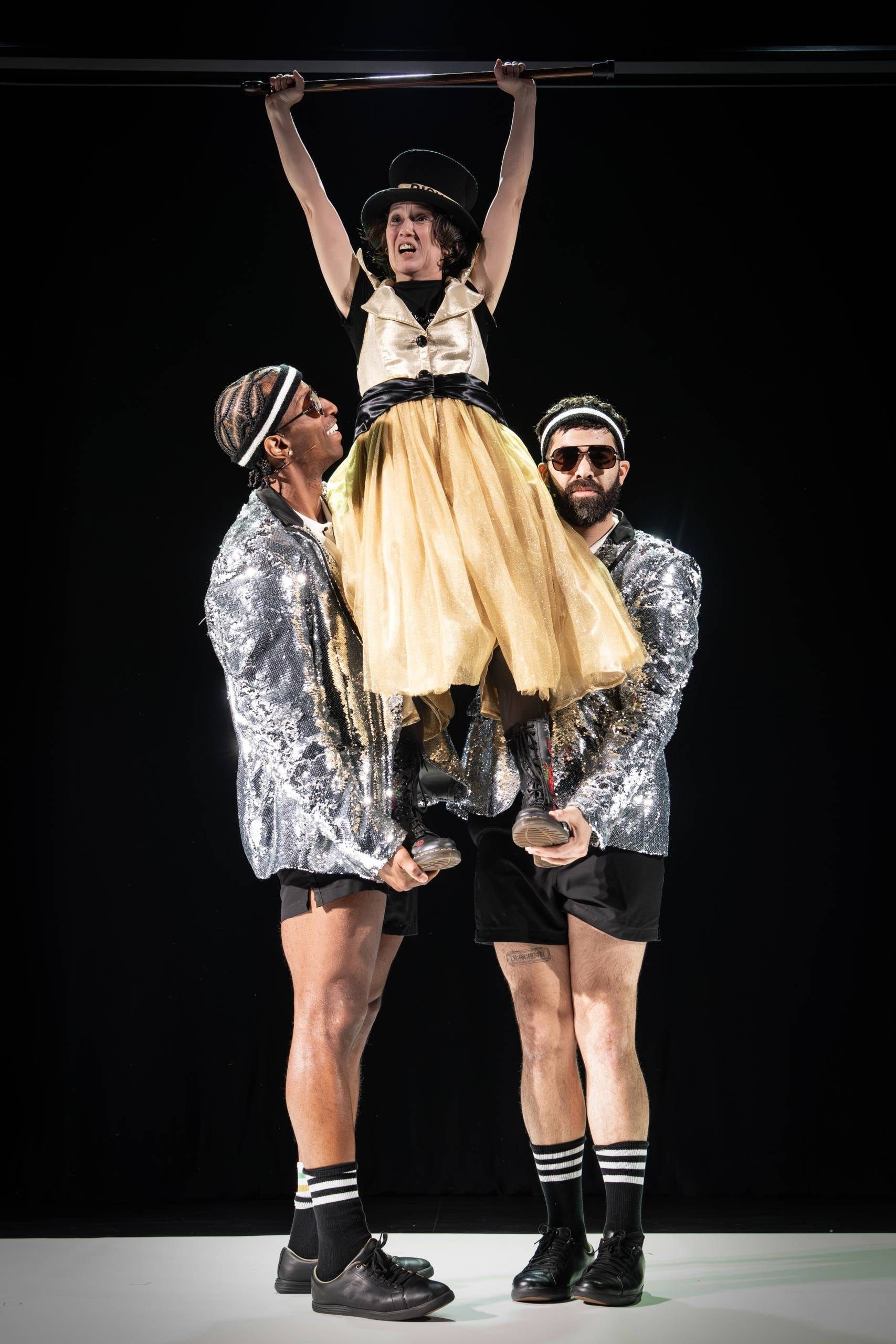
Gridley went to great lengths to drive home her points about the disease, even donning a costume that represented her faulty neurons. Acting as the embodiment of her self-professed rampant ableism were two handsome, fit actors (Fernando Contreras and Keith Johnson) portraying Adonis, the Greek god revered for his beauty. The two Adonises towered over her, mirroring her movements. They provided comic relief with outrageous costumes, funny quips, silly booty-shaking dances and dramatic songs. At times, they carried her around the stage like a queen.
The show was an effective way to learn about a tough, little-known subject. After all, sometimes participating in a sing-along is stickier than a pedantic lesson.
Gridley taught us many definitions of words used for physical disabilities.
We learned that Botox was originally developed to treat cerebral palsy. “All of Hollywood should thank a gimp,” Gridley declared.
We also learned that she has limitless sticks in an array of colors and designs that she names. In one scene, someone offstage threw her sticks to her. In another, sticks came flying from the ceiling.
“I want my mobility aids to look cool,” Gridley said.
Then, game show-style music filled the room as it went black, and a plume of smoke erupted. A spotlight flickered on, illuminating the grand reveal: a sleek yellow walking bike emerged from behind the curtain that Gridley climbed astride.
But along with these light moments came sorrow.
We learned that, back in the day, people with disabilities were thought to be possessed by evil spirits: In some religions, a physical blemish was seen as a blemish to the soul. People with disabilities were often abandoned. In 13th century Europe, they used “idiot cages” to put people with disabilities on public display. Disabled people were forced into being sterilized. And it was once ILLEGAL in some American cities to be visibly disabled in public during the 19th and early 20th centuries because of “ugly laws”.
Present day, there are constrictions that come with disability insurance: To qualify, you can’t make more than $1,900 a month. Thousands of dollars are required for orthotics. (She was wearing these cute boots that she said offered great support. Unfortunately, due to her gait, they must constantly be re-soled. Yet another expense to consider.)
There is also a severe lack of research on the disorder.
Because HSP affects less than 200,000 people in the United States, it is a rare disease, also known as an orphan disease. (Naturally, to highlight that fact, she sang as Little Orphan Annie in a pinafore and red wig.)
She also shared other stories of her struggle: the death of her brother, issues with substance abuse and self-harm, a prior heart condition and an eviction.
The darkest moment was when Gridley grimly shared her mother’s reaction to learning about her daughter’s dismal inheritance.
“I’m sorry you were born.”
Gridley made a joke of it and quickly moved on to other subjects, but the immense pain of that trauma resonated in the room. The silence that followed that statement exuded abject hopelessness. What can you even say after that?
Gridley doesn’t villainize her mother, though. She portrayed her difficult relationship with her mother as a facet of her more encompassing struggle with an ableist society.
The show would have been even more compelling had she taken a moment to lace up someone else’s shoes for her walk. The specter of race missing from the disability story diminished the production. Gridley could have taken more steps to address her privilege. She kind of took it there, which made its semi-erasure more glaringly obvious.
For example, she acknowledged that there were certain assumptions about her because she’s “short and white,” but she didn’t get specific.
She addressed eugenics and its marking of people with disabilities as genetically undesirable — even acknowledging Yale University’s role — but didn’t get into the details of scientific racism. Funny, because it was the Black Adonis (Keith Johnson) who was posing for that scene. Even more interesting, she said that her grandmother Mary was Native American and also had HSP. It would have been illuminating to learn if she received poorer medical treatment than that of her white progeny because of it.
If they were all misdiagnosed, imagine what else Mary had to endure. Gridley shared that her grandmother tried to commit suicide. Did the world have even less patience and empathy for her?
One can’t expect an artist to cover everything in their work, but it is worth examining which stories get to be told.
Flaws aside, it was a well-executed production. You could not leave that show without feeling moved. The two standing ovations she got on Friday evening were proof.
The show closes the way it began, with a recording of an endearing phone call between her mother Teresa and her creative collaborator, Pavol Liška. Teresa reflects on Gridley’s “absolutely not sexual” rain dance from childhood. She used to move with wild abandon, twirling with arms flung here to there. She said she misses witnessing that freedom in her daughter. Her wishing her daughter hadn’t been born may have been a twisted desire to protect her.
After the call ended, Gridley haltingly stood up, holding on to the chair’s arm with her back to the audience. She was not holding her stick.
The Talking Heads’ “Thank You for Sending Me an Angel” began to blare: Oh, baby, you can walk, you can talk just like me…
She turned around, stretched out her arms and danced.