
By Allan Appel
Stories of a City: New Haven’s Jewish Writers of the 19th and 20th Century
Jewish Historical Society of Greater New Haven
Mitchell Branch Library
New Haven
Aug. 17, 2026
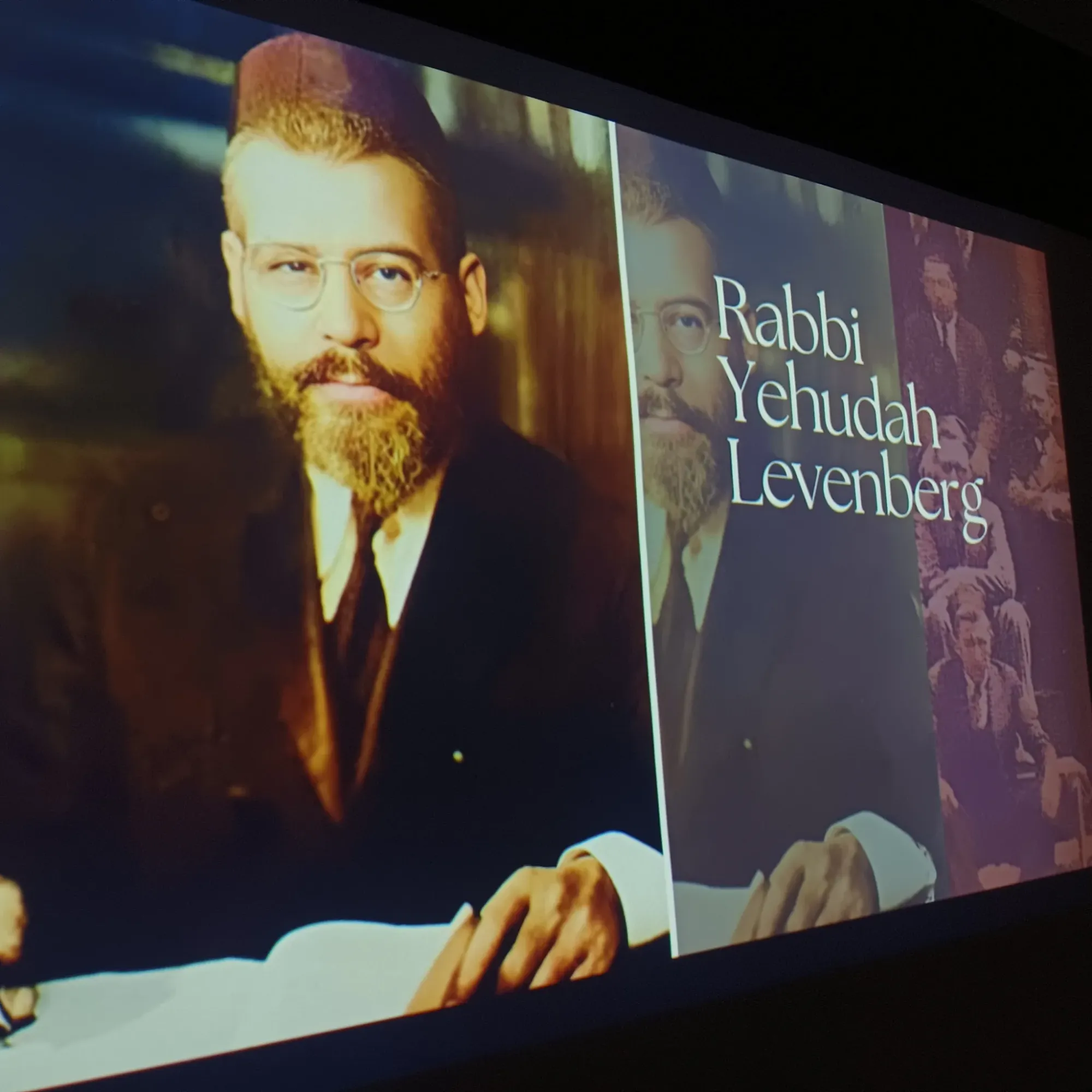
The dauntingly strict Orthodox Rabbi Yehuda Levenberg was declared the first — and since then the only — Chief Rabbi of New Haven starting in 1920.
A decade and a pulpit later, Levenberg had relocated his pioneering New Haven yeshiva to Cleveland. There he took the side of one kosher chicken market and its shochet, or slaughterer, against another in an impassioned dispute about the interpretation of religious law pertaining to ritual slaughter. When the rival market was fire-bombed, the rabbi was swept up in a group arrest as a possible suspect or person of interest.
The next day 2,500 spiritual followers gathered at a mass meeting to protest, resulting in the cops’ admitting their mistake, and then issued a formal apology.
Monday evening that tidbit from the wacky kosher poultry market wars of the 1930s emerged in a fascinating illustrated lecture — titled “Stories of a City: New Haven’s Jewish Writers of the 19th and 20th Century” — delivered to a standing-room-only crowd at the program room of the Mitchell Branch Library in Westville.
The presenter was Nicole Zador, archivist of the Jewish Historical Society of Greater New Haven. The evening was the culminating event in the group’s “Rooted in Place” series, marking the 250th anniversary of American independence, the Jewish experience in New Haven, and the historical society’s 50th anniversary.
The saga of Levenberg, whose skills helped to transplant Eastern European Jewish religious life and institutions into New England, was captured in his writings, newspaper clippings of the era, and in recordings by Levenberg’s students.
Click here for the full PowerPoint of Zador’s presentation.
Levenberg belonged to the second wave of Jewish immigrants to New Haven. So did journalists and poets highlighted Monday evening such as David Kravitsky, Abraham Abelson and his daughter Evelyn Abelson (president of the writing club and 1933 graduate of Hillhouse High).
They arrived from Eastern Europe and were driven to New Haven shores by pogroms and historic persecution in the early 20th century. They brought with them socialist persuasions and literary and journalistic ambitions, founding Yiddish newspapers and magazines.
The first smaller wave of immigrants were Bavarian Jews arriving after 1848 in the wake of the failure of liberalizing political revolutions in Germany. They founded Mishkan Israel,New Haven’s first synagogue, and included Isaac Strouse and Max Adler, the corset and foundation garment kings of Wooster Square, and the redoubtable Morris Steinert.
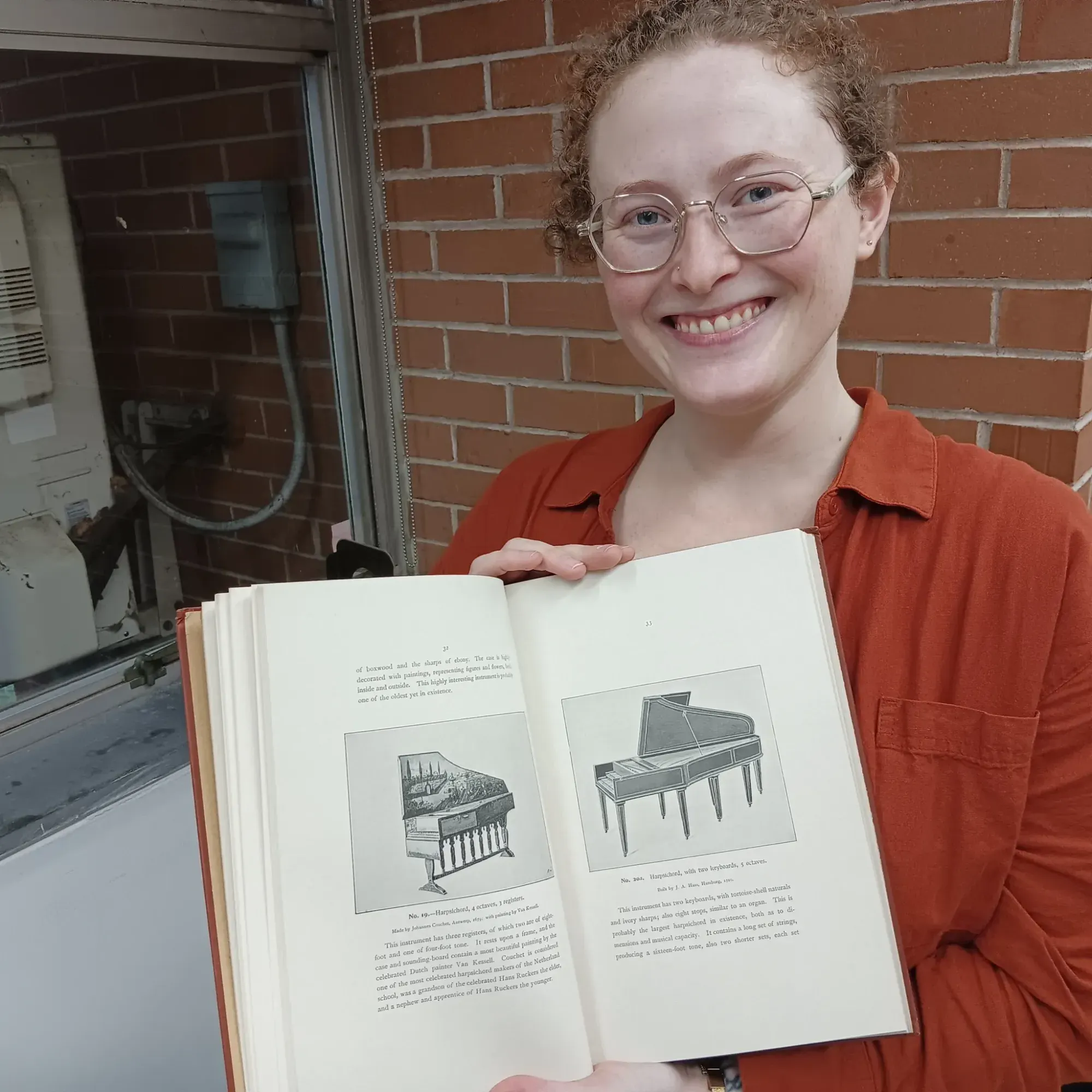
Steinert was the New England sales rep of Steinway. He opened a music and musical instrument-making shop on Chapel Street in 1861 and was a principal founder of the New Haven Symphony Orchestra in 1894.
Because Monday evening’s event was literarily focused, Zador leaned into the story of Minna Kleeberg, the wife of Mishkan Israel’s founding rabbi. Arriving in 1878, and dying tragically only a few years later, Kleeberg was a Jewish feminist avant la lettre.
“She published her first poem at age 14, and refused to accept the subordinate rules” (\for women in Jewish life, said Zador.
For example, recounted Zador, “she cried that she wasn’t allowed to read from the Torah and she refused to say the prayer thanking God for not making her a woman.”
Shortly before her death Kleeberg published a book of poems that contained her “The Jewish Church Yard at Newport.” It was an ad hominem response to Henry Wadsworth Longfellow’s famous “The Jewish Cemetery at Newport.”
Contemplating the graveyard adjacent to the historic Touro synagogue in Newport, Longfellow’s opening lines read: “How strange it seems! These Hebrews in their graves, / Close by the street of this fair seaport town, / Silent beside the never-silent waves, / At rest in all this moving up and down!”
Well, Kleeberg would have none of the implication that the Jews are pretty much all gone, Zador reported. Kleeberg’s poem states, in part and in German, “We are not dead. By almighty God we live!”
Kleeberg was taking specific issue with Longfellow’s closing quatrain which, by today’s lingo, might be said to imply that good Jews are dead Jews:
But ah! what once has been shall be no more!
The groaning earth in travail and in pain
Brings forth its races, but does not restore,
And the dead nations never rise again
Kleeberg was well known enough that Longfellow in fact wrote to her. He said he admired her poem and even admitted he could have done a better job. “He regretted the way he ended it,” said Zador.
On display for attendees at the event were some books of the writers Zador cited in the society’s collection, including Morris Steinert’s Reminiscences, Solace, a poetry collection written by \New Haven educator Shulamith Chernoff; and Three Centuries of New Haven, one of the foundational works of New Haven History. Published in 1938, on the 300th anniversary of New Haven, it was written by Rollin Osterweis, a Yale grad and professor.
“We have many other stories,” concluded Zador. “Come to our archives. We are lucky to have many materials that are unpublished, including boxes of unpublished poetry.”
Those are in Yiddish. She appealed to audience members who know the language to drop by, have a hand at translation or cataloging help. The society is augmenting its ten-volume written history of New Haven Jewish life with a growing collection of oral history recordings.
Next up for the Jewish Historical Society is a Nov. 15 50th anniversary celebration. Among the Jewish history stars scheduled to attend and to speak are Jonathan Sarna, who helped found the society in 1976; Dan Oren, who wrote Joining the Club; and Connecticut State Historian Andy Horowitz.
Contact the society here.


