
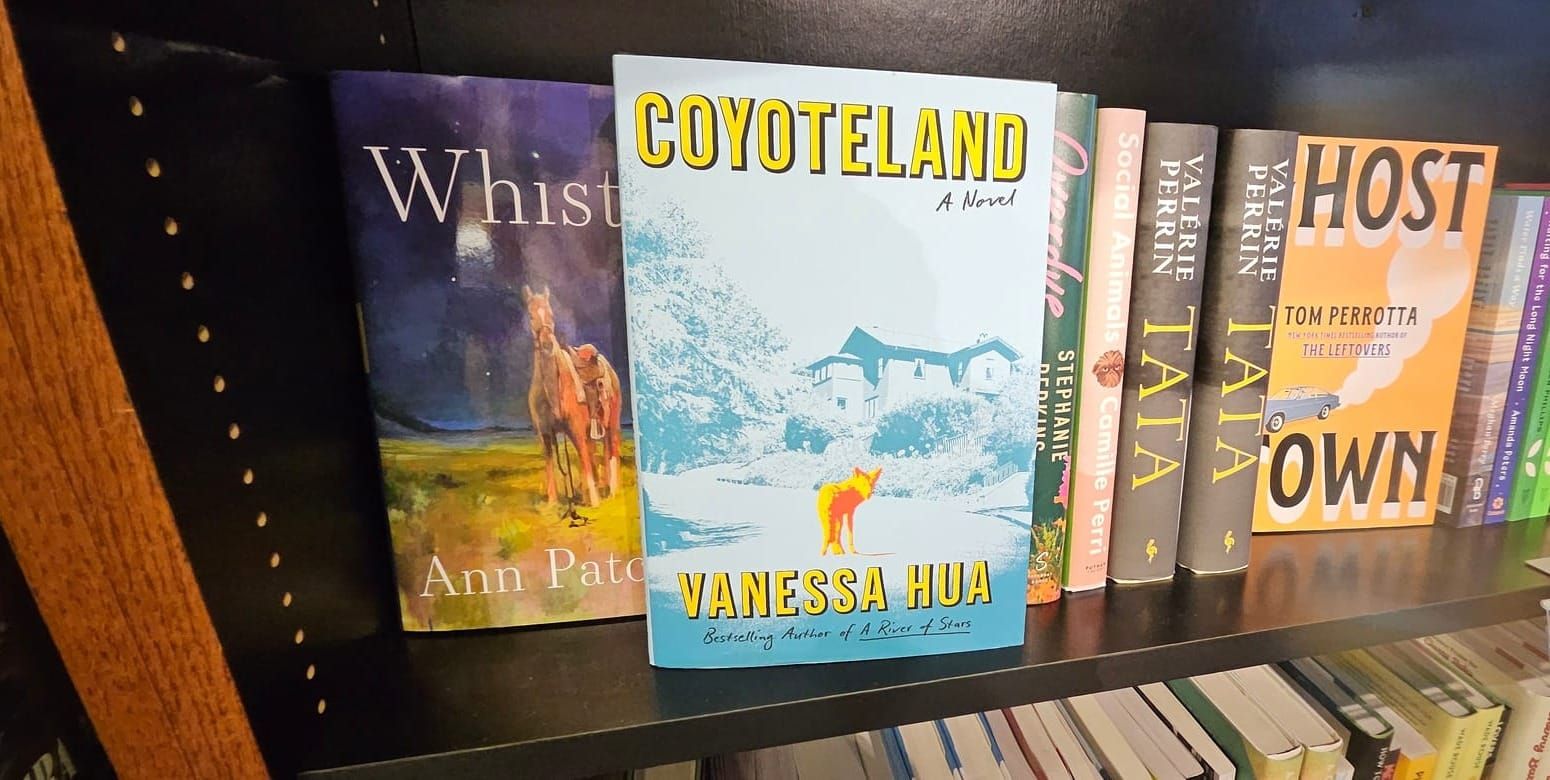
Coyoteland
By Vanessa Hua
Flatiron Books
Told from multiple points of view, Vannesa Hua's new novel "Coyoteland" follows four families who each harbor secrets in the elite, exclusive enclave of El Nido, a community just outside the hills of Berkeley, California. The book calls to mind other recent tales that reveal the seamy underside lurking beneath the seemingly sublime culture of the suburban utopias that define The American Dream, like Nicole Yoon’s One of Our Kind and Lights Out in Lincolnwood by Geoff Rodkey.
Coyoteland, Hua’s third novel, explores issues of race, class, and what surveillance looks in today’s everyone records everything culture. It also tackles domestic violence to immigration and body image. Three teenagers at the heart of this book drive the story. Hua uses wit and a deft understanding of human nature to craft a believable world where people grapple with complex questions and choices.
Jane Chang and her family are moving to El Nido. As they ride into the seemingly idyllic community to begin anew, they encounter a small herd of deer, wild animals leaping across the road. We learn that deer are a common site in El Nido and that hitting a deer is a rite of passage in this bucolic community. El Nido, like many exclusive developments, destroyed their habitat, putting the wildlife and residents on a collision course of change. The encounter with the deer is a foreshadowing of the tense relationship between man and nature that plays out in the book, called "Coyoteland" because El Nido was once just that.
Jane’s father, Jin, meets their new neighbor Blair, the neighborhood “Karen.” Without batting an eye she chastises him for parking in front of her mailbox as if she owns the street. This first meeting sets the tone for how this relationship and that of thier daughters unfolds. Jin distrusts Blair, and Blair never quite believe the Changs belong in the El Nido cul-de-sac where much of the story takes place.
Hua uses these opening moments to set and establish the entitlement of the residents of El Nido and create a tension that simmers and brews throughout the book. Hua’s pacing here works well as she guides us from these seemingly innocuous first meetings to the book’s explosive final scenes.
Jane becomes best friends with Tasha, a Black teen whose family hopes to win a spot in the newest development on the horizon, Bellavista. Tasha, who learned to forage during the long weeks of the pandemic, is wise beyond her years. She possesses a reverence for nature, unlike many of the others in town. She wants to preserve the land and ensure that it lives to share its legacy and bounty. Tasha understands the synergistic relationship between man and nature and wants to learn the healing arts used by Black communities for generations. She wants to also protect her family and help her mother regain her sense of smell, which she lost after a bout with Covid, hence her foraging for natural remedies.
Quinn, Blair’s daughter, is one of the “cool” kids, and much like her mother is duplicitous, superficial and narcissistic. She is the embodiment of a “Karen’s Daughter”: entitled, selfish, and oblivious to her narcissistic, racist ways. Following her mother’s lead, Quinn believes she is impervious to the repercussions of her actions even when they have potentially dangerous outcomes. She is the quintessential mean girl, a bully who wants what she wants and doesn’t care how she acquires it.
Anna works as a nanny for The Belles. An immigrant whose DACA status is in jeopardy, Anna is hiding from her abusive husband, whose violence has hospitalized and traumatized her and her young child. For them, El Nido is a haven, a safe place to regroup and regain her DACA to stay in the country.
Perhaps one of the most intriguing characters in the book is Wiley, the coyote whose image appears on the cover. Wiley is angry and hungry. He’s a loner in search of a pack. Hua brings us into his world and mind as he does what coyote’s do. The humans threatened his land and ecosystem. He is now threatening theirs with late night raids on chicken coops and attacks on children and pets. He, like the humans in the book. is struggling for survival.
The novel is populated with a number of characters with their own story plots and subplots. Hua does a good job of making them each distinct and fairly easy to know. A few of the characters feel a little flat, like Jane’s mom, Anna's sister, and Blair’s husband, but this doesn’t compromise the story.
Writing across race and culture is not easy. Creating believable characters from cultures not your own requires empathy and a willingness to step outside of yourself and acknowledge your own bias. Hua does a credible job writing the Black and Latino characters. There are a few times when their dialogue and responses to social issues seem a bit off, like when Blair’s friend Jackie agrees to host and attend a “Pimps and Hos” party. But overall Hua gets quite a bit right in her portrayal of these people facing the challenges of being “other” in a predominantly white space.
Creating youth voices for an adult audience is also challenging. Adult authors must recapture the wonder and freshness of a teenagers voice. They also have to recall that perspective of not knowing, searching for answers about the world while allowing for a depth and understanding of the world that speaks to adults. It works well here. The teen characters feel authentic in their knowledge and their inquisitiveness about the world. They also allow readers to find the liminal space between teenager and adulthood where we come of age and begin to understand who we are and how our values guide our actions.
Hua uses news pulled from the headlines of the past decade or so to contextualize parts of the story. That allows us to make connections between the real and fictional worlds and enhances our emotional tie to the story and characters.
Coyoteland is a good read. It will make you think about how urban sprawl impacts everyone – developers who build these communities, the people who live there, and the animals and people displaced as they grow. It will make you think about what privacy looks like and how easy it is to slip into following the herd and not question the herd psyche. The book takes a hard look at privilege from several angles as it makes us question how and why we relinquish our ability to think critically to influencers and screens. In Coyoteland, Hua creates a perfect storm where nature, race, class and gender collide.


