
sweat variant presents adaku, part 2 work-in-process
Yale Schwarzman Center
New Haven
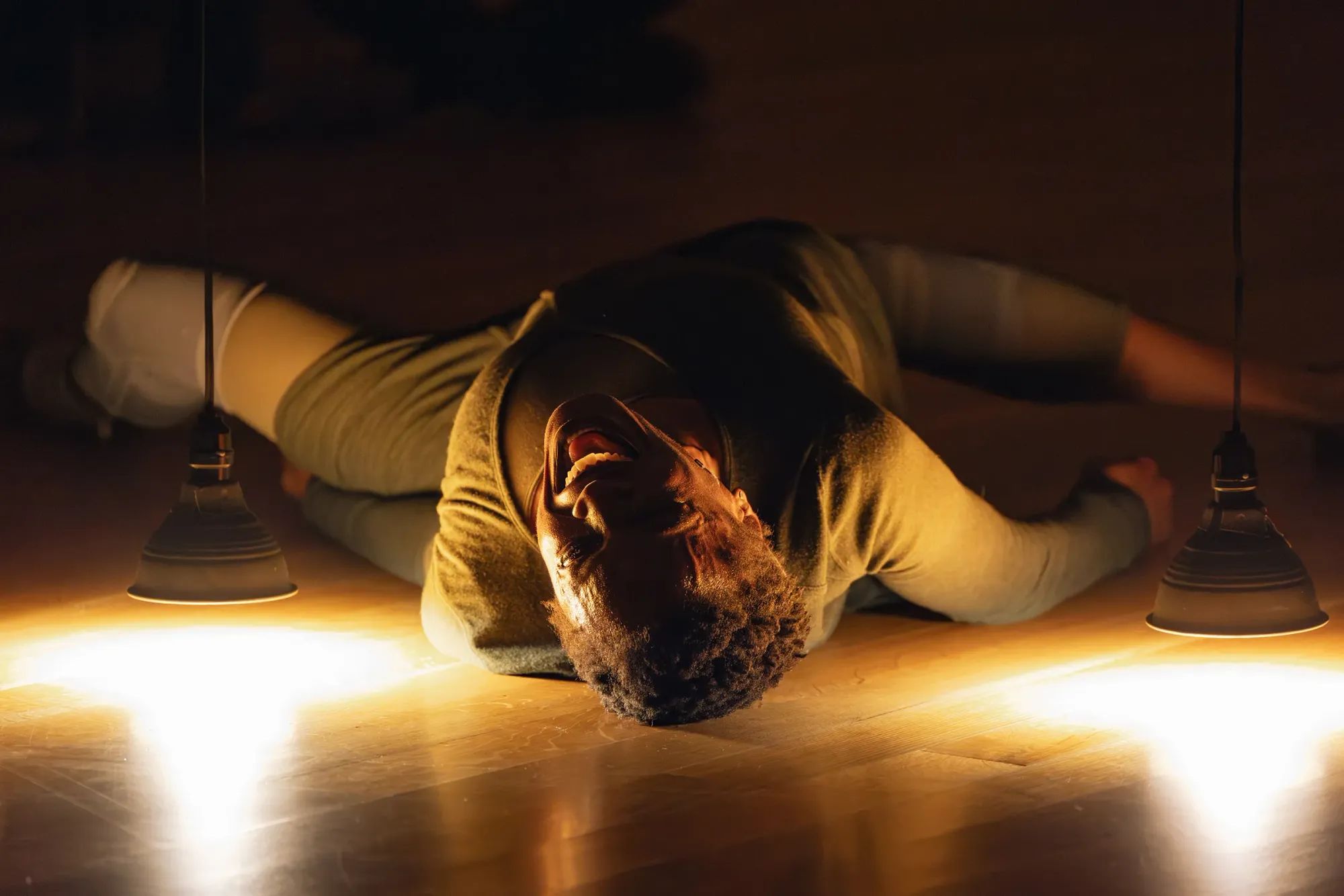
Walking into the softly lit Dome at Yale’s Schwartzman Center felt like the disruption of something profound. Dancer Okwui Okpokwasili was a portrait of anguish as she lay writhing on the floor. A sonorous humming streamed from speakers placed all around the room. The night sky peeking through the Dome’s oculus added a patina of somberness.
The audience barely got settled into the circle of chairs and low stools before the humming intensified into an all-consuming wailing.
That night, the Dome was host to a showcase that Okpokwasili deemed an experiment, not a performance.
adaku, part 2 work-in-process is the second part of a trilogy imagined by 2018 MacArthur Fellow Okpokwasili and her partner (in work and in love) director and composer Peter Born. Together, the multi-hyphenated artists make up sweat variant, a critically acclaimed interdisciplinary collaboration that merges dance, visual art, movement and performance into an immersive storytelling practice. sweat variant explores Black interiority while removing expectations of how Black bodies are meant to perform in the world.
About adaku, part 2 work-in-process, Okpokwasili said at the performance this past Wednesday night, “I’ve wanted to hold and make space for this collective cry, a collective kind of wailing and mourning. And I also [was] trying to think of [its] reverberation. I think about the first cry of the woman who lost that child, never to be seen again. How does that cry reach through her lineage and beyond?”
The adaku trilogy examines the long-lasting repercussions of the transatlantic slave trade. The second installment begins with the chorus of wails that ensued at the end of adaku, part 1: the road opens after a girl is snatched from her pre-colonial West African home to be taken across the ocean. adaku, part 2 examines the resounding impact of that violence on the seized girl’s lineage.
Okpokwasili’s role in the “experiment” was undefined by design. The audience didn’t know if she was the girl from adaku, part 1. And walking in on such a raw performance, mid-action, was further destabilizing. As an audience member, you couldn’t engage with her choreographic language expecting a linear narrative. Rather, you had to sit and simply bear witness to the torture of psychic and physical violence.
As she gasped for air, Okpokwasili twisted and turned her body into ragged shapes. She roughly dragged herself, clad in a sheath dress, back and forth across the floor. Her legs and arms went akimbo as her body convulsed. She was a fallen marionette controlled by invisible forces.
Each movement of her uncannily claustrophobic dance felt unsettling. The two suspended lights that grazed the floor and narrowly framed her straining body added to the constricted atmosphere. Okpokwasili vibrated and shook, looking like a woman on the verge of giving birth under the worst conditions.
Throughout the dance, she would go hunched back, struggling to her forearms. The unease was tangible as we watched her repeatedly trying to get up, only to collapse every time. She intermittently slapped the floor with such force, her frustration vibrating within the room. At one point she threw her body down with such commitment there was an echo when her head hit the floor.
The wailing notes accompanying Okpokwasili’s performance varied in texture and tone. She screamed out forebodingly, harmonizing with the haunted chorus. Eventually, what began as discordant cries swelled into a poignantly beautiful song. With searching eyes, she reached her arms out to the audience encircling her. She managed to get to her knees, but she fell again. Then Okpokwasili curled into herself, an embodiment of every weary stolen soul.
Suddenly, a whooshing sound surged like an oncoming train. The wails ceased.
In the abrupt stillness, Okpokwasili’s stark, jagged cries were those of an exhausted child. Then her cries broke off into a bitter laugh. Her face a sheen of tears, she finally rose to her feet, crackling with pent-up energy.
As she stood at the center of the audience, she looked scared and unsure of her existence. Without warning, she directly addressed us.
“Oh God. Whoa. Okay. Hi. How are you?”
We answered Okpokwasili with a frozen silence. The onslaught of intimacy was immobilizing. Was she really talking to us? What did she expect from us? Our non-reaction seemed to upset her. “If I’m okay, you should be okay,” she told us sternly as she stalked the perimeter of the circle.
Chiding herself for being “a bit aggressive,” she changed tack, asking, “Should we breathe together?”
We tenderly traded inhalations and exhalations and felt relief from pain both visceral and intangible.
“We’re not alright, but we’re alright,” Okpokwasili affirmed, proclaiming the sentiment to be the evening’s theme. Vigorous clapping followed as the audience emerged from our emotional stupor. “That’s not necessary,” she insisted. She began to clap for us. After all, we were research partners in this momentous investigation.
“[adaku] will never happen again this way,” Okpokwasili said with a smile. “So, keep it tucked away in your hearts and minds.”
Reflecting on her performance, she said she “tried to listen with every part of [her] body and then respond.” Rather than imagining herself to be one person in the hull of a slave ship, she saw herself as a nodal point through which the sorrow of the chorus (eight voices in total) – and ultimately that of the entire world – could be expressed.
The clear parallels between the transatlantic slave trade’s horrors and the atrocities of the present day inspired rumination amongst the audience, judging by the robust post-show discussion. For some, including Okpokwasili, the ache of personal tragedy was evoked.
“I was just thinking about the impact of racism that started to actually live in her body,” she said about her mother whose pregnancies were cut short by trauma, one after the other. The pain was palpable as she described the devastating awakening her Nigerian family received upon arriving in the land of the free and “becoming Black,” being denied apartments and other markers of a dignified life.
One audience member, a descendant of enslaved Africans, wondered whether it was even appropriate for adaku, part 2 (work in process) to be viewed universally. She questioned whether a wide-ranging audience could connect with and understand the depth of this particular grief.
sweat variant’s goal with adaku, however, is to include all of society and open eyes to the communal grief that lingers in the wake of the foundational rupture that was slavery. They aim to create a safe space for genuine connection and understanding; for unearthing that which lies below the surface, incapable of being articulated but acutely felt.
“I feel like we’re living in this ongoing loop of the ramifications of bondage and terror and violence. I can’t believe how impossible it feels to escape,” confessed Okpokwasili.
Iran. Lebanon. Sudan. Gaza. The litany tragically continues.
“[Part] of the anguish and agony,” mused Born, “is that ‘Wow, I’m a part of a machine and a system that creates this condition, and I am privileged. My house is built on the bones of so many.’”
Performance, for sweat variant, is a powerful means of grappling with this moral dilemma while practicing radical empathy. If only sweat variant could pull off the Sisyphean task of grieving on behalf of the Earth – they would.
“I think an artist’s ultimate job is to expand everyone’s sense of empathy so that, as we go out into the world, our relationship with each other starts with that,” declared Born.
Radical empathy forces you to deeply consider another’s suffering, no matter how inconceivable; and even how you might be implicated. sweat variant’s work forced that reckoning, guiding the audience through a confrontation with our alarming reality.
The evolving adaku, part 2 work-in-process did not offer resolution, only a question: what does it mean to truly see and listen, and how do we live with what we witness?
Visit Yale Schwarzman Center’s website to mark your calendars with more of their compelling events.


