
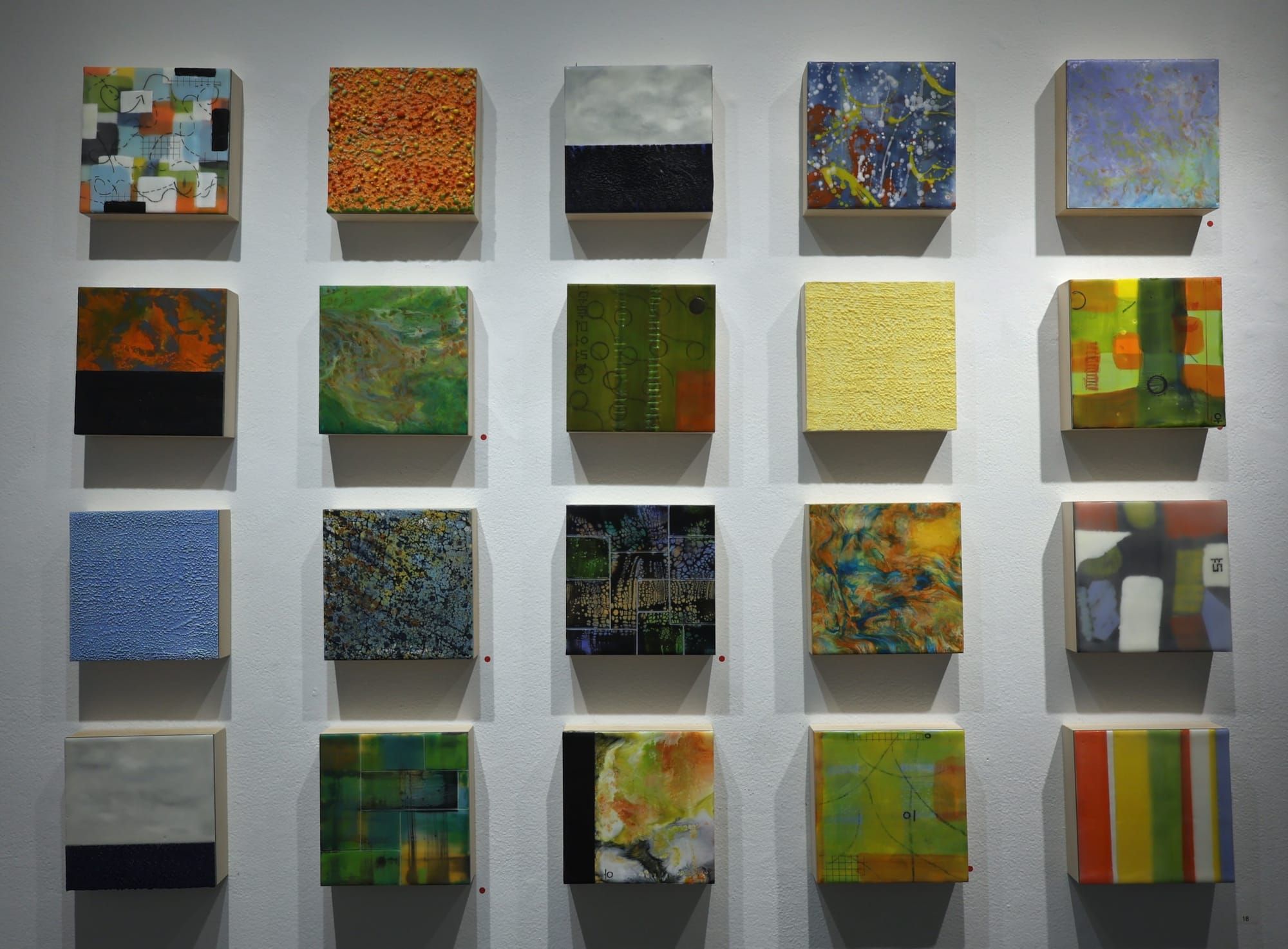
Amy Arledge, "Eclectic"
City Gallery
New Haven
Through May 31
It's just 20 small boxes in a grid on the wall, but there the uniformity ends. The range of colors, shapes, and moods suggest that the format of a little square is a trap the artist, Amy Arledge, already knows she can escape from, over and over, before she even begins the painting. So one vibrates with overlapping shapes like a quilt. Another is about the luminosity of a certain yellow, and the texture that the color lets pop. Another has a splay of vivid color like a closeup of a butterfly's wing. Still another has the serene blues and greens of a summer sky at dusk, viewed through trees when lying on the green. There are 20 of them, but it's easy to image that Arledge could make 200 more and always have a fresh idea, in the way that one can always lead to another.
20 Minis is just one piece of Eclectic, a show of Arledge's work running at City Gallery on Upper State Street through May 31. The exhibition is a showcase for a painter and sculptor who has moved back to town after years of being away. One gets the sense she hasn't missed a beat.
An accompanying note explains that "Arledge’s primary medium is encaustic — a combination of purified beeswax and damar, a tree resin that adds durability to the beeswax. The word encaustic is derived from the Greek enkaustikos, which means to burn in. Encaustic was used in Ancient Greece and Egypt both as an artistic medium and a building tool."
“Nature is an endless source of fascination and inspiration for me,” says Arledge. “It is a common thread in all of my work, whether through actual depiction or in abstract shapes and colors.... I’ve painted with encaustic for several years depicting landscapes, seascapes and the non-objective,” explains Arledge.
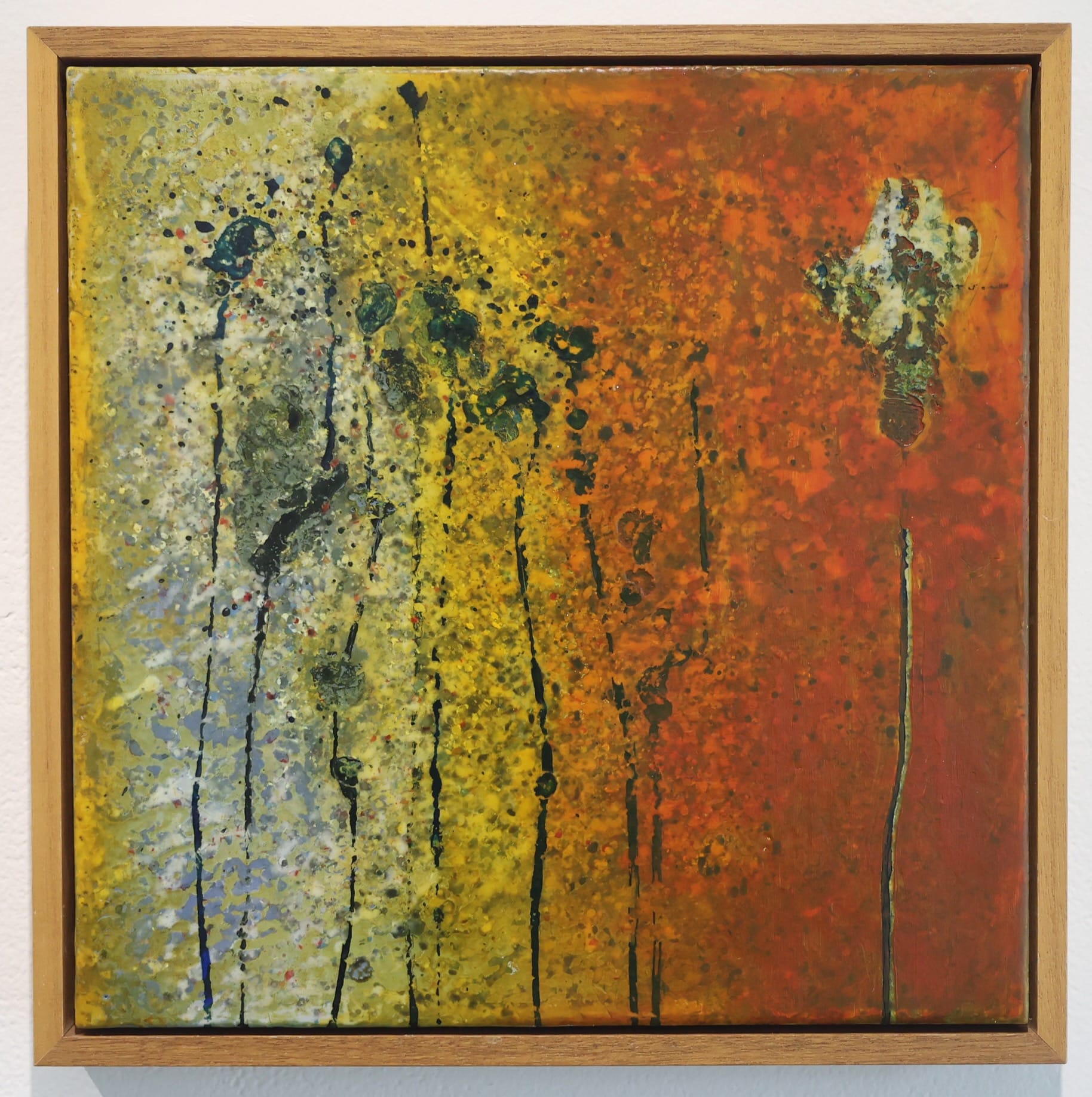
The encaustics in the show display this range. 20 Minis is all abstraction, as are many of the other paintings; they lean hard into the vibrant hues the medium can create, and the shapes and textures that can be made. But in one, a crow appears, unmistakable. And Autumn Prairie hovers in tension between the two poles. The background is all abstraction. The shapes in the foreground are an exercise in pattern recognition? Did the artist intend to make shapes that resemble plants or did they just emerge? Once we make them into plants in our minds, can we see them any other way? Regardless, the atmosphere evoked of a sun-baked haziness comes through loud and clear.
Arledge's sculptures display even more range than her paintings. "Her assemblages originate from found objects, often wood, which resemble something in addition to what they actually are. She adds color, additional items, and sometimes wax to accentuate what she sees and give them personalities," an accompanying note explains. For some of the sculptures, the paint gives the shape meaning. An array of spots along a spindly piece of driftwood turns it at once into a giraffe, even if its head is artfully absent. Another, coated with beads, becomes a snake.
For some of her pieces, Arledge shows off her skill in rendering the faces of humans and animals. An unsettling one features the face of a terrified man trapped in a boat; its title, Nulla Pax ("no peace"), offers no relief. The head of a crow curls over the top of another.
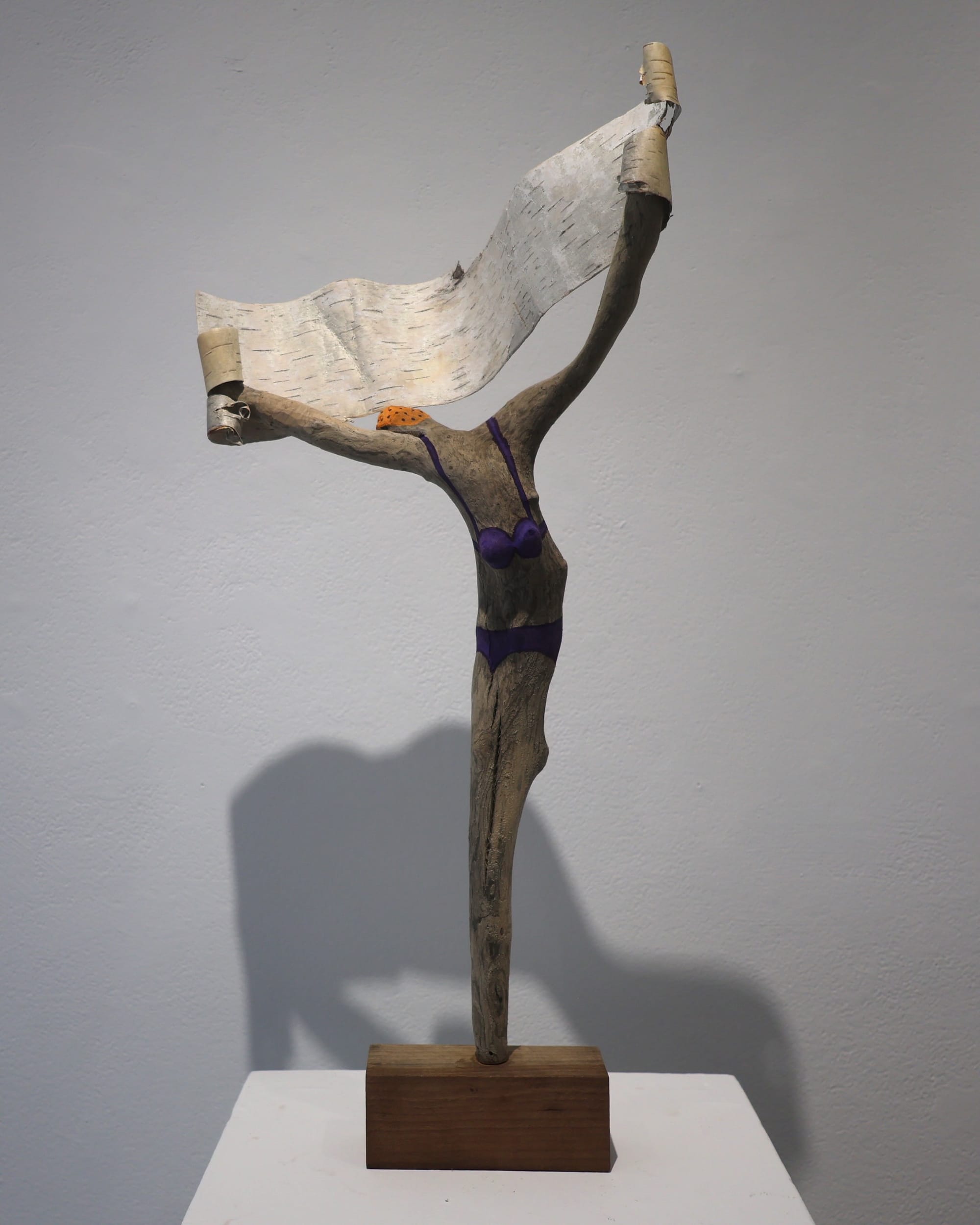
Arledge's assemblages can become whimsical, whether it's faces and figures rendered from playful geometric shapes or the undeniable humor in a piece like The Sunbather, in which Arledge brings out the meaning in the form through a purple bikini, a painted orange suncap, and an unfurled piece of birch bark to direct the rays in the right place.
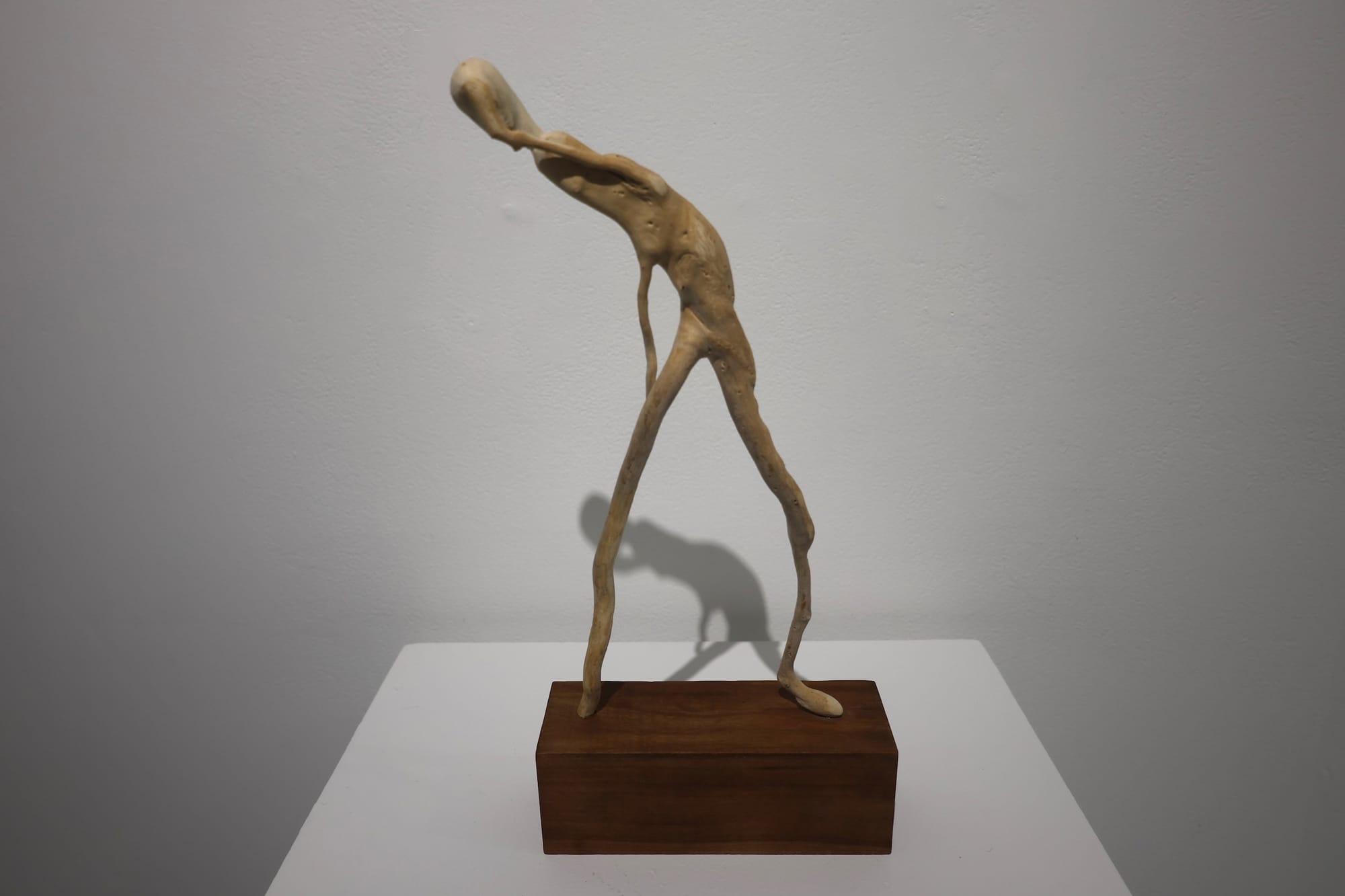
Perhaps Arledge's most successful sculptures are the ones that rely solely on her eye, in being in the right place at the right time, to find just the right piece of driftwood, see it at just the right angle. Two in particular, Arledge deemed right, require no ornament. Her Swimmer is a sinuous piece of driftwood that resembles, to an uncanny degree, someone who has just gotten out of the water to rest. Onus, meanwhile, rewards a longer gaze, a second look, a third. The first glance is about celebrating the improbability that nature could produce a piece of driftwood in the shape of an expressive human form, let alone that Arledge would come across it. But knowing that the form arose by luck doesn't rob it one bit of its power to communicate emotion. On the beach, jumbled among rocks and other branches, it conveys nothing. Mounted on a block, it communicates an array of complicated emotions. There's joy in the way the figure appears to be dancing, but something more complex in the flow of its body, the way it holds its head. With shyness? With sadness? With something else? It's up to us to decide. Nature, which made the shape, has no intention, or all of them. Arledge is just there to see it, and show it to us.


