
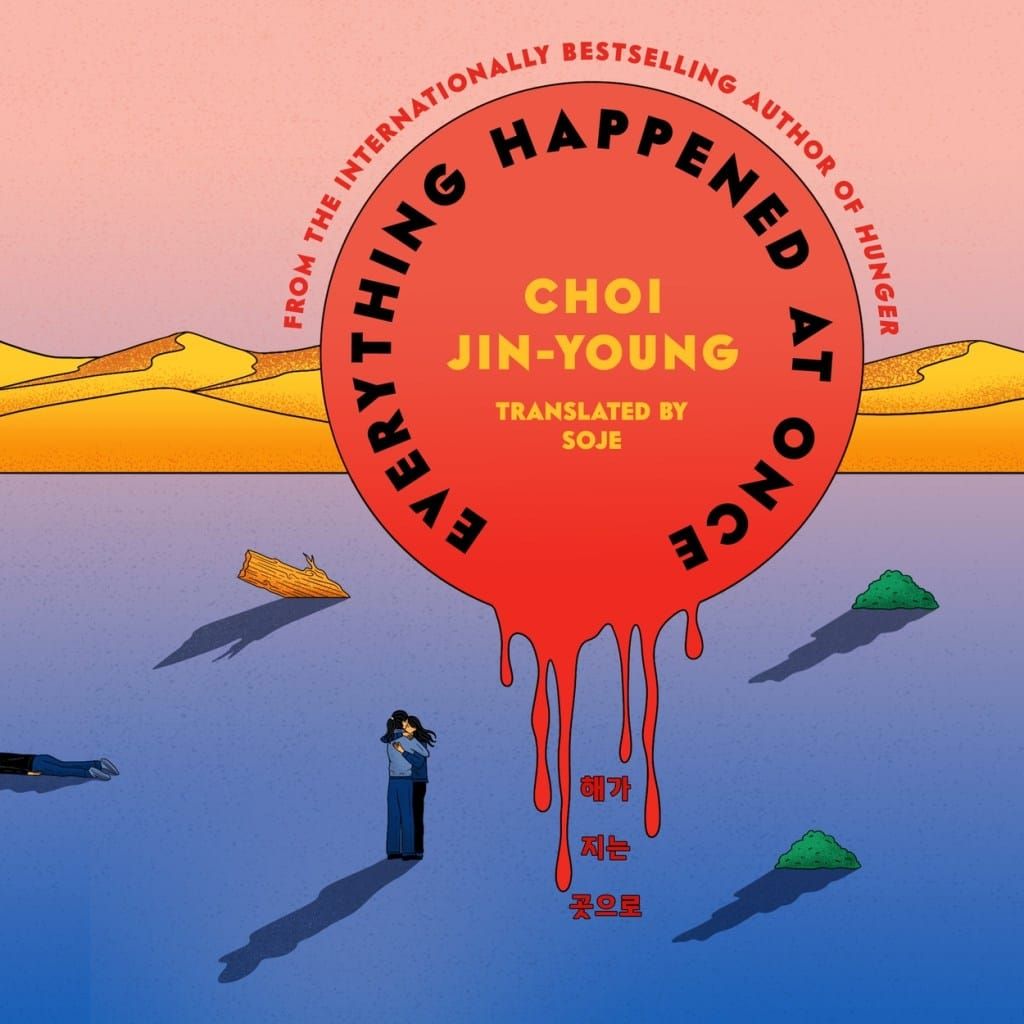
Everything Happened at Once
Choi Jin-Young
Translated by Soje
Hachette UK
English translation published July 30, 2026
(Jisu Sheen recently moved from New Haven to Gwangju, South Korea, where she’s covering local arts and culture for the New Haven Independent and Midbrow.)
Choi Jin-Young's dystopian book Everything Happened At Once reawakened my fear, not of the apocalypse, but of a danger present from the beginning of humanity on earth: men.
In this universe, the cause of the end of the world is a deadly virus. It decimates Korea, and the survivors cross through Russia in search of safer soil. As in other illness-based disaster tales, like zombification in Train to Busan or the animal epidemic in Tender is the Flesh, the real tragedy is how humanity responds to its new reality.
Choi weaves in and out of the narratives of her characters, trusting the reader to handle non-linear timing and order. There is an element of suspense to the reveals, like when she builds up to a scene already recounted from another person's perspective.
Time jumps add to the depth of betrayal the characters experience. When one character, Ryu, recounts meeting a girl named Dori, she notes that Dori believed in God at the time—a faith that has since faded. The narrators are let down by the fabric of society as well as the individuals in their lives. They lose each other and reunite under circumstances that have turned them into different people.
Ryu, Dori, Dori's little sister, Joy, and Dori's love interest, Jina, are sensible, trying to survive and making time for tender moments when possible. Meanwhile, the men in their lives sink to the depths of human depravity.
Trusted adults enact shocking violence on the young people in their care. Jina's father's authority, which at times seems protective and efficient, turns into a nightmare. In one couple, Ryu's husband pressures Ryu for sex and crosses the line into marital rape, reasoning that it's one of his few vices in the midst of world devastation. It's a twisted logic — isn't this a time to protect relationships, not throw them away? — and one that exists in the world as we know it.
It stressed me out that Ryu still goes back for her husband after they're separated, but then a lot of harmful-and-harmed characters in media stress me out (June in the TV version of The Handmaid's Tale, Bojack Horseman in Bojack Horseman, most of the characters in Infinite Jest...). I find myself itching to check with fellow audience members, This reads as a desperate argument, right? Not a revelation? So I may just be a needier media consumer in terms of wanting the art to spell it out.
The love shared between Dori and Jina hints at an alternative route. Their relationship blossoms over small moments of recognition, like Dori scavenging a lipstick for Jina. Their disinterest in control shows that sticking together is not just about comfort, or even security from enemy forces. It's also about remembering how to be human.
When I lived in New Haven, Connecticut, I would spend afternoons talking with friends about the world that raised us: the security theater playing out at U.S. airports, the home invasion horror movies that cropped up in the 2000s, copaganda on TV. It was only as an adult that I read the words of U.S. Rep. Barbara Lee, the sole person out of over 400 members of Congress to vote against war in 2001: "Let us just pause for a minute and think through the implications of our actions today so that this does not spiral out of control." (And more famously, her quote of a clergyperson: "As we act, let us not become the evil we deplore.")
Lack of safety is a problem. When the available solutions are all some flavor of amassing power, another issue emerges: the chaos that power entails. When we think danger fundamentally comes from others, we can bend over backwards keeping the outside out while ignoring the rot within.
In a belief system where safety comes from authority, those who are physically smaller or psychologically less commanding are seen as incapable of providing that resource. When Dori and Joy join Jina's crew of survivors, they're treated as obvious liabilities.
I was moved by a part in the book where Joy becomes interested in the ways people get together. She tells her big sister to get married. "I want there to be three of us, not two," she says to Dori in Korean Sign (Joy is Deaf). "Four would be even better."
Dori tries to explain that people get divorced. Undeterred, Joy urges Dori to get married and stay with her person forever. Unlike Dori, Joy seems to believe in the goodness of other people. The capacity for spontaneity in both sisters means this difference isn't set in stone.
In quiet moments like this, the wreckage in Everything Happened At Once proves itself to be more than a high-stakes setting for a sapphic coming-of-age. It's also a world where readers can question their own beliefs about danger, trust, and what matters when there seems to be nothing left.
Sign up here to get Gwangju Midbrow email updates delivered straight to your inbox.


