
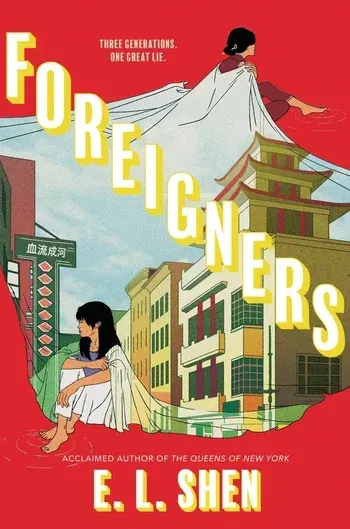
Foreigners
By E.L. Shen
Quill Tree Books
How well do you know your grandparents, really? Would you know if everything they told you about themselves was a lie?
In Foreigners, a new novel by E.L. Shen, high schooler Dawn Chin faces this dilemma. For a history class project, she is tasked with interviewing a family member about their memories of a significant historical event. As she talks more with her grandmother, Zheng Yi, it becomes evident that she’s not getting the whole story. The book switches between Dawn, Zheng Yi and an ancestor from the 1870s, Duanfang’s point of view. They all have their secrets they’re protecting, and things are not as they seem.
The novel, like all good stories, started with a seed of truth. Shen’s author’s note at the end of the book reveals that she was inspired by the real life lies told by her great-great-great grandfather Duanfang and her grandfather.
“While different and far less dramatic than the lies in Foreigners, it got me thinking. What is the cost of our lies both big and small?” she writes.
Especially for those who have language barriers with extended family members, it can be difficult to truly know one’s family’s life before you. What do you know about your parents’ much less your grandparents’ lives besides what they’ve told you? What if it isn’t true?
Shen tells an ambitious story that weaves across generations from the 1870s with Duanfang, a Qing Dynasty statesman, to the present. The majority of the book features Dawn commuting to chat with her grandmother in New Hampshire and dealing with problems at school intercut with Zheng Yi’s actual story as a new immigrant in the '60s.
Duanfang’s timeline was interesting but felt superfluous to the book since each section with his point of view was much shorter than the other chapters, and in the end, it didn’t intersect much with the main plot. The moments when we’re in his head feel like an interruption to the story Shen is telling rather than an organic part of it.
But as a YA novel, the story is both engaging and radical in its portrayal of Asian elders not just as struggling, hard working immigrants, but as young people falling in love, making silly decisions and trying to self actualize. So many stories of older Asian generations feature poverty, war and deep trauma. It can sometimes feel like a story isn’t worth telling if it doesn’t have those dramatic elements. Most of life is lived without the significance we assign in hindsight in mind. As when Dawn asks her father what he was doing during the 2008 financial crisis, he says that he was in grad school making no money with his friends who were also making no money.
“'Hoped the economy would get better once we finished school,' he chuckles. ‘Why do you ask?’”
Her mom was working through the whole thing. Dawn groans that she’s going to fail history because she has no one to interview. She’s skeptical that her grandmother, who immigrated in 1965, right at the brink of the Cultural Revolution and in the middle of the Civil Rights Movement, would have much to say.
Especially these days, we like to remind each other that we’re living through history. Maybe it’s so that we can make sense of tumultuous things that are happening internationally or with the economy. We feel viscerally the way our hopes and dreams are being shaped by the forces around us that are out of our control. Yet we press on, making our own choices, doing the best with what we’ve got and trying to not lose ourselves on the way.
It can be hard to give previous generations the same credit — that they had dreams too and maybe the dreams had nothing to do with us. Especially if they don’t talk about them or even talk much to us at all. But Shen’s choice to introduce readers to Zheng Yi before Dawn sets the precedent that she and by extension the readers will take both characters seriously. Dawn’s struggles aren’t minimized just because she lives a fairly privileged life. Zheng Yi is a full human being whose life isn’t defined by the time it was lived in.
Foreigners is the kind of representation I want to see more of in the world. It’s a captivating reminder that sometimes the best stories are the ones society tells you don’t deserve to be told.


