Miguel Angel Rischmaui
Organized by 김수환 (Suhwan Kim) x girlsbookshop
Girlsbookshop
Gwangju
Aug 14, 2026
(Jisu Sheen recently moved from New Haven to Gwangju, South Korea, where she’s covering local arts and culture for the New Haven Independent and Midbrow.)
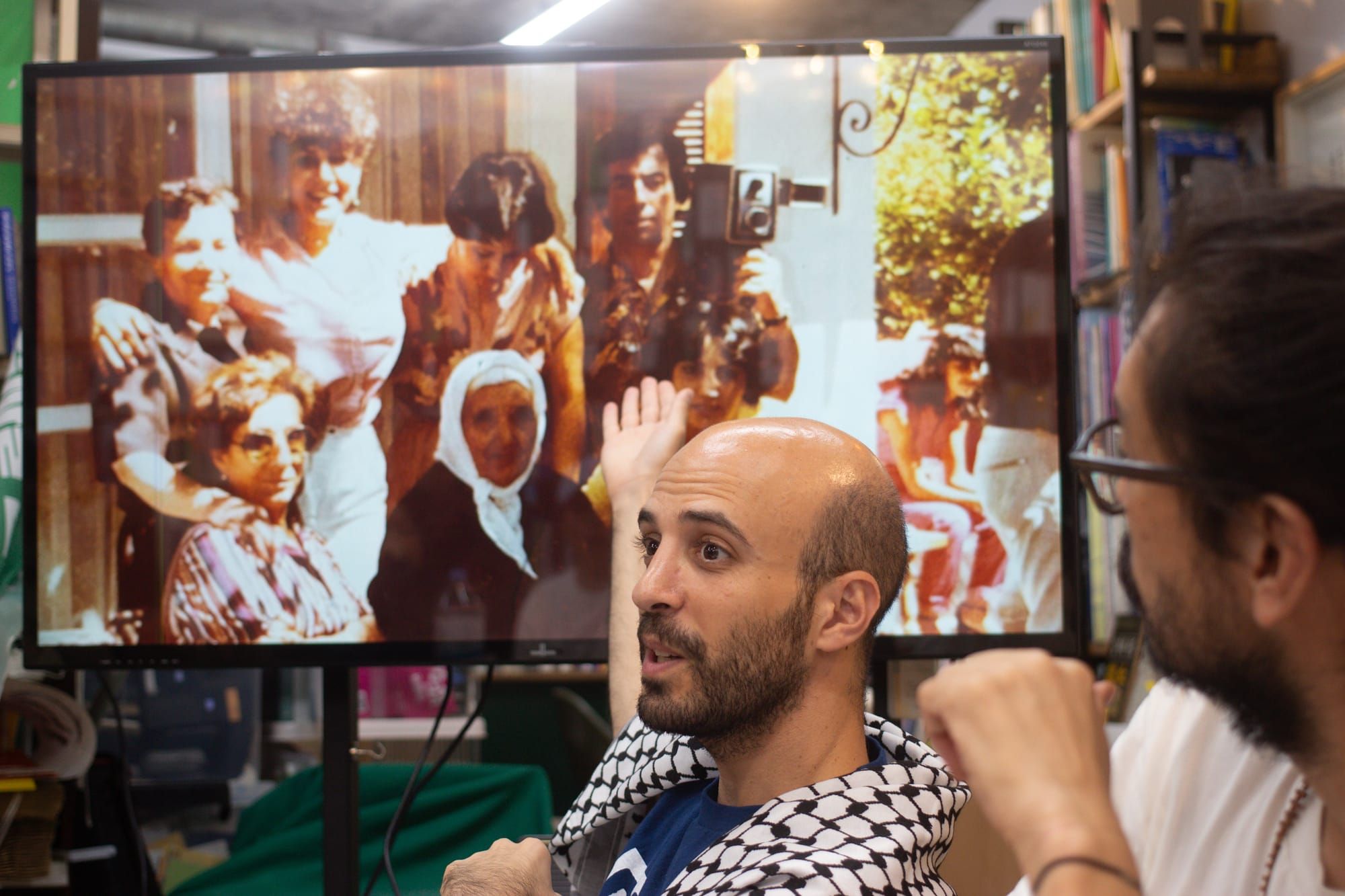
On Friday night, Miguel Angel Rischmaui showed the room at indie Gwangju bookstore girlsbookshop a picture of his family's house in Chile. He pointed out a few key features.
There was an Arabic tea set, revealing the family's Palestinian lineage, as well as an olive wood cross and cushions with Arabic designs.
Then he pointed underneath the table in the photo. There, piled up on each side, were stacks of photo albums. When Rischmaui looks back over the generations, he doesn't have to imagine what his family's past looked like; he can pick from one of over 100,000 photos.
That's not a typo. It's the result of generations of family history and a cross-cultural penchant for photography.
Rischmaui was in Gwangju presenting a talk on Palestinian Chileans, the largest diaspora of Palestinians outside West Asia. He would know; his family moved from Beit Sahour, Palestine, to San Fernando, Chile, in the early 1900s, at the height of Palestinian-Chilean migration.
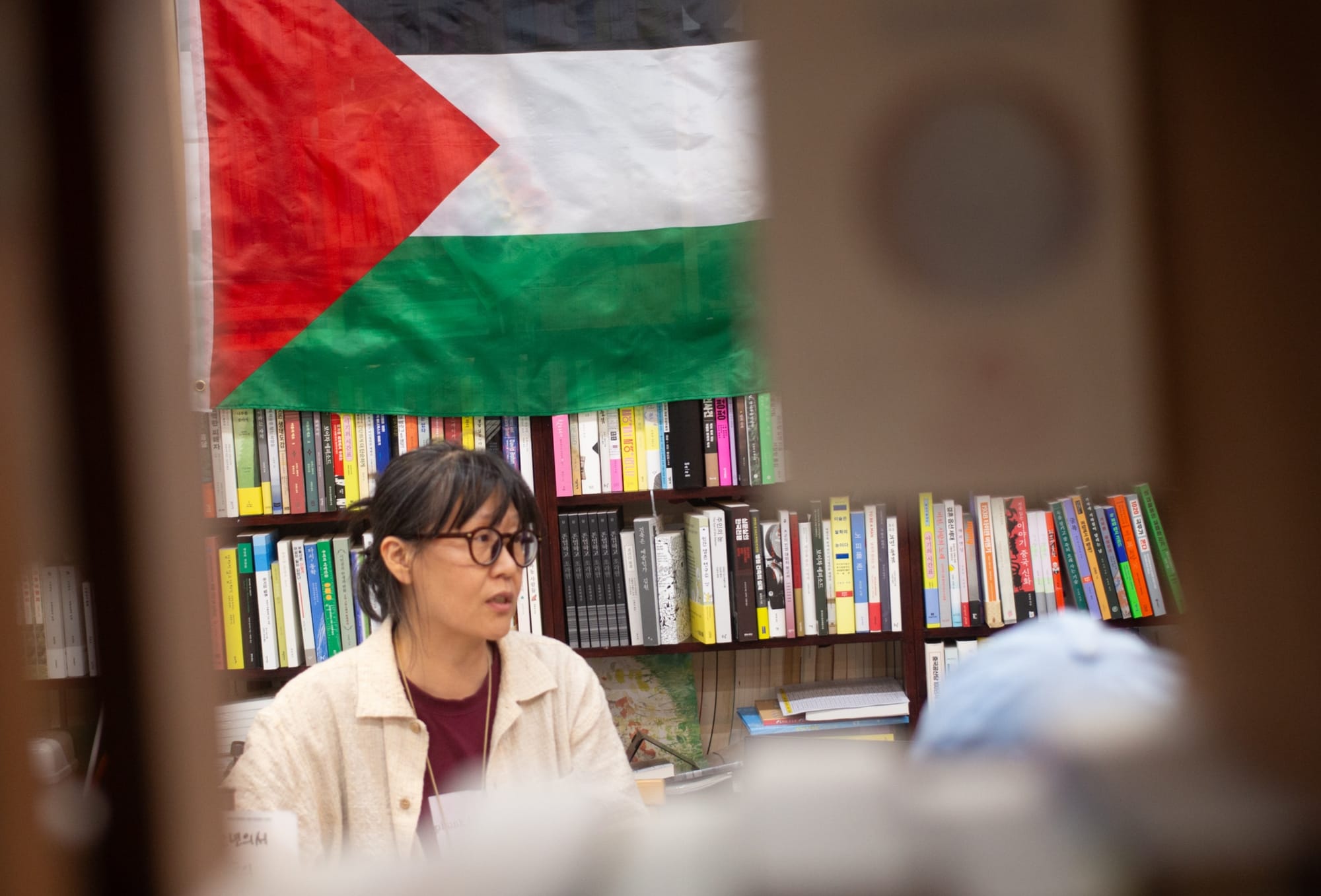
The audience at girlsbookshop sat around a table (the seating spilled out into the bookcases as people arrived) and listened to Rischmaui's story. In between numbers and facts, Rischmaui showed selections from his family's photographs. They said what data couldn't alone.
"We have been in Chile for more than 100 years," Rischmaui said of the Palestinian Chilean community. The earliest documented record of this kind of immigration is from the 1850s, though it might have started well before. The wave crescendoed from the 1900s to 1930s, in the form of ships docking at ports in Brazil and Argentina. From there, passengers traveled on foot or by horse to cross the Andes mountains.
In Beit Sahour, Rischmaui's family ran one of the first photo studios in Palestine. When they got to Chile, they opened one of the only photo studios in San Fernando as well.
"We were lucky because we were able to make our own photos," he said.
Like pieces from different puzzles that somehow fit together, elements of life in Palestine and Chile aligned in unexpected ways.
For example, most Palestinian immigrants gravitated around Chile's capital city, Santiago, which has a Mediterranean climate. They were able to grow many of the same crops they were used to back home.
When it came to grapes, the two cultures made use of the same plant in different ways. Chile is famous for its wine; Palestinians in search of grape leaves began to source the ingredient from wine vineyards.
Rischmaui's predecessors might never have guessed one of their descendants would someday tell their story in a bookshop in Gwangju. Here's what they did know: how to take a picture.
Almost every photo Rischmaui shared was a group photo of family. He explained that in both Palestinian and Chilean culture, family is everything. In one photo, his great-uncle is holding a camera, "because we are always taking pictures."
At first, the transition wasn't picture-perfect. Unlike European immigrants, Palestinian newcomers to Chile did not receive government support. People called Palestinians and other Arab immigrants "turcos," a term for people from Türkiye that carried a derogatory connotation.
Now, Rischmaui said, the accepted term in Chile is "paisanos," meaning "compatriots."
Over the years, Palestinian Chileans were able to turn food stalls into mom-and-pop-shops and, in some cases, factories. Rischmaui spoke of the safety of being Palestinian in Chile, noting that unlike Palestinian diaspora in West Asia, his community largely does not have the label of refugee. He left space for people to imagine what other Palestinian diaspora communities might look like if they were shown more societal support.
This doesn't mean Palestinian Chileans have lost touch with Palestine. Rischmaui pointed to active Palestinian politics within Chile. Club Deportivo Palestino, a sports club in Chile founded in 1920, uses a map of Palestine to depict the number "1" on their uniforms. They were fined for this in 2014, "but we still use it," Rischmaui said.
Because many Palestinian Chileans still have relatives in Palestine, the community's frequent efforts to raise money for their homeland can go directly through families. "Chile is at the frontline for the Palestinian cause," Rischmaui said.
He talked about the lives of Palestinians in Palestine, who face torture, murder, and dispossession of land by Israeli forces. In describing Israel's current genocide in Gaza, Rischmaui noted that it is only the latest of many. Rischmaui has family in the West Bank, where Israeli settler colonialism and apartheid restrict Palestinians' everyday lives.
In the post-talk Q+A, a few attendees asked if, as Palestinian Chileans gained economic stability, they also gained any tensions with working-class Chileans as a whole.
To do that, Rischmaui said, "we have to go back to the dictatorship."
The dictatorship of Augusto Pinochet in Chile from 1973 to 1990 did deepen a divide, Rischmaui said, between left- and right-wing Palestinian Chileans as well as Chileans in general.
Under the previous government, then-president Salvador Allende had nationalized businesses as part of his socialist reforms. Then the United States led a coup in Chile to replace Allende with Pinochet, who became a military dictator.
When Pinochet took power, he returned banks and businesses to upper-class Palestinian Chileans, garnering political support. He also threatened dissenters with torture. Pinochet was, Rischmaui clarified, "not a good person."
Rischmaui described the difficulties of talking to older Palestinian Chileans on the other side of the political divide, who are still affected by a fear of punishment by the dictator. Because Pinochet established the constitution Chile still uses today, he continued to hold power even after his removal from office, until his death in the 2000s.
"It's the same story in Korea," an audience member said in Korean, about years of political repression causing generational rifts.
I asked Rischmaui if his family still takes photos. Every generation, he replied, has a few people who become the photographers or archivists of their era. These days, the documentarian is his older sibling who is digitizing the mountain of family photos for the future.
In his closing thoughts, Rischmaui noted that perhaps because Korea has a recent memory of dictatorship, the people here seem open to talk about activism. He encouraged the crowd to lean into the research.
"If people can understand their history—if they can understand the reality of their history—they can understand Palestine as well."
Sign up here to get Gwangju Midbrow email updates delivered straight to your inbox.