

Hank Paper: See-Scapes
Eddie Hall: Framework
Kehler Liddell Gallery
Westville
Through Oct. 11
Hank Paper's "Welcome Aboard, Isle of Wight, England" has an almost Renaissance-like quality to its composition. Four of the five people in the picture are facing the same way. Their heads form one line. The edge of the sailboat they're on forms another. Together those lines make an arrow that passes almost all the way through the image, stopping at the fifth person, clambering onto the back. His awkward pose suggests some of the humor. The way his shorts are moving, and what they're exposing, seal the deal. It's enough to make a viewer — or at least this viewer — snicker, but it's not at the fifth person's expense. It's at the way Paper managed to snag a fleeting second before it was gone.
Paper's eye for levity, and the technical acumen to capture it, is on display again and again in See-Scapes, a show of his photography up now at Kehler Liddell Gallery through Oct. 11, running alongside Framework, a show of work by sculptor Eddie Hall. The two are connected by the way they make light, in its many meanings, the subject of their work.
"A mundane moment doesn’t exist," Paper writes in an accompanying statement. "At the very least, each moment is a mystery. I walk, and when I see an interesting moment — beautiful, funny, uncanny, inspiring — I paint it with light and hope to make it worthy of contemplation — or a good laugh — or both. Where we come from and where we’re going is, of course, the biggest mystery. And in between we’re absurd, funny, scary, sad, poignant, happy — a few of these moments teasing at that larger mystery. Yes, a moment can have it all. Being busy people, we don’t always see those moments. But the camera does. And, let’s face it, here on earth, moments are all we’ve got."
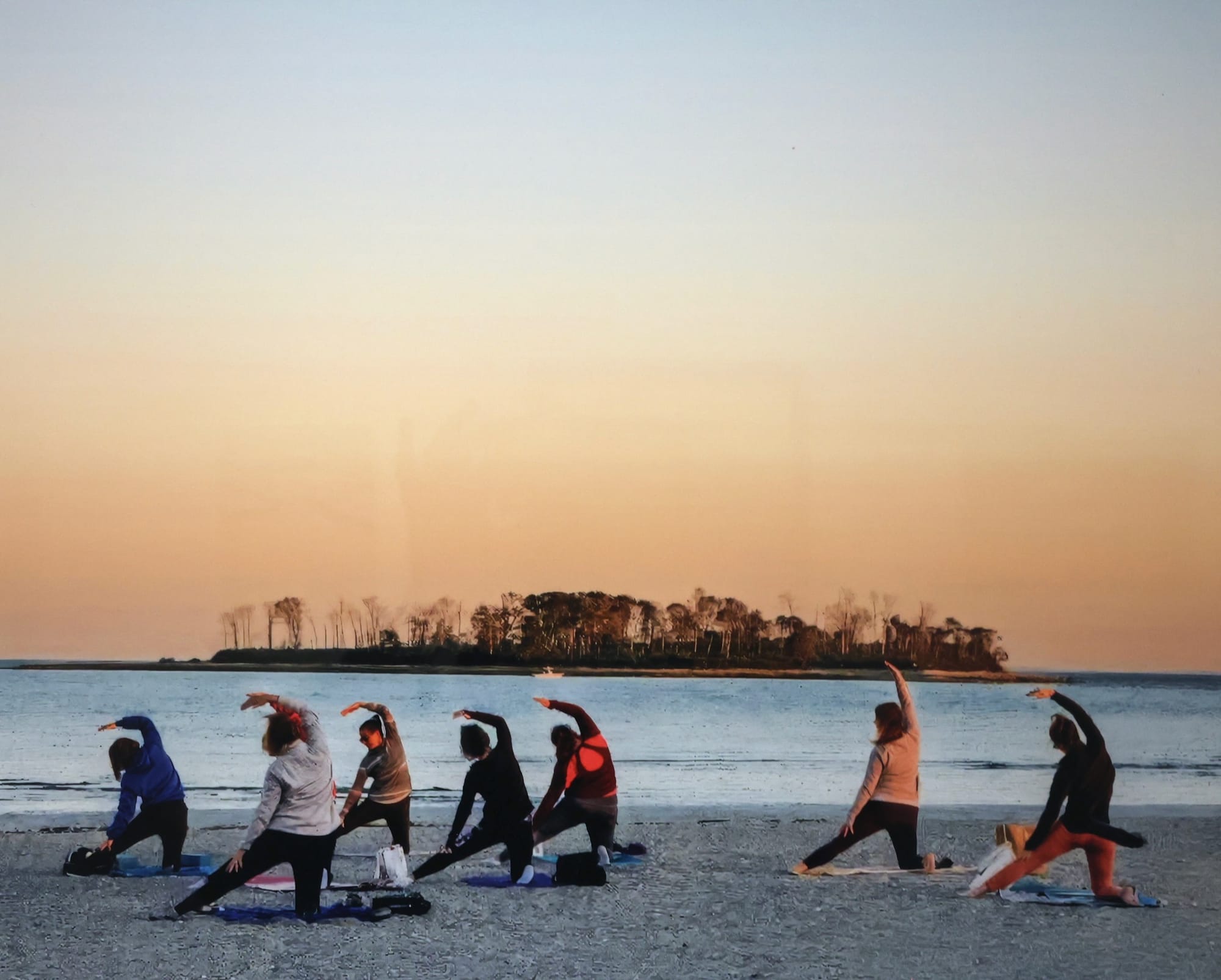
Many of Paper's pictures have outright humor in them. At a July 4 parade in Madison, Conn., he shows us the anachronism of a man dressed in Revolutionary War-era garb heading into a port-a-potty. On an urban street, he takes a picture of a skeleton — a Halloween decoration — on a porch that seems to have something to say about the No Standing Anytime sign in front of the house. Paper also gives us moments that feel like lightness of a more cosmic kind, stars aligning. He has a picture of a street musician whose garb oddly resembles that of the figure in the mural behind him. Or in Yoga at Dusk, Silver Beach, CT, he gets the yoga practitioners in just such a pose that they resemble the trees on Charles Island, just offshore.
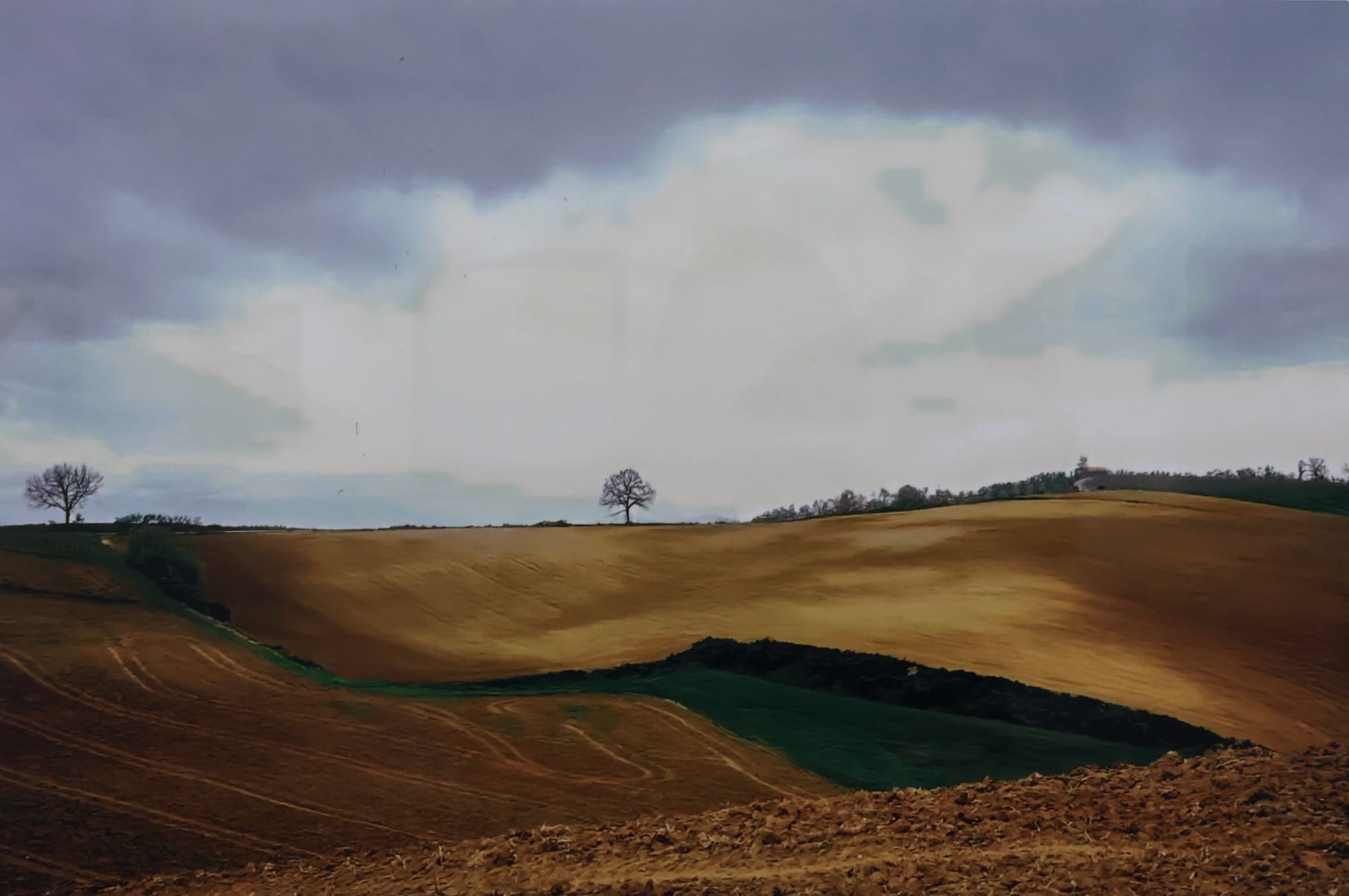
Then there are pictures where light itself is the subject. Paper's Santa Monica Sunset is less about the palm trees, which are in silhouette, than it is about the pinks and oranges in the sky behind them. In the Fold of the Landscape, North Yorkshire, England is a study in saturated greens. And Tuscany Landscape Strip, Florence is about the way the clouds and sun together mottle the land below, showing the way the hills undulate, and turning a couple lone trees into sharp shadows of themselves.
Eddie Hall shares Paper's occupation with light. But where Paper takes it as he finds it, wild in the world, Hall uses it to illuminate his controlled creations, "Framework brings together three connected areas of artistic focus," an accompanying statement reads, "all created on reclaimed house windows. Using salvaged architectural materials as both canvas and structure, Hall explores the relationship between geometry, pattern, and the built environment. Inspired by architecture and design, the works reduce familiar forms into arrangements of color, line, and repeated shape. Throughout the exhibition, the reclaimed windows remain central to the work, carrying traces of their previous lives while becoming the framework for new compositions."
Some works, Hall writes, reference "portals, facades, floorplans, and construction details." Other pieces serve different goals, "using layered geometry and shifting spatial relationships to create movement and visual tension." Both groups of works are concerned with "the way simple geometric structures shape visual experience." A third grouping "draws from architectural ornaments, textiles, and traditional repeating patterns, building rhythmic compositions from repeated elements while subtly disrupting their internal order. While highly ordered, the works contain intentional irregularities and also retain the imperfections of the reclaimed surfaces beneath them. Taken together, the works in Framework examine how built spaces continue to shape perception long after their original function has disappeared."
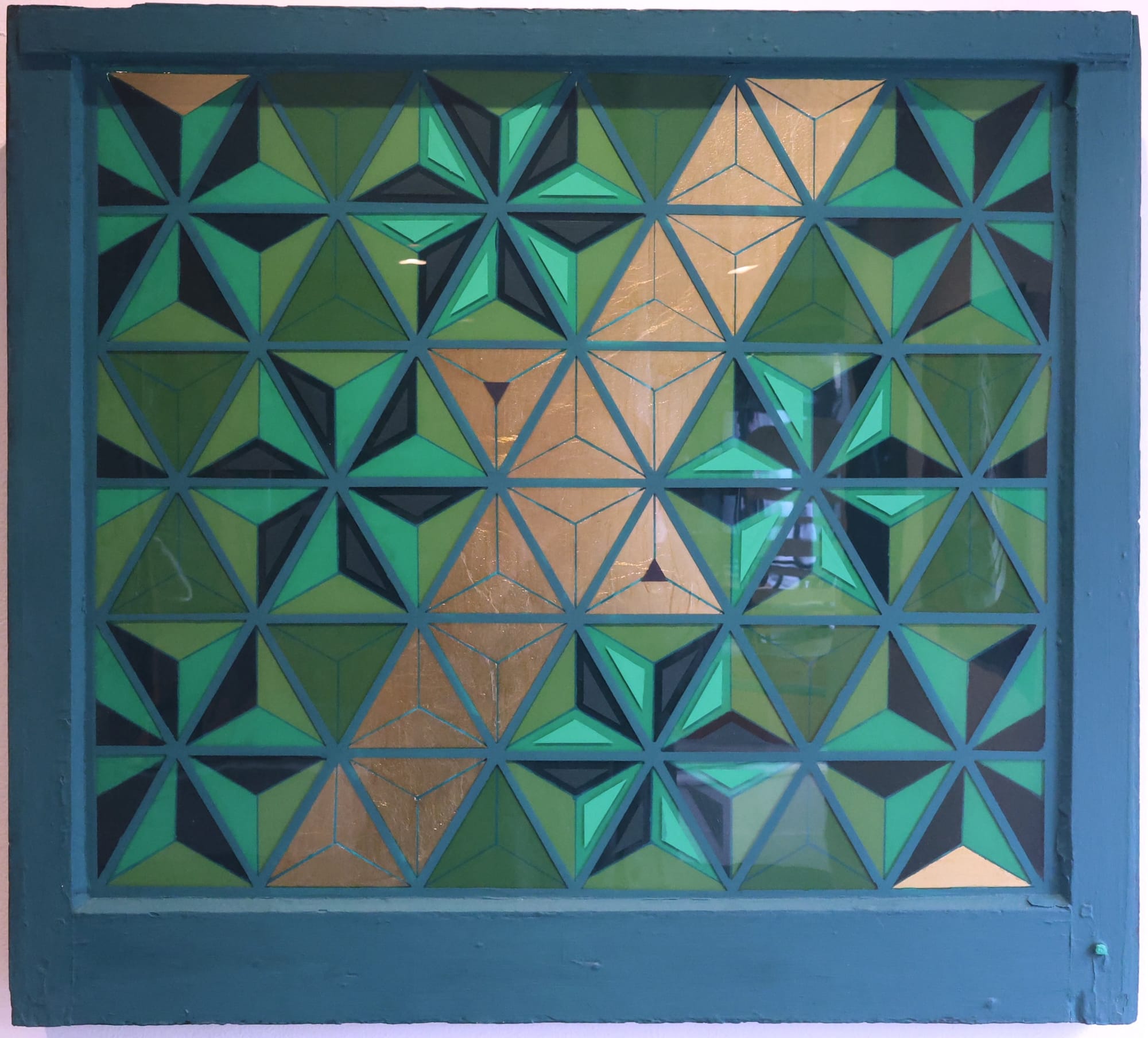
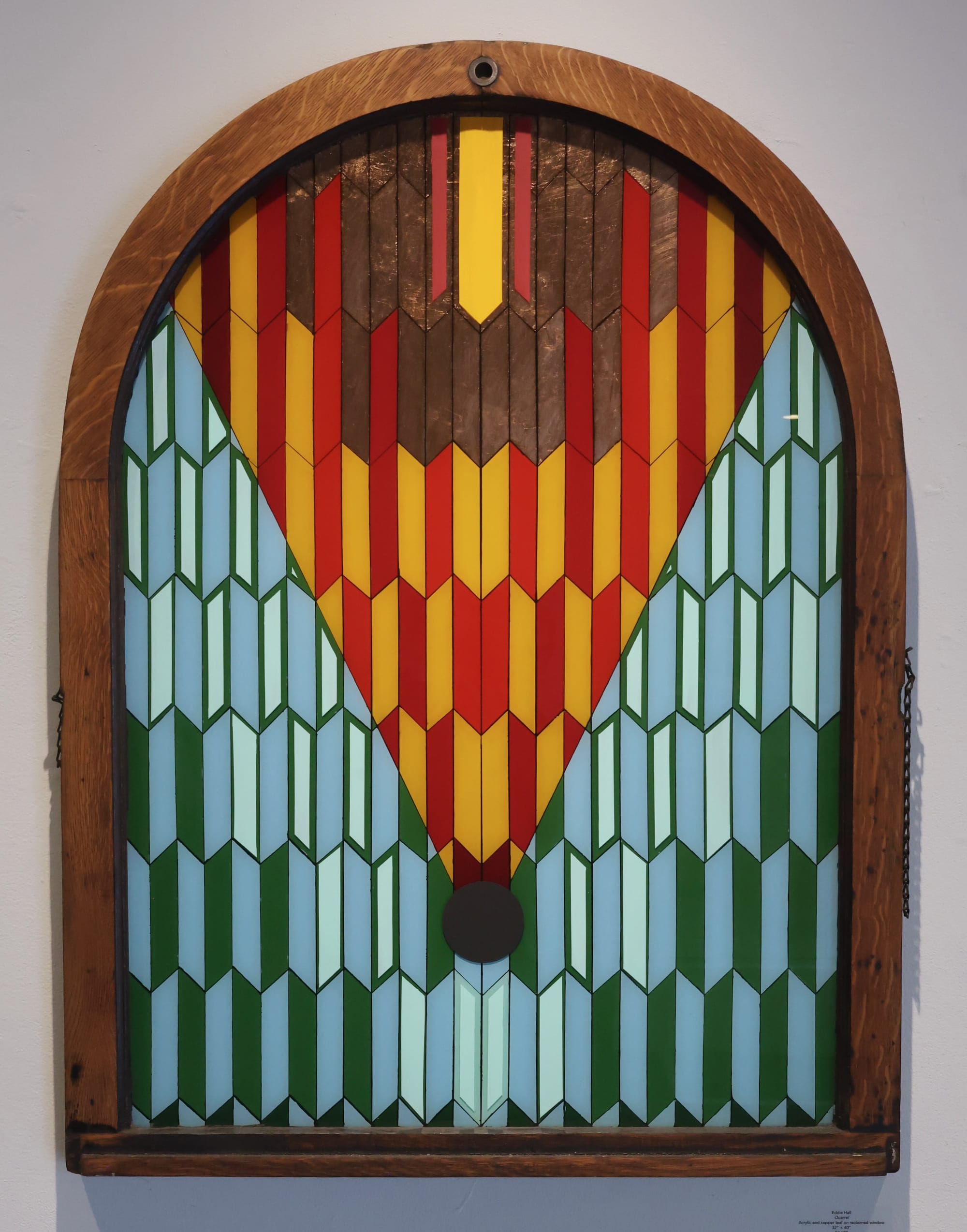
Pieces like Quarrel hew closer to their origins; it's possible to imagine, installed in an old house, that it would pass for an original piece from a century or more ago, designed by someone with a forward-thinking eye. As Hall says, however, other pieces push farther away from architecture and toward art. The shapes in Asanoha still carry a sense of how floors and windows work. But the shapes interrupt in two ways. If the piece is a window, it's no longer one that people can see out of. If it's a floor, the reflective pieces carry more light than floors do.
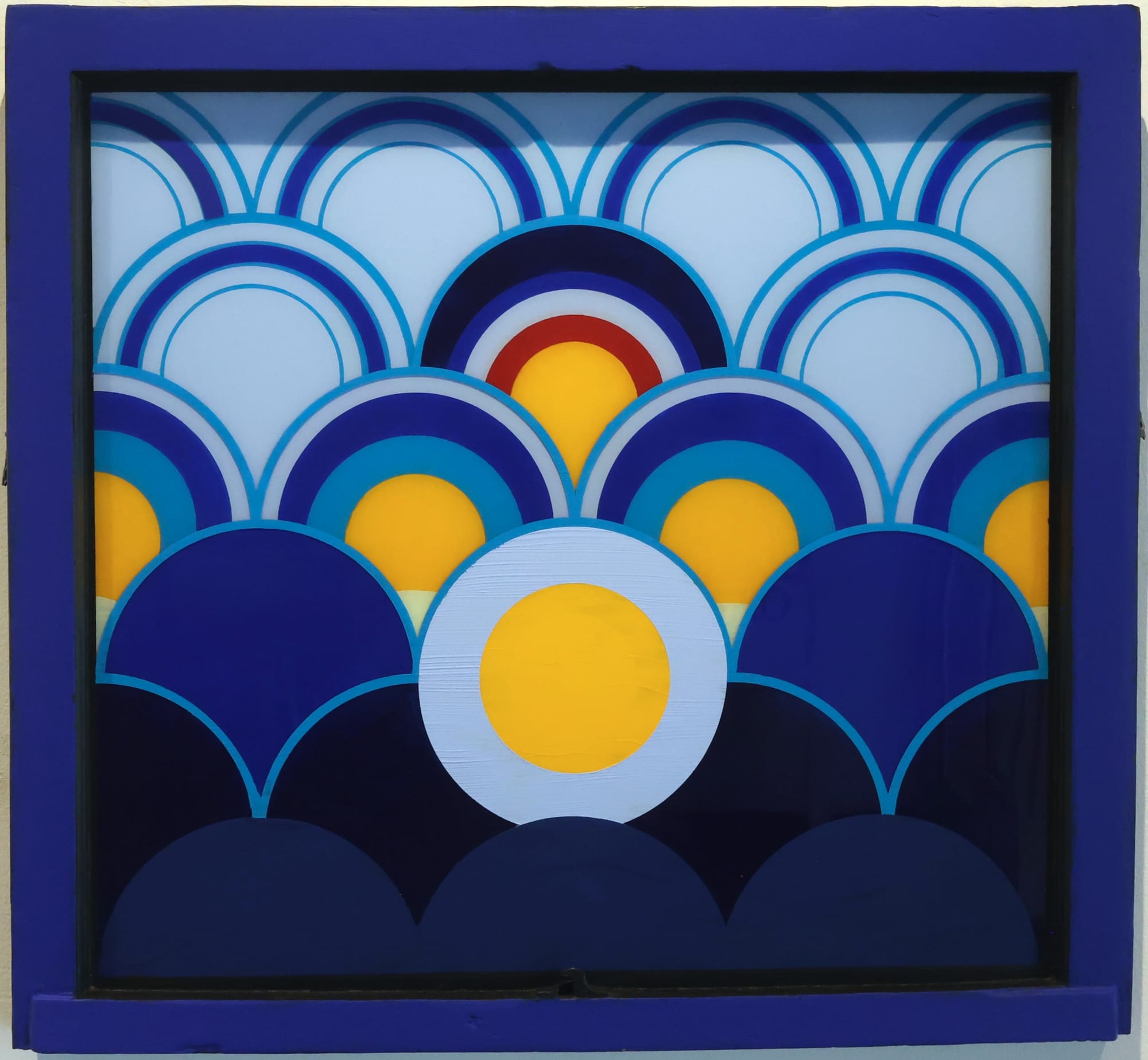
Then there are the pieces where Hall escapes into pure geometry, as in the interlocking circular patterns that make up Seigaiha. The piece is also where Hall's and Paper's works dovetail. The two artists differ in many respects. They choose different media. They treat color in different ways. Paper is drawn to the rougher textures of landscapes and street scenes, while Hall heads toward bold, even colors. But one gets the sense that both Hall and Paper are there to bathe in the light of a thousand sunrises and sunsets.


