

Open The Floodgates
By Nina Schuyler
Reverberation Books
What if your town put its river on trial to defend its very existence? That’s what happens in Nina Schuyler’s recent release, Open The Floodgates from Reverberation Books.
The main character is a river that runs through a small town that could be any town, and it receives a personhood designation. Like rivers around the world, as Schuyler points out in the epigraph, the river is in danger. One way to save it is to make it a person with rights. These designations compel us to rethink how we steward and value the land, its rivers, mountains that have existed for generations, millennia, eons.
The stakes are clear in the first pages of this cautionary tale. What is man’s relationship to nature and the natural world? And how do we preserve it for future generations, or not?
Schuyler has written a compelling story that reads like a fairytale and pulls the reader in from the outset. She plays with and uses form and space on the page. The words take on a meandering shape and wend their way across the white space to capture the way in which the river flows and moves.
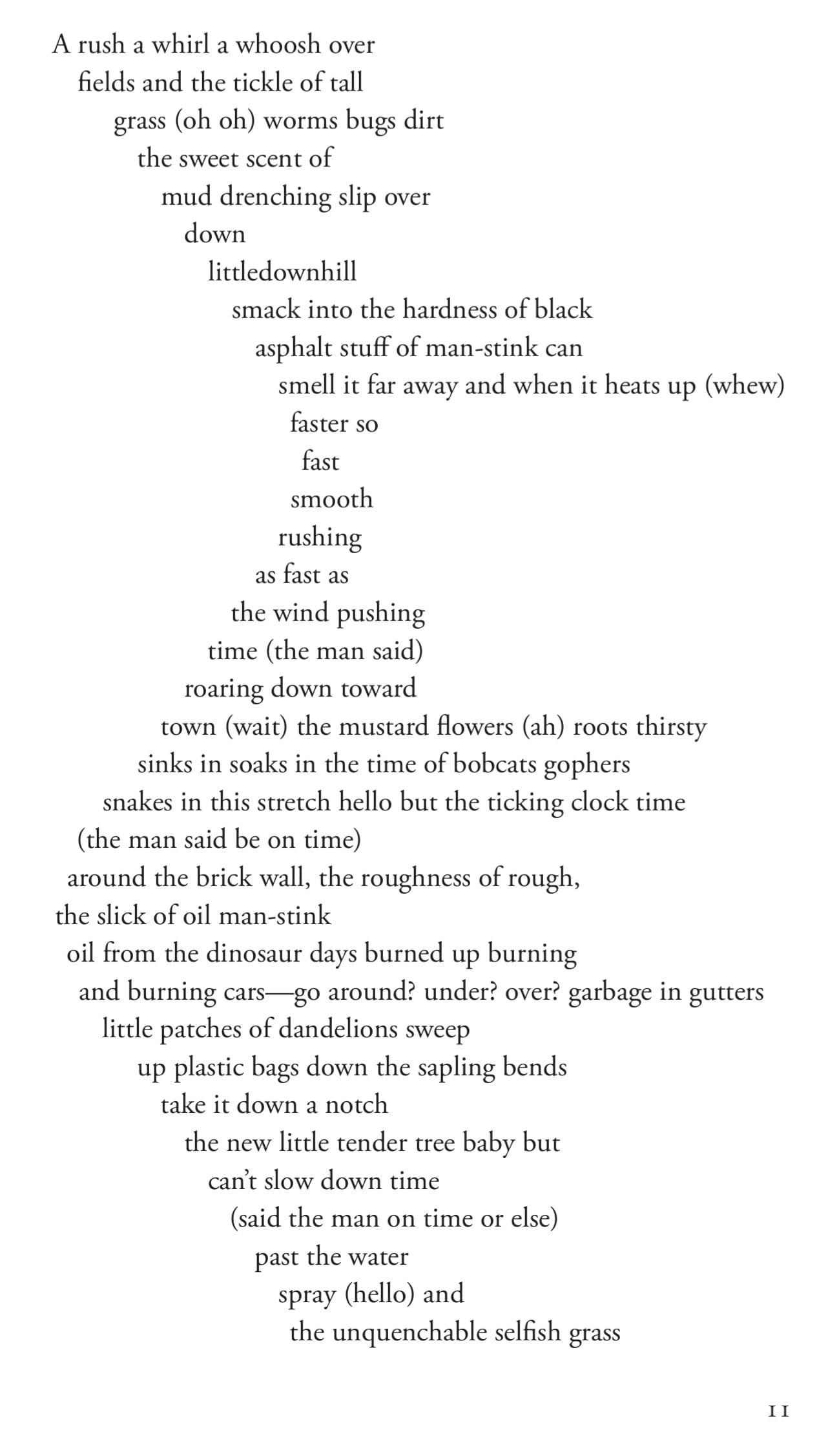
The author also uses pacing and voice to emulate the rivers’ fluidity, conundrum, and connection to the people who have come to have disdain for it,and no longer see its value. There are moments when you are not sure whose internal thoughts you’re hearing. The use of the close third omnipotent point of view allows the author to achieve this.
The characters here are priceless. Each brings a different perspective to the courtroom drama that plays out over months. The embittered battle divides couples, families, the town. Some believe in the rivers right to personhood and sovereignty while others think the river should be a river because it is a river. A scratch line is drawn and as the town watches, the prosecutor and river battle it out as the judge tries to remain impartial even as he reminisces and becomes nostalgic about his relationship with the river as a boy.
Perhaps one of the most compelling and endearing characters is George. He is a boy who revels in the river. They are friends, companions who spend time together. George understands the river and his youthful innocence shames the adults who, over time as they became engulfed with the business of “adulting” have forgotten how they too once spoke to and communed with the river. George sees the river’s life force in ways that his parents, the judge, the prosecutor, and other townspeople cannot.
The omnicient narrator is also a character. It breaks the fourth wall to engage directly with readers. This device contextualizes the story, asks probing questions and provides background on the life cycle of the river and its importance to the town’s survival. It does this without feeling gimmicky or pulling you out of the story.
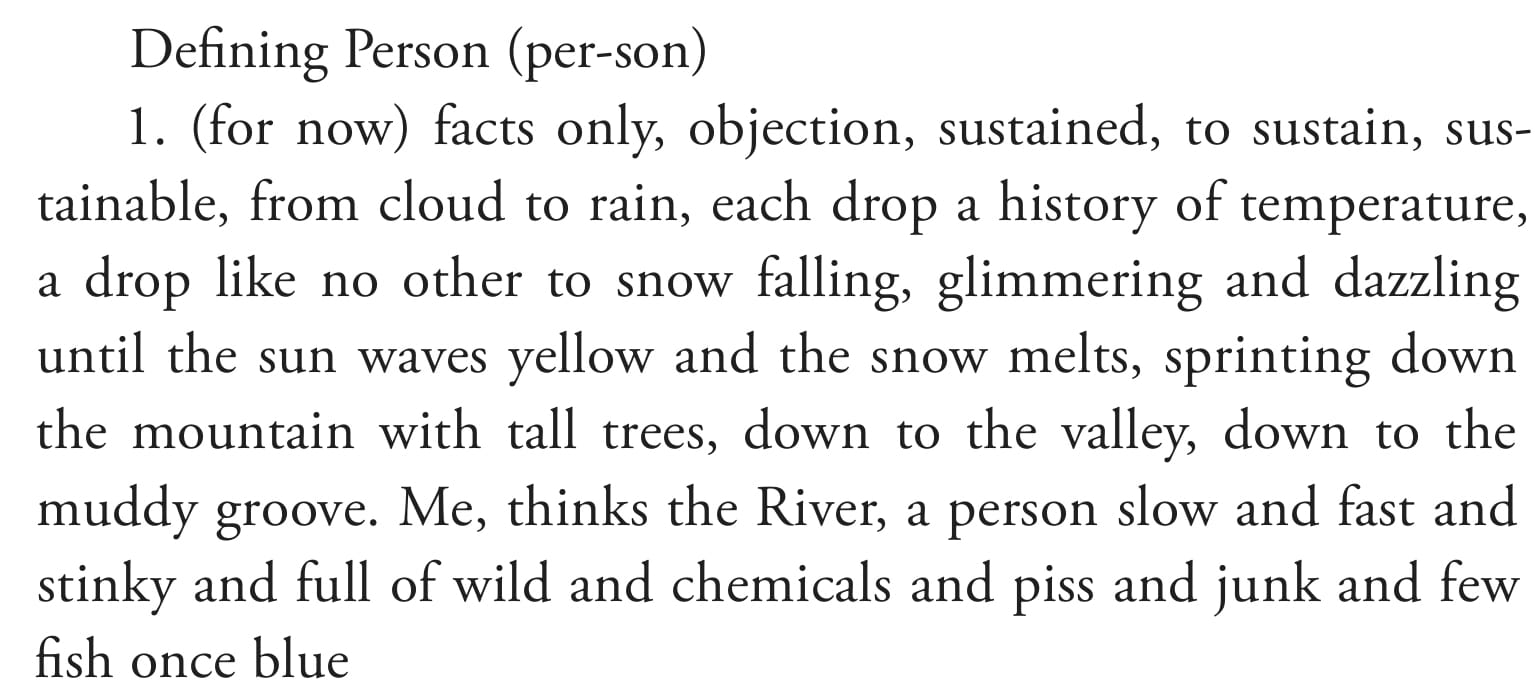
Schuyler also cleverly uses lists as a device. The river tries to understand what personhood is and means to the town and to it. It makes a list of what it means to be a person. It observes human behavior and uses those observations to formulate a deeper understanding of what personhood is. It puts these observations into a list to decide if personhood is something it even wants.
As the trial proceeds, witnesses testify and make the town ponder the river's value and purpose. They grapple with big questions around development, climate change, and their responsibility to the river, to keep it safe, clean, and preserved for future generations. There is a level of deep introspection here that forces readers to think more deeply about critical questions. What is our responsibility to the land and the creatures who inhabit it? What will we leave for future generations if we continue to allow development and greed to act as guiding forces in our stewardship or lack thereof?


