
The Black Cat Theatre Café Grand Opening ft. The 66 Kicks
The Black Cat Theatre Café
August 29, 2026
Like a lot of things about The Black Cat Theatre Café, its grand opening hitting at the leading edge of spooky season feels weirdly correct. Did they time the opening like that on purpose, because of the name, or was it a chef’s-kiss coincidence, or maybe a bit of both?
Appropriately for a space that’s set to house all manner of improv and live performance, it’s hard to tell the difference between what’s planned and what’s spontaneous here, and that imperceptible line is what makes it so good. Kismet is welcome, but the work takes discipline; when the setup is solid, what happens inside it is free to go wild—like, say, two women flirting in a pickup bar with instant replay amenities, which is the improv scene I walked in on as I arrived a little late and slipped into a comfy seat at the edge of the packed crowd full of musicians, actors, and other creative-madness-adjacent Tulsans.
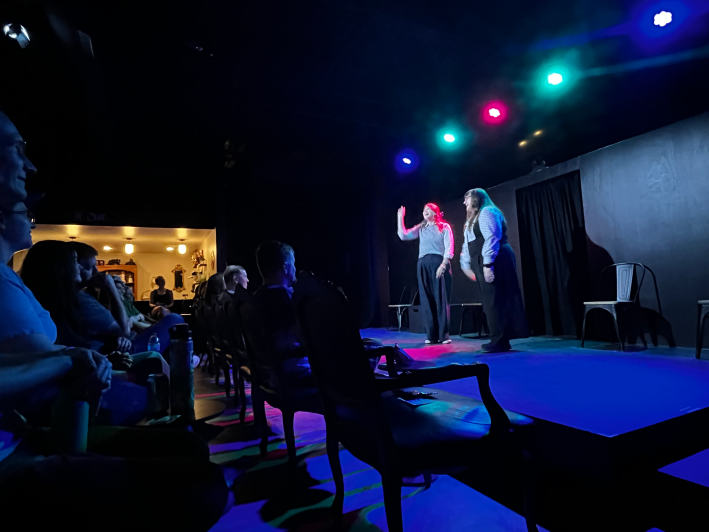
The situation at The Black Cat didn’t seem that different from the Blonde tribute at LowDown I’d just rushed over from: a sleek room big enough to relax in but small enough to enjoy a random shoulder brush with a neighbor, a stage that seems able to hold way more activity that its size would suggest, a template (in this case, the structure of a 66 Kicks show) that ingeniously balances the known and the unknown.
This new space—yes, there is an actual kitschy-kitchen-esque café called The Olive inside the black box theatre, and it'll have regular hours next year—is an offshoot of Cody Mayo Studios, which has operated on Studio Row for the past several years as a full-service hub for training in acting, auditioning, improv, public speaking, and the like. At CMS, Mayo and Ryan “Arch” Archibald (a veteran of Chicago’s legendary Second City) kicked off The 66 Kicks, a professional improv group; the training they offer has now spawned a handful of other improv teams, all of which are performing regularly at The Black Cat. Still to come in the new venue: a theatre troupe called Ninth Life, original shows like the upcoming R-rated Edgar Allan Poe-inspired Nightfall, and a month-long family-friendly Halloween experience (magicians, jugglers, circus performers) called Nevermore Season.

It’s a room built for agility, able to change form to respond to different needs, like improv performers do themselves. Mayo noted at the opening that the room would be unrecognizable during October compared to how it looked that night, and I think part of the fun of The Black Cat will be going back multiple times to see what they can do with the place. The venue joins a growing complex of businesses—Tulsa Guitar Co., Real Ones Vintage, Ruth’s Chicken—on the north side of 3rd Street between Utica and Peoria, as Studio Row expands its footprint beyond the Church Studio block. I could imagine Leon Russell, with his ever-changing hats, seeing the shapeshifting vision here.
Unfortunately (or not?) I’m one of those people who’s pretty into people who are pretty into clowning, which means I may be spending a lot of time over here in any case. Like LowDown, The Black Cat feels like something that’s easier to find in a bigger city, intimate enough to see the sweat and effort onstage and to feel something like the un-suburban density you feel on a sidewalk full of pedestrians.
You face the café/bar as you walk in, with the stage set up on your right. To get to the former (and the bathrooms beyond) you have to move through part of the seating area; on the way, you may have to navigate little clusters of audience members chatting before the show and during intermission, but the amiable friction is part of the experience. There are seats in front of the stage and to its left, with a private table on the other side, which means that wherever you sit you feel tucked right in with the performers, almost behind the scenes at times, and the size of the space means they don’t need amplification.
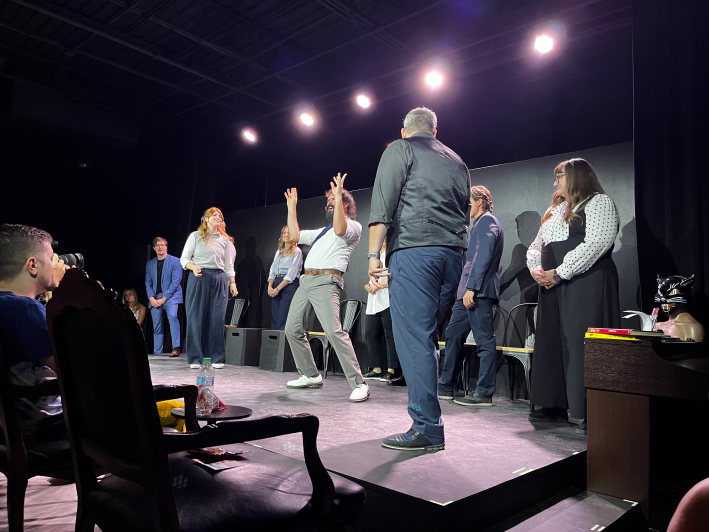
The material during this particular 66 Kicks show held a specific but undefinable line between accessible and genuinely risky—a satisfying tension that I don’t see often enough in Tulsa. It’s comedy that asks us to take a real chance with the performers, to be as vulnerable as they are and to skate as close to the edge of a comfort zone as they do. That doesn’t have to mean incomprehensible Blue Man Group performance art or material that has you cringing in your seat. Most of it hits, some of it doesn't, but the audience seemed down for it all, like when you silently cheer on a friend who’s got a wild story going and you don’t really care how it turns out—you just want to see how she sees it through.
The night did include a reference to the Blue Man Group, ironically, during a series of games based on one prompt—“blue”—that also ventured through a “subway jazz band vs. jazz dancers” situation and an ode to Bluey that had Mayo spontaneously tooting out the theme song from behind the curtain. The troupe called in a pile of crowd suggestions throughout the night, which ranged from favorite movie lines to “things your dad used to say” to “a dialect that this group of people can appropriately do.”
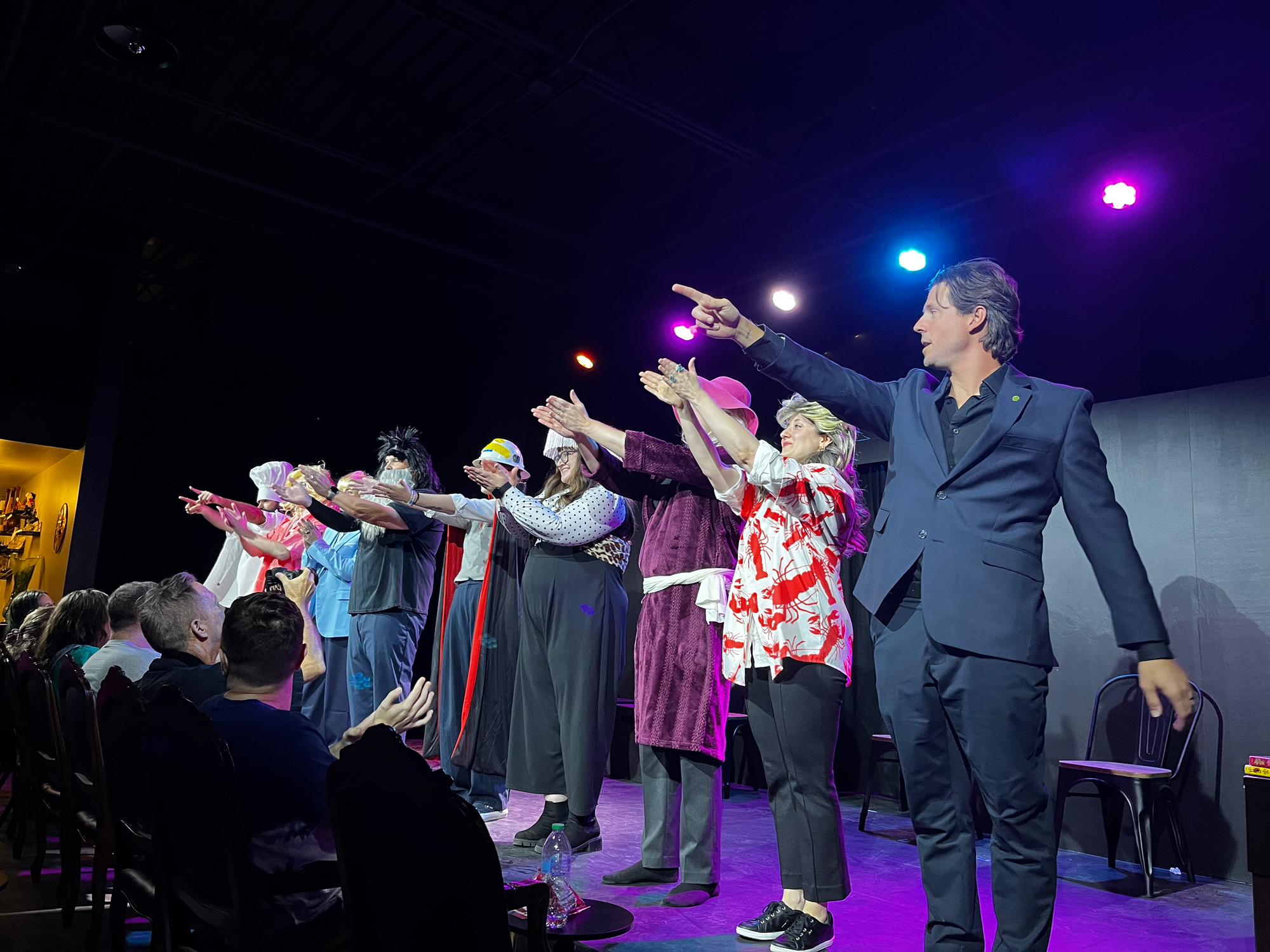
“Give me one word you think of when you think of Oklahoma” brought out “dust” as a prompt from the audience, and the ensuing scene (someone bringing his family member’s ashes to scatter at a QuikTrip) was repeated note-for-note several times in hilariously different settings, including as a film noir and in Appalachia. The closing sequence had the whole cast dressed in nightmare versions of the characters they’d created throughout the show, haunting the dreams of audience participant Charlie Williams, who helps run Tulsa Guitar Co. next door and whom Mayo hauled onstage in a gesture of neighborly goodwill as the subject of the antic finale.
This sort of show is good for the brain (the focus! the quick pivots!) and good for the heart (the dopamine! the excellent crowd vibes!). I came into this one after a difficult day and a transcendent early evening at that Blonde tribute, and it closed out my night with an electric sense of risk and luck, like a black cat crossing the street in front of you. It was the sense of how—as in an improv set, on a Pearl District block, or in a city as a whole—fortunes can change for good at any moment, and how fortunate it feels to catch one of those moments as it happens.


