
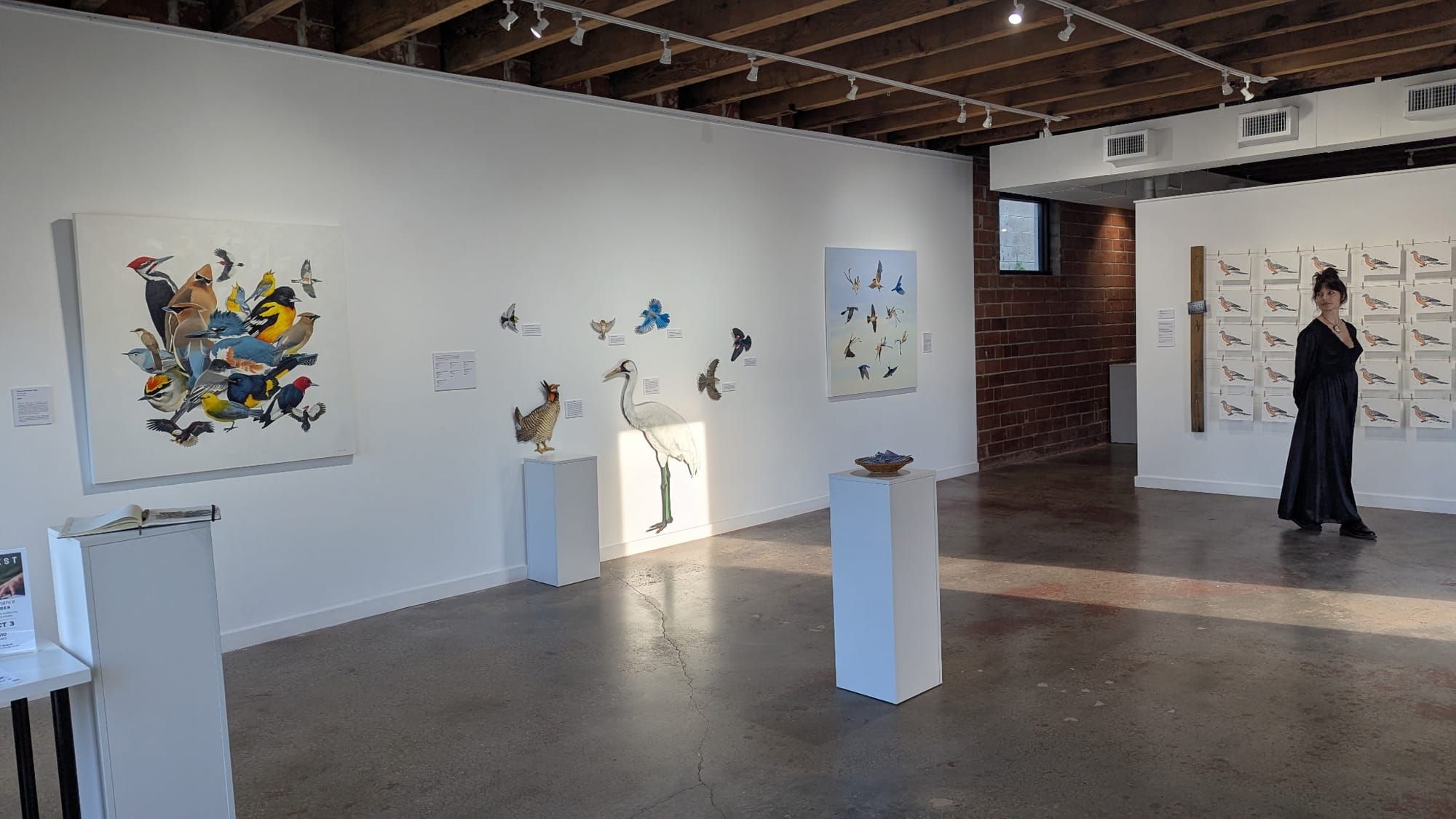
Remember Me: Musing on Birds by Zia Daugherty
Positive Space Tulsa
through October 24, 2026
In her first solo exhibition, Tulsa-based painter Zia Daugherty delivers both a detailed look at the colorful compositions of birds and a thoughtful examination of humanity’s ominous relationship with the natural world. She created the works in Remember Me: Musing on Birds in the span of eight months, working mostly with oils. The medium takes a long time to dry, which allowed her space to sit with her thoughts as she developed the concept for her next piece. Daugherty's show invites us into that musing time, allowing us to alight (like her subjects) on one painting, gather sustenance, and move to the next carrying fresh insight.
Approaching the show clockwise, I spent the most time examining Nature, Preserved, in which a bouquet of birds the artist saw while visiting Oxley Nature Center displays their colorful palettes in various poses of perch and flight. “Why do we think of nature as something ‘over there,’ contained within an allotted space with invisible barriers?” the artist asks in her accompanying wall label.
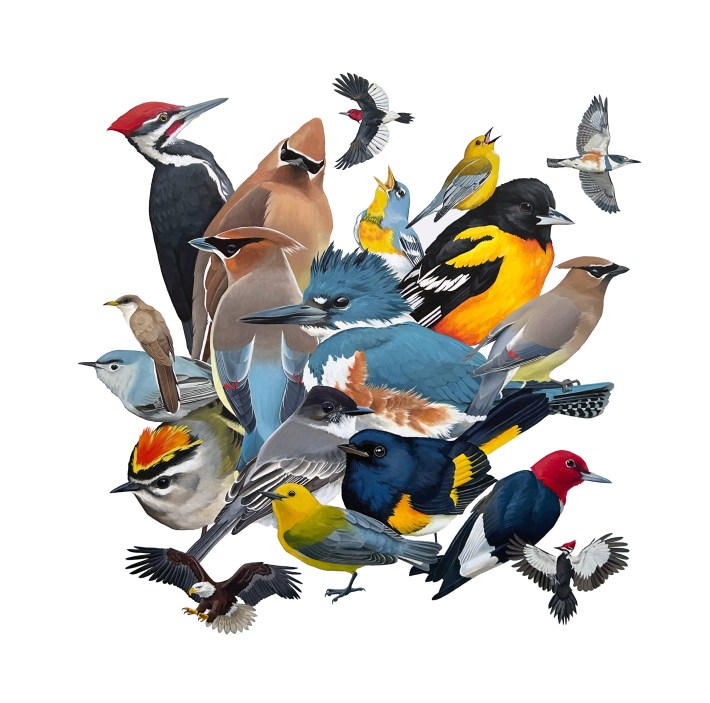
For many—like the Gen Z folks discovering birding for the first time—birds serve as a primary connection to the natural world, one of the few wild creatures we regularly encounter regardless of where we live. “They do not conform to borders, fences or walls. The bird you see on a power line in the summer may be the same bird that will fly to South America in the winter,” writes the artist, setting up her subjects as ecological barometers of the issues highlighted in each painting that affect our shared earth.
In seven oil-painted panels of endangered birds of North America, the Golden-Cheeked Warbler stood out with its bright little head contrasted against its dark shoulders. It flew into the rest of the endangered flock at 7” x 5”, looking for juniper woods in which to nest. (All of the bird cut-outs are made to scale.) Unfortunately, many of these wooded areas are being cleared for our food and homes, leaving the warbler with no place to land. “These birds aren’t gone. Not yet. They deserve to be here,” Daugherty notes. Since most of us won’t see these birds in our lifetime, she decided to bring them into being in the most realistic way she knew how.
Daugherty takes her time to make sure each bird is accurately represented in her paintings, creating a permanent record of groups that are swiftly leaving our planet. More than 50 percent of the world’s migratory bird species are declining, giving these artworks a status of visual archive much like the watercolor paintings of John James Audubon two centuries ago. Unlike Audubon, this artist did not need to kill her subjects to study their features, thanks to the advent of modern photography. Each bird is captured with accurate personality and color, while still allowing for strokes of featherless hues that move this work beyond the merely painterly and into a richer truth-telling. Strokes of varnish cover each work as a gentle reminder of its place as a memento mori, a preserved representation of entities that soon will be gone.
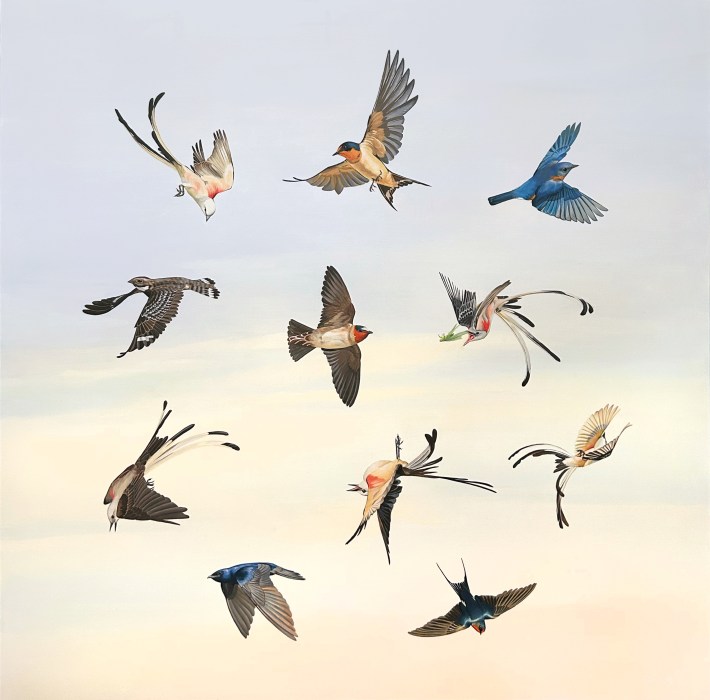
Beyond the wall of endangered birds is The Bug Eaters, a 48” x 48” painting of 11 birds in various states of flight hunting for dinner. It can take the artist days to arrange her compositions and this painting is evidence of her skill in balancing her subjects to perfection. Birds fly upside down, diving gracefully through the air in moments of striking determination. Scissor-tailed flycatchers abound, their tails trailing behind like calligraphic marks. The title reminds me of the Lotus-Eaters who greet Odysseus’ mariners with a sweet intoxicating fruit that lulls the men into a blissful sleep—only these birds face the sleep of death consuming bugs poisoned with insecticides.
On the opposite side of the gallery hangs Update/Displace. A pixelated chimney any millennial would recognize from Super Mario Brothers anchors the bottom as two Chimney Swifts fly above in the empty air, emphasizing their dwindling numbers. (These birds usually fly in tornadic swarms called “screams.”) The artist joined Tulsa Bird Collaborative to count these diminishing chimney-dwelling birds whose homes are being lost to new construction and pesticides. The pixel-painted roof is a deviation from Daugherty’s realism, intentionally rendered in a more abstracted style to represent technology’s detachment from physical reality. There is no place for the birds to land or live in, so they keep moving.
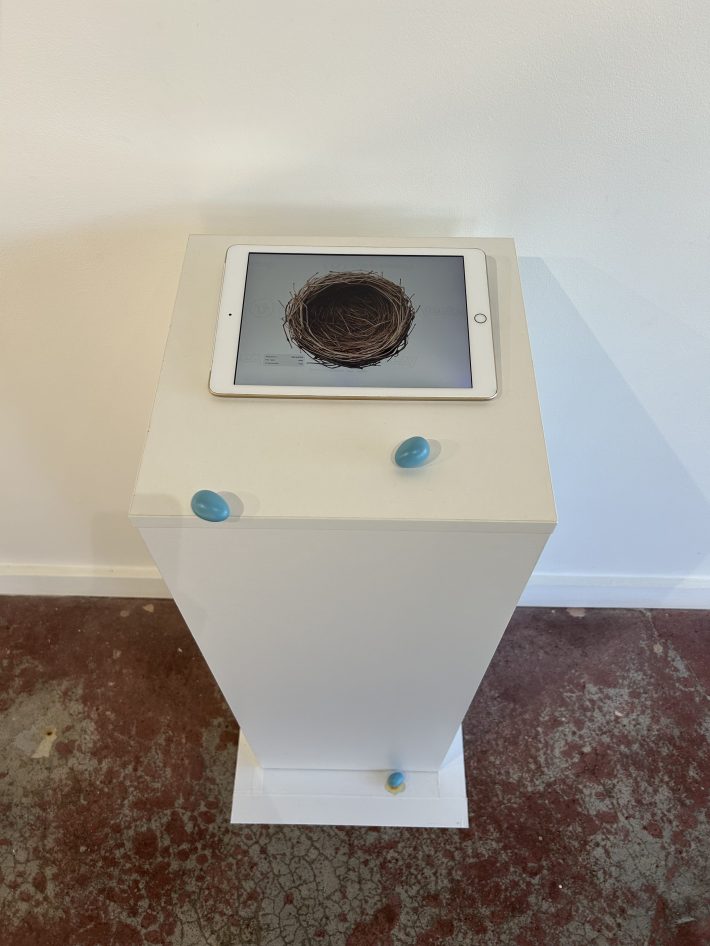
In a similar vein, perched on a pedestal, Cannot Harbor Life displays an iPad showing a digital display of an AI-generated nest. Two sculpted blue eggs sit nearby, one of them right at the pedestal’s edge, luring the eye to the floor where a third egg (all made from oil-painted epoxy putty) lays cracked open oozing its yellow liquid (epoxy glue tinted with pigment). Daugherty highlights the physical void of technological advancement—specifically AI—and the precarity that follows for living beings that need shelter. Pigments stand in for life, and a plaster pedestal is all that remains of supports that are being removed in the name of progress.
While the works in Daugherty’s show explore many of the threats facing birds in the United States, the artist does not want to leave her viewers feeling sad and hopeless, and her paintings (like those in Storm’s Comin’, Katherine Hair Eagle’s August show at Positive Space, which juxtaposed “a queasy feeling of looming doom” with beauty, urgency, and energy) are anything but. To turn concern into action, she created a small colorful zine filled with simple steps to alleviate some of the challenges highlighted in her paintings for viewers to take with them free of charge.
“Remember Me is meant to be from the birds themselves, a plea not to be forgotten,” the artist explains. “Whether from birds currently threatened, long extinct, or hidden away in factory farms, that plea could refer to any piece in the show.” Ultimately, Daugherty’s exhibit asks us to consider the losses that come with advancement and whether we are willing to make changes before the birds we displace survive only in the art that remembers them.


